Are you trying to scale your customer support without your budget skyrocketing? Many businesses have found a powerful answer in call center outsourcing to the Philippines. This isn't just a simple cost-cutting trick; it's a strategic move that unlocks a massive pool of talented, English-speaking professionals, letting you redirect your in-house team toward core growth activities.
Why Smart Businesses Outsource Call Centers to the Philippines
Think about what your team could accomplish if they were free from the daily grind of customer service. Imagine them focused entirely on innovation, marketing, and big-picture strategy. That's the real power of outsourcing to the Philippines—it turns your customer support from a necessary expense into a strategic asset that builds loyalty and keeps customers happy.
For years, the Philippines has built a rock-solid reputation as the world's go-to destination for customer support. This isn't just about lower labor costs. It's about a workforce known for its genuine empathy, patience, and a cultural knack for connecting with Western customers. Filipino agents don't just read from a script; they're experts at building real rapport and solving complex problems with a personal touch that makes your brand shine.

A Powerhouse of Talent and Infrastructure
The numbers behind the country’s BPO dominance are staggering. The Philippines holds a massive 16% share of the global outsourcing market, a clear indicator of its reliability and quality. This is driven by a strong workforce of over 1.8 million professionals who are not only fluent in English but also deeply familiar with Western customer service expectations.
Tapping into this ecosystem gives you several key advantages:
- Access to a Skilled Workforce: You get immediate access to a deep talent pool of educated, tech-savvy professionals ready to become the voice of your brand.
- Cultural Compatibility: The workforce naturally understands and aligns with Western business culture and service standards, making for smoother interactions.
- Focus on Core Business: You can shift your internal team's focus away from support tickets and toward revenue-generating activities like product development and sales.
- Scalability and Flexibility: Need to ramp up for the holidays or scale down during a slow season? It’s far easier than managing the complexities of direct hiring.
Lowering the Barrier to Entry
In the past, setting up an offshore team meant a huge upfront investment in real estate, IT gear, and a lengthy recruitment process. That’s not the case anymore. New, flexible models have completely changed the game, making world-class customer service a real possibility even for startups and small businesses.
One of the biggest game-changers is seat leasing. This is essentially a "plug-and-play" solution where you rent fully equipped workstations in a professional BPO facility, completely wiping out the need for massive capital investment in an office.
Instead of burning through months and millions to build out a physical location, you can be up and running in a matter of weeks. This model provides all the infrastructure and support you need to hit the ground running. By exploring options like affordable seat leasing solutions, companies can launch or expand their operations with incredible efficiency, turning what was once a logistical nightmare into a simple operational expense. It truly levels the playing field, giving everyone access to the powerhouse that is the Philippine BPO industry.
The Financial Case for Outsourcing to the Philippines
When you start looking into call center outsourcing in the Philippines, the conversation almost always kicks off with cost savings. But if you only focus on the lower salaries, you’re missing the bigger, more exciting picture. The real financial magic happens when you combine direct and indirect savings, turning a necessary expense into a powerful engine for growth.
Think of your budget as a ship. A lower salary is like finding a slightly cheaper fuel source—it helps, but it’s not going to change the game. True strategic outsourcing, on the other hand, is like completely redesigning the ship's engine to be vastly more efficient. Suddenly, you have immense power to go faster and farther. That’s what a smart partnership in the Philippines can do for your business.

Beyond the Paycheck: The Hidden Cost Advantages
The most obvious win is the labor cost, no doubt. But the financial benefits run so much deeper. Building and maintaining a team in-house triggers a whole cascade of expensive, time-consuming activities that simply vanish when you partner with a BPO provider.
Just think about all the typical expenses you get to sidestep:
- Recruitment and Onboarding: Forget about paying for job postings, recruiter fees, background checks, and sitting through endless interviews. Your partner handles it all.
- Specialized Training: Your provider is the one investing in continuous agent training, keeping them sharp on customer service best practices, new tech, and your industry’s specific needs.
- Employee Benefits and HR: The headaches of managing payroll, health insurance, paid time off, and other mandatory benefits? They’re no longer your problem.
This multi-layered cost reduction is a massive part of why outsourcing to the Philippines is so appealing. You’re not just hiring agents; you’re gaining a fully managed, highly skilled team without all the administrative and financial weight of direct employment.
Slashing Overhead with Smart Infrastructure
The most dramatic savings, however, often come from overhead—the huge, ongoing costs tied to physical infrastructure. This is where you’ll see the most significant impact on your bottom line, hands down.
Think about the capital it takes just to set up a new office. You’re on the hook for long-term leases, office furniture, utility deposits, and a mountain of expensive IT hardware. For a growing business, those costs can be absolutely crippling.
Outsourcing eliminates these capital expenditures entirely. You are no longer responsible for rent, electricity, internet bills, or the maintenance of a physical workspace. This operational shift is what truly unlocks capital for reinvestment.
Modern solutions like seat leasing push this advantage even further. This model gives you a "plug-and-play" workstation in a fully managed facility. Everything is included in a single, predictable monthly fee—from the desk and chair to the high-speed internet and IT support. It’s like subscribing to an office instead of buying one.
To see just how big the difference is, let's compare the two approaches.
Cost Savings Comparison Between Traditional Office and Seat Leasing
This table illustrates the dramatic cost reductions businesses can achieve by opting for a seat leasing model over a traditional, self-managed office setup when outsourcing.
| Expense Category | Traditional Office Setup (Capex & Opex) | Seat Leasing Model (Opex Only) |
|---|---|---|
| Office Space | High (Lease deposits, monthly rent, renovations) | Included in per-seat cost |
| IT Infrastructure | High (Servers, network hardware, security) | Included (Managed by provider) |
| Workstations | High (Desks, chairs, PCs, headsets) | Included (Fully equipped) |
| Utilities | High (Electricity, internet, water) | Included |
| HR & Recruitment | High (Salaries, job boards, agency fees) | Included (Managed by provider) |
| Support Staff | High (IT support, admin, security personnel) | Included |
As you can see, the seat leasing model converts a long list of capital-intensive and variable operational costs into one simple, predictable monthly expense.
A Real-World Scenario: Turning Savings into Growth
Let's make this tangible. Imagine a startup that needs to build a 20-person support team from scratch.
The Traditional In-House Approach:
- High Upfront Costs: Just to get started, they’d need to secure an office lease, buy desks, computers, headsets, and set up a secure network. This could easily run into tens of thousands of dollars before a single agent is even hired.
- Ongoing Overhead: Every month, they’re paying for rent, utilities, IT maintenance, and office management, which quickly eats up a huge chunk of the budget.
- Slow Deployment: The whole process—from finding a location to hiring and training everyone—could take six months or more. That’s half a year of delayed customer support.
The Seat Leasing Outsourcing Approach:
- Zero Capital Expenditure: The startup pays a flat monthly rate per agent. There are no upfront costs for an office build-out or IT infrastructure. Period.
- Predictable Operating Costs: The monthly fee is all-inclusive, which makes budgeting incredibly simple and transparent. Overhead costs are slashed.
- Rapid Deployment: The team can be up and running in a matter of weeks, not months. The business can scale its support capabilities almost instantly.
The cost savings here are the crown jewel of outsourcing. Companies routinely slash labor costs by up to 70% compared to operating in the U.S. For startups crushed by capital expenditures, this means they can reinvest those savings into core growth activities. Models like seat leasing can deliver up to 80% in overhead reductions by taking care of all the IT, cybersecurity, and setup. If you want to dive deeper, you can find more insights on how Philippine BPO models achieve these savings on supportyourapp.com.
By turning a major cost center into a lean operational expense, businesses can redirect that freed-up capital into what truly matters: product innovation, marketing campaigns, and expanding their market reach.
Getting to Grips with Philippine Labor and Business Regulations
Whenever you set up shop in a new country, you have to learn the local rules. For companies looking at call center outsourcing to the Philippines, this means getting familiar with the labor and business regulations that define the industry. The good news? The Philippine government has spent decades building a stable, supportive framework just for the Business Process Outsourcing (BPO) sector, so compliance is refreshingly straightforward.
It helps to think of these regulations less as hurdles and more as the bedrock for a fair and productive work environment. This is what keeps the Filipino workforce so loyal and high-performing. A big piece of this is the country's pro-employee labor laws, which are designed to protect workers and are a huge factor behind the high retention rates you see in the industry.
What You Need to Know About Labor Laws
To forecast your costs accurately and run an ethical operation, you'll need to understand a few key labor rules. These aren't buried in complex legal jargon; they're standard practices that any reputable outsourcing partner will handle for you.
Here are the big ones:
- Standard Work Hours: Just like in most Western countries, the standard is an eight-hour workday, which comes out to 40 hours over a five-day week.
- Overtime and Holiday Pay: Any work done beyond the standard eight hours or on official national holidays comes with premium pay. It’s a standard practice that ensures people are fairly compensated for their extra time.
- The 13th-Month Pay: This is a big one. It's a legally required, tax-free bonus equal to one month's basic salary, usually paid out in December. This is a cornerstone of Philippine labor law and a benefit that employees truly value.
These aren't just legal checkboxes; they're woven into the cultural fabric that creates such a dedicated and motivated workforce. When you work with an established BPO, you don't have to worry about any of this. They manage all the HR, payroll, and compliance details for you.
Government Backing and Powerful Incentives
The Philippine government doesn't just put up with the BPO industry—it actively champions it. This enthusiastic support is a major reason the sector has enjoyed such steady, reliable growth over the years.
A key player here is the Philippine Economic Zone Authority (PEZA). PEZA sets up special economic zones that give BPO providers and other registered businesses some serious advantages. The whole point of these incentives is to draw in foreign investment and make the Philippines an even more appealing place to do business.
Some of the key perks include:
- Tax Holidays: Companies can get a complete holiday from income tax for several years.
- Duty-Free Importation: Bringing in essential equipment, spare parts, and supplies is often free of taxes and duties.
- Simplified Procedures: PEZA cuts through the red tape, making customs and import/export processes much faster and easier.
This solid government backing provides a predictable, secure business climate. It’s a clear signal to companies worldwide that the Philippines is a serious, long-term partner. When you decide on call center outsourcing in the Philippines, you’re not just hiring a vendor; you're tapping into an industry that is a national priority, complete with robust infrastructure and business-friendly policies. This turns what could be a complex international move into a smart, low-risk decision, letting you focus on your business while your partner expertly navigates the local landscape.
How Technology and AI Are Shaping Philippine Call Centers
If your picture of a call center is just rows of people answering phones, it’s time for an update. The top providers in the Philippines today look more like tech hubs than traditional phone banks. They’re using sophisticated tools to build a customer experience that’s not just efficient, but genuinely intelligent and often proactive.
This is the real shift. Instead of just reacting to customer problems, modern call centers are using technology to get ahead of them. The goal is to provide solutions before a customer even knows they need one, turning a simple support interaction into a strategic advantage.
The Rise of AI-Powered Customer Support
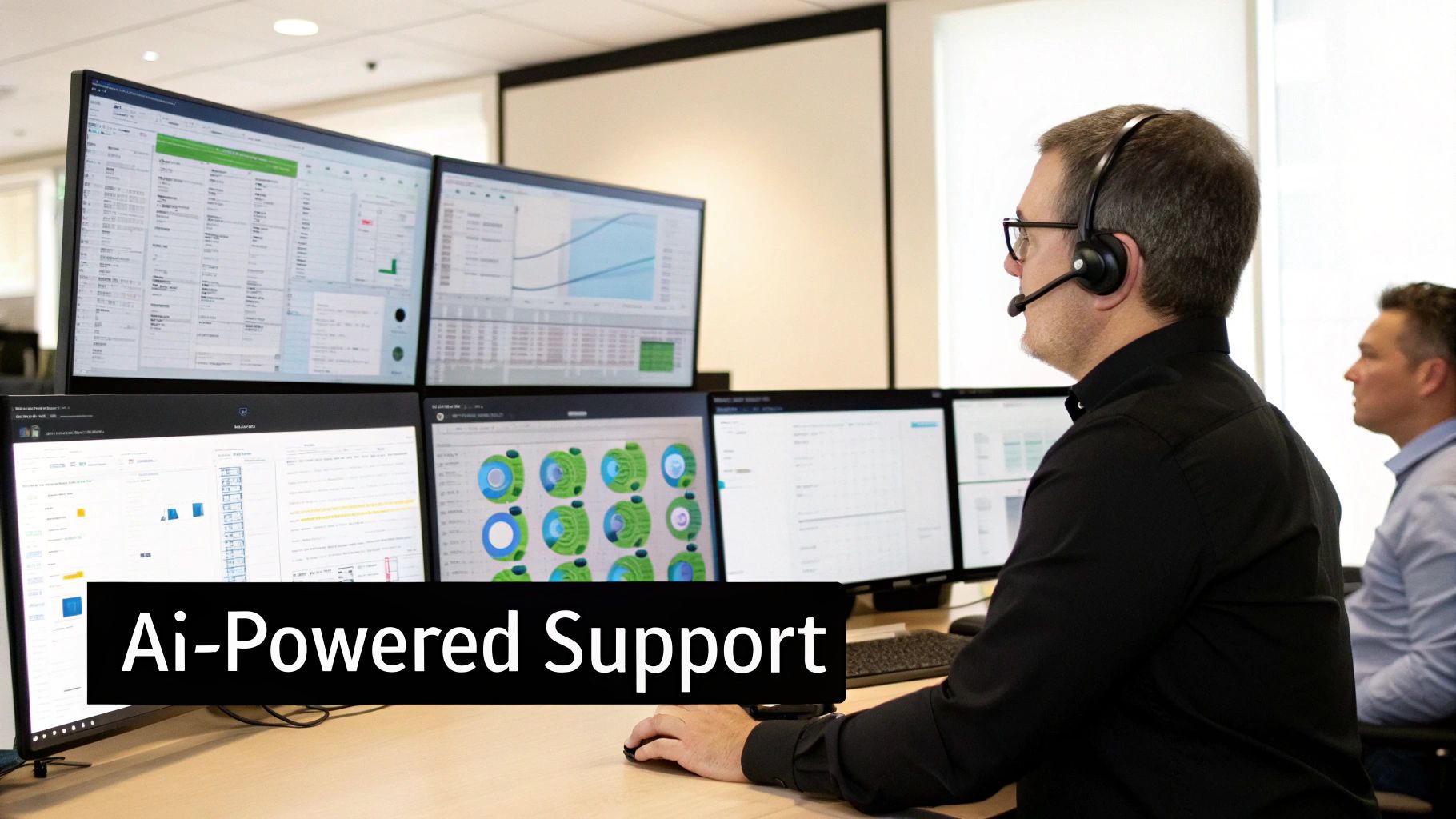
Artificial Intelligence isn't some far-off concept anymore; it's a practical, everyday tool that supercharges what human agents can do. In the Philippine BPO world, AI shows up in several powerful ways to boost both the speed and quality of service.
These aren't just buzzwords. They represent a ground-level change in how customer support gets done. When you partner with the right provider, you tap into this entire tech infrastructure without having to build—or pay for—it yourself. Our own BPO blog offers more insights into how these operational shifts create real value.
Key Technologies Driving Efficiency
A few core technologies form the foundation of this modern approach, each playing a specific role in making the customer journey smoother and more insightful.
- AI-Powered Chatbots: Think of these as the first line of defense. They handle the common, repetitive questions instantly, 24/7, which frees up your human agents for the complex, nuanced problems where they can really shine.
- Natural Language Processing (NLP): This is the tech that can "read the room." NLP tools analyze customer emails, chats, and even calls to understand sentiment. Is the customer frustrated? Confused? Delighted? This allows teams to spot and escalate issues before they blow up.
- Predictive Analytics: By digging into past customer data, these systems can make surprisingly accurate predictions about future behavior. An agent might get a real-time alert suggesting a relevant upsell or warning that a specific customer is showing signs of churn.
The point of all this tech isn't to replace agents—it's to empower them. It’s like giving a master craftsman a set of perfectly calibrated power tools. The skill is still there, but now they can work faster and with greater precision than ever before.
And the Philippine call center industry is all in on this. As of 2025, over 60% of BPO operations are already using AI tools like predictive analytics and NLP. This tech adoption is a huge reason the sector is on track to hit 3 million full-time employees by 2028 and hold onto its 16% global market share. To see the full picture, you can read the full analysis of the AI revolution in Philippine CX on outsource-consultants.com.
This deep commitment to technology means the Philippines isn't just a place to cut costs. It’s a strategic hub for sophisticated, data-driven customer support that can give your business a serious leg up on the competition.
Your Vetting Checklist for Choosing the Right Partner
Picking a partner for your call center outsourcing to the Philippines is easily the most critical decision you'll make. This isn't just about hiring a vendor; it's about forging a relationship that will directly shape your customer experience. Think of it like bringing on a new business partner—you need someone with the right skills, a solid track record, and the reliability to stick with you through thick and thin.
A proper, thorough vetting process is your best insurance policy against the common headaches of outsourcing. It forces you to look beyond the slick sales pitch and focus on what really drives success: operational skill, airtight security, and a culture that aligns with your own. Skimp on this step, and you could end up with a partnership that costs you a fortune in poor performance, revolving-door agent turnover, or even a damaging data breach.
Foundational Experience and Reputation
Before you get lost in the weeds of tech specs and pricing, start with the basics. Does this company have real-world, in-the-trenches experience? It’s not just about how many years they’ve been around, but about the quality and relevance of that experience to your specific industry.
Your initial background check should cover these key areas:
- Proven Industry Experience: Have they worked with companies like yours before? An e-commerce brand has completely different support needs than a B2B software company. A partner who already speaks your industry's language will get up to speed much faster.
- Authentic Client Testimonials: Don't just settle for a list of logos. Ask for detailed case studies and to speak with current or former clients—ideally ones of a similar size to you. Any provider worth their salt will be happy to connect you.
- Scalability and Flexibility: How do they handle growth or changing needs? You need a partner who can flex with your business, whether that means quickly staffing up for a holiday rush or supporting a brand-new product launch.
Don't just take their word for it. Do your own digging. Look for independent reviews, search for them on industry forums, and check for any awards or recognition. A strong reputation is hard to fake.
Security and Compliance Protocols
In this day and age, data security is absolutely non-negotiable. When you outsource, you're handing over the keys to your most valuable asset: your customer data. A single mistake can destroy the trust you've spent years building. This part of your vetting needs to be intense.
Your potential partner has to prove they have an ironclad commitment to keeping your data safe. Ask direct, pointed questions about their security posture.
- Data Security Certifications: Look for globally recognized standards like ISO 27001, which is the gold standard for information security management. This isn't just a piece of paper; it proves they have a systematic, audited process for protecting sensitive info.
- Physical and Network Security: How do they lock down their physical locations? Ask about access controls (keycards, biometrics), surveillance, and their network firewalls. You need confidence that they’re preventing both digital and physical intrusions.
- Compliance Knowledge: Do they understand the specific regulations that govern your business, like GDPR for European customer data or HIPAA for healthcare? A knowledgeable partner will already have the processes in place to keep you compliant and out of legal trouble.
Technological Infrastructure and Support
A BPO's technology is the central nervous system of the whole operation. Old, clunky systems lead to dropped calls, slow software, and frustrated customers. A partner who is serious about quality invests heavily in modern, reliable infrastructure. This is especially true if you’re looking at seat leasing, where the tech and facilities are the entire product.
When you kick the tires on their tech stack, zoom in on these essentials:
- Internet Redundancy: One internet connection is a recipe for disaster. Ask them about their backup internet service providers (ISPs). They should have multiple, diverse connections to ensure your team stays online even if one provider goes down.
- Disaster Recovery Plan: What’s the game plan for a power outage, a typhoon, or some other major disruption? A prepared partner will have a well-documented business continuity plan ready to show you.
- IT Support Structure: Make sure they have 24/7 on-site IT support. When a technical problem pops up at 3 AM your time, you can't afford to wait for a ticket to be answered the next day. You need experts on the floor, ready to fix it immediately.
Choosing the right partner is a process of asking tough questions and expecting clear, confident answers. To help you structure these conversations, we've put together a simple due diligence checklist.
Vendor Due Diligence Checklist
| Evaluation Criteria | Key Questions to Ask | Ideal Response or Red Flags |
|---|---|---|
| Experience & Reputation | – How long have you served clients in my industry? – Can I speak to 2-3 current client references? – How do you handle seasonal ramps or unexpected growth? |
Ideal: Shows relevant case studies, provides references willingly. Red Flag: Vague answers, no industry-specific experience. |
| Security & Compliance | – Are you ISO 27001 certified? Can I see the certificate? – What are your physical security measures? – How do you ensure compliance with [Your Regulation, e.g., GDPR]? |
Ideal: Provides documentation, has clear protocols. Red Flag: Downplays the importance of certifications, lacks specific compliance knowledge. |
| Technology & Infrastructure | – How many redundant ISP connections do you have? – Can you walk me through your disaster recovery plan? – Is your IT support team on-site 24/7? |
Ideal: Details multiple fiber lines, has a documented BCP. Red Flag: Single ISP, no formal DR plan, relies on off-site or on-call IT. |
| Talent & Operations | – What is your agent attrition rate? – What is your training process for new accounts? – How are your team leaders and managers developed? |
Ideal: Low attrition (below industry average), structured training. Red Flag: High turnover, generic or "one-size-fits-all" training. |
This checklist is a fantastic starting point for any serious evaluation. A transparent, high-quality provider will not only have answers to these questions but will welcome the chance to prove their capabilities.
If you're ready to start this conversation and see how a potential partner measures up, you can contact our team for a detailed consultation to discuss your specific needs.
A Practical Roadmap for Onboarding and Management
You’ve signed the contract and picked your partner. That’s a huge step, but now the real work starts. A successful move to call center outsourcing in the Philippines hinges on a smart, well-structured onboarding process. Don't think of it as just a hand-off; it's more like building a bridge between your core business and your new team, ensuring your culture, knowledge, and goals can flow freely.
The whole journey kicks off with a deep dive—what we call the discovery phase. Your BPO partner will need to get inside your business, learning everything from the nuts and bolts of your products to the specific tone of your brand voice. This initial knowledge transfer is absolutely critical. It’s the bedrock for all the training scripts and operational playbooks that come next.
From there, you move into the technical setup. This is where you get the systems talking to each other: setting up secure CRM access, configuring the phone systems, and getting everyone on the same communication channels like Slack or Microsoft Teams. When done right, your remote team has the exact same tools as your in-house staff, right from day one.
Structuring a Smooth Transition
You don't want to flip a switch and send every call overseas overnight. That’s a recipe for disaster. A phased approach is always the best way to launch your outsourced team, as it minimizes risk and helps build momentum. A thorough vetting process is the foundation for making this transition a smooth one.
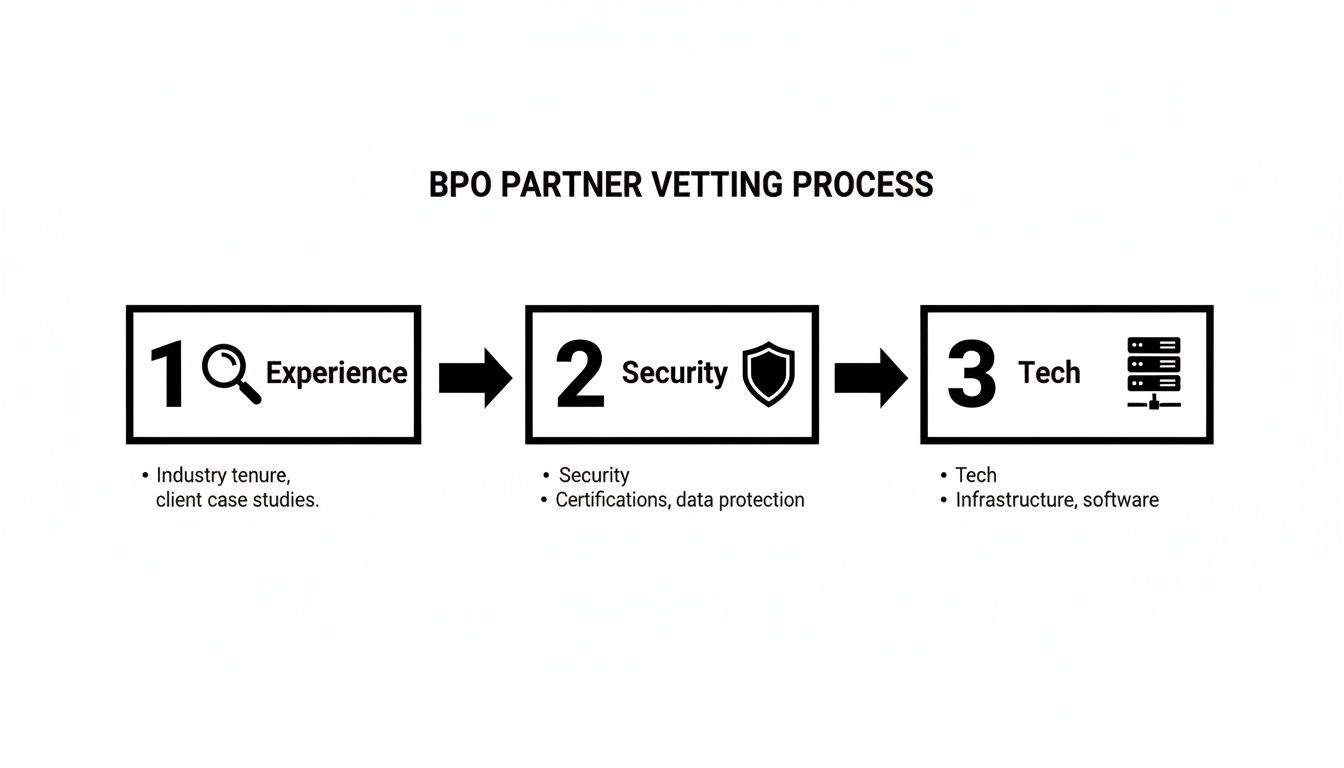
This kind of process—where you meticulously check for experience, confirm security protocols, and test their tech stack—is what leads to a reliable partnership and a far less bumpy onboarding experience.
Here’s what that rollout typically looks like:
- Agent Training: Using the documentation you provided, your partner's trainers get the new agents up to speed. This is usually a mix of classroom-style sessions and role-playing simulated customer calls.
- Nesting Period: After the initial training, agents enter a "nesting" phase. They start handling real, live calls but with a safety net—supervisors and trainers are right there to provide immediate support and feedback.
- Gradual Ramp-Up: As agents get more comfortable and prove their skills, their workload is slowly increased. This continues until they’re fully integrated and taking on a full share of the volume.
This methodical rollout makes sure agents are truly ready before they fly solo, which is crucial for protecting your customer experience during the switch.
Best Practices for Effective Remote Management
Managing an outsourced team isn't about micromanagement. It's about clear communication, shared goals, and focusing on the numbers that actually matter. The objective is to make them feel like a genuine extension of your company.
The secret to great remote management isn't constant oversight. It's building a system of trust based on clear expectations, consistent communication, and shared goals.
To make that happen, get a regular communication rhythm going. Daily huddles between team leaders and weekly performance reviews with your main point of contact at the BPO are non-negotiable. These meetings should be driven by data, not just feelings, focusing on key performance indicators (KPIs) that tell you how happy your customers are.
You’ll want to keep a close eye on a few crucial KPIs:
- First Call Resolution (FCR): What percentage of issues are completely solved in a single phone call?
- Average Handle Time (AHT): How long does an average interaction take from start to finish?
- Customer Satisfaction (CSAT): What are customers saying in post-call surveys?
By using modern tools and focusing on these tangible metrics, you can manage your outsourced team with incredible precision. This is how you build a strong, accountable partnership and ensure your call center outsourcing in the Philippines becomes a seamless, high-performing part of your organization.
Your Top Questions About Outsourcing to the Philippines, Answered
Deciding to move a key part of your business overseas is a big step, and it's natural to have questions. Getting clear, honest answers is the best way to build the confidence you need to move forward. Let's tackle some of the most common concerns we hear from businesses considering call center outsourcing in the Philippines.
Think of this as your practical Q&A session. We'll get straight to the point on quality, management, and security so you have a realistic picture of what to expect.
Can We Expect the Same Quality as an In-House Team?
This is usually the first question on everyone's mind, and it's a fair one. The short answer is yes—if you choose the right partner. The BPO industry in the Philippines didn't just pop up overnight; it was built on delivering world-class quality. You're tapping into a workforce that is not only highly educated and fluent in English but also deeply ingrained with a culture of exceptional customer service.
A reputable BPO partner doesn't just hire agents; they build professional teams. They make serious investments in:
- Intensive Training: Before an agent ever speaks to one of your customers, they go through deep training on your brand voice, product details, and specific service protocols.
- Quality Assurance (QA): Dedicated QA teams are constantly listening to and reviewing interactions. They’re there to make sure every conversation hits your benchmarks for tone, accuracy, and first-call resolution.
- Data-Driven Performance: Everything is tracked. Your partner will use clear KPIs to manage performance, spot trends, and find ways to get even better over time.
How Do We Manage a Team From Half a World Away?
Managing a team remotely isn't about physical proximity; it's about having the right systems and communication in place. Thanks to modern tech and proven management strategies, keeping your outsourced team on track is surprisingly straightforward.
The secret isn't micromanagement. It's building a true partnership based on transparency, consistent communication, and mutually agreed-upon goals. Your BPO partner is your management team on the ground, handling the daily supervision so you can focus on the big picture.
You'll stay firmly in control through regular check-in calls, detailed performance dashboards, and open lines of communication with your team leads. The goal is to make your outsourced team feel like a natural extension of your own company, all working towards the same objectives.
Is Our Company’s Data Secure?
Without a doubt. For any established BPO provider in the Philippines, data security is non-negotiable. Their entire business and reputation hinge on it. The best vendors operate under strict international security standards to keep your company and customer data locked down tight.
When you're evaluating a potential partner, ask for proof of their security framework. You should be looking for things like:
- ISO 27001 Certification: This is the international gold standard for information security management systems.
- Physically Secure Facilities: Think keycard access, 24/7 on-site security personnel, and comprehensive surveillance systems.
- Fortified Network Security: This includes enterprise-grade firewalls, encrypted data channels, and secure VPNs.
A professional BPO will be completely open about their security measures. They know that protecting your data with the same level of care you would is just part of the job.
At Seat Leasing BPO, we provide the secure infrastructure and fully-equipped workstations that allow you to launch your Philippine operations with confidence and efficiency. Learn more about our flexible plug-and-play solutions at seatleasingbpo.com.