Picture this: your business is humming along, and not a single person on your team is stressing about a flickering light, a sluggish internet connection, or who's supposed to clean the conference room. That's the core idea behind facility management outsourcing. It's a strategic move where you hand over the keys to your physical workspace to a specialized partner.
What Is Facility Management Outsourcing?
Simply put, facility management outsourcing is when you hire a third-party expert to run your physical office operations. This isn't just about calling in a cleaning crew. It’s about entrusting the entire ecosystem of your workspace—from the complex IT network and building repairs down to daily janitorial services and security—to one dedicated provider.
Think of it as bringing on a Chief Operating Officer for your building. This lets your own team stop worrying about the office and focus entirely on what they do best: driving your business forward.
The Shift from In-House to Expert Partners
For a long time, companies handled all these tasks internally. But this often meant pulling skilled people away from their real jobs to deal with a broken AC unit or a vendor contract. Businesses are increasingly realizing this model just doesn't make sense anymore.
Instead of juggling separate vendors for IT, cleaning, and maintenance, they're now partnering with a single firm that manages everything. This isn't just a fleeting trend; it’s a fundamental shift in how modern businesses operate.
The numbers back this up. The global facility management market was valued at USD 48.3 billion in 2025 and is expected to rocket to USD 82.2 billion by 2035—a 6.1% compound annual growth rate (CAGR). This massive growth, detailed in reports like this analysis from Future Market Insights, shows just how many organizations are turning to outsourcing to work smarter and cut down on operational drag.
Why It Matters for Growing Businesses
For startups and small to medium-sized businesses (SMBs), this approach is a game-changer. It gets rid of the operational headaches and heavy upfront costs that can easily slow down growth. Instead of sinking capital into infrastructure or hiring a full-time facilities team, you get access to top-tier services on a flexible, pay-as-you-go basis.
A perfect example of this in action is seat leasing. When you lease a "seat," you're not just getting a desk and a chair. You're getting a fully managed workspace bundled into one predictable monthly fee. This typically includes:
- High-speed internet and IT support so your team stays online and productive.
- Building maintenance and security for a safe, professional, and well-kept environment.
- Utilities and daily cleaning services to take care of all the background logistics.
By handing off these functions, leadership can shift its energy from managing the office to driving innovation, delighting clients, and hitting major business goals. It’s about turning a necessary expense into a real competitive edge.
Choosing Your Outsourcing Model
Deciding to outsource your facility management isn't a simple "yes or no" question. It’s more about finding the right way to do it. The best model for you will come down to your company's size, your long-term goals, and, frankly, how much control you want to keep.
Think of it like this: are you looking for a fully catered, hands-off experience, or do you just need an expert to handle a few specific dishes? Each approach strikes a different balance between convenience, control, and cost. Getting a handle on these options is the first step to finding a partner that truly fits your business.
This decision path can help you visualize how to get from "our office is a constant headache" to a smart outsourcing strategy that actually helps you grow.
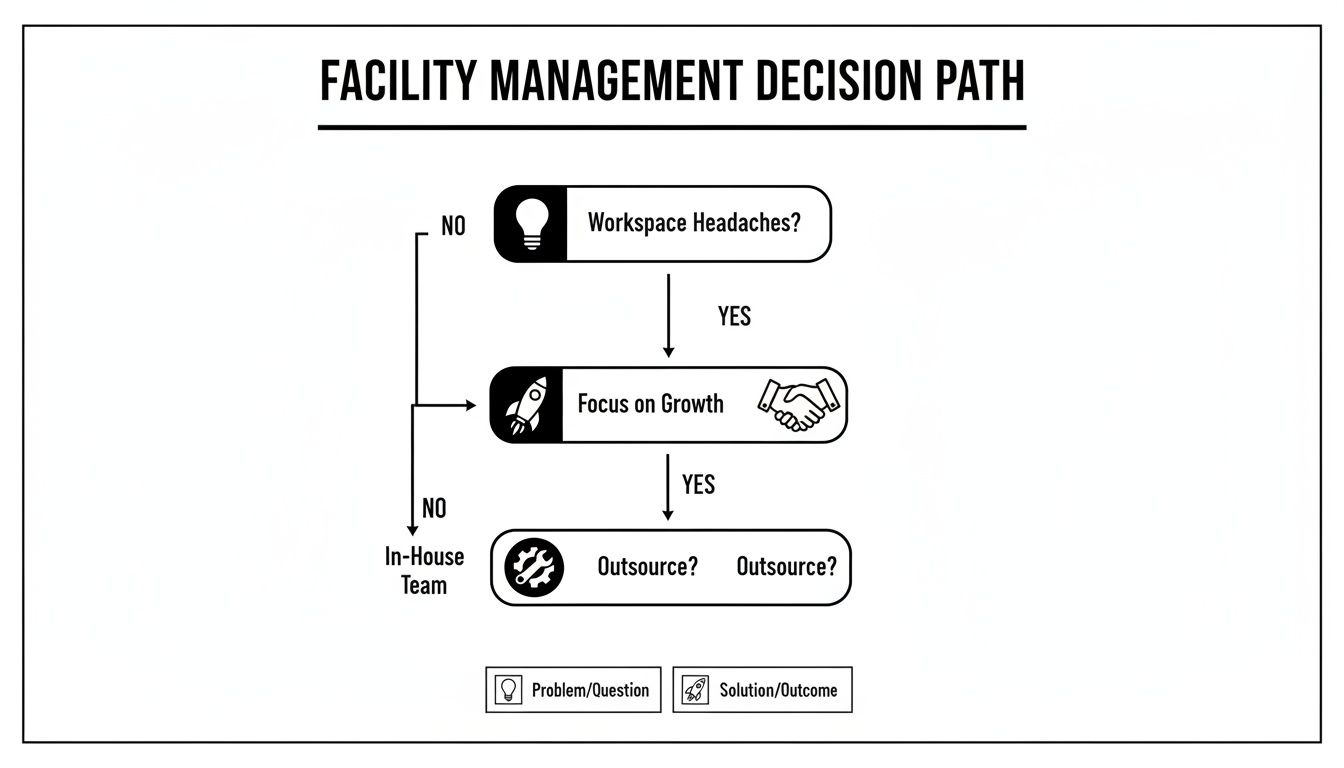
As you can see, those persistent workspace problems almost always force a choice between building an in-house team or bringing in the pros. The goal is always the same: sustainable growth.
Let's break down the three main ways you can structure this kind of partnership.
Total Facility Management: The "All-In" Approach
Total Facility Management (Total FM), also known as Integrated Facility Management, is the most hands-off option. You essentially hand the keys to your entire facility operations over to one expert provider.
This is your "general contractor" model. You share your vision and budget, and they handle everything else—from sourcing vendors and managing maintenance to ensuring the lights stay on. You get one point of contact and one invoice. Simple.
This all-inclusive strategy is perfect for businesses that want to completely step away from the daily grind of running an office. It frees up your team to focus 100% on what they do best: driving your core business forward.
Managed Services: The À La Carte Model
What if a complete handover feels like too much? That’s where the Managed Services model comes in. It allows you to pick and choose which specific functions you want to outsource while keeping the rest in-house.
Think of it like ordering from a restaurant's à la carte menu. Maybe you need an expert to handle the complex stuff, like IT infrastructure and cybersecurity, but you're perfectly happy managing daily cleaning and front desk duties yourself.
This model is a lifesaver for companies that already have strong internal teams but need to fill a few specific gaps. The most common services outsourced this way include:
- IT Infrastructure: Keeping the Wi-Fi humming, the network secure, and the hardware supported.
- Specialized Maintenance: Dealing with tricky HVAC systems or planning a major office fit-out.
- Security Services: Sourcing professional on-site guards and sophisticated surveillance tech.
A Managed Services approach lets you plug operational holes with targeted expertise. You get high-level support exactly where you need it, without giving up control over your entire workspace.
The Hybrid Model: A Collaborative Partnership
The Hybrid model is exactly what it sounds like: a blend of your internal team and an external provider working together. It’s less of a handover and more of a genuine partnership designed to create a solution that's a perfect fit for your unique needs.
This is a joint venture. Your in-house team knows your company culture and specific operational quirks inside and out. The outsourcing partner brings specialized tools, new technology, and industry best practices to the table. You manage the facility together.
This collaborative style is fantastic for companies that want to keep strategic control and institutional knowledge in-house but still benefit from outside expertise. It’s a powerful combination, but it hinges on one thing: crystal-clear communication. To make it work, you need a rock-solid contract that spells out exactly who is responsible for what.
Comparison of Facility Management Outsourcing Models
To make the choice clearer, here’s a side-by-side look at how these three models stack up against the factors that matter most.
| Model | Level of Control | Cost Structure | Best For | Example Scenario |
|---|---|---|---|---|
| Total FM | Low (Handled by provider) | Fixed fee or management fee + pass-through costs | Businesses wanting to fully focus on core operations and minimize administrative burden. | A fast-growing tech company that wants a single partner to manage its entire headquarters. |
| Managed Services | Medium (You select services) | Per-service or retainer-based | Companies with existing in-house capabilities that need specialized support in specific areas. | A law firm that handles its own admin but outsources IT security and after-hours cleaning. |
| Hybrid | High (Collaborative) | Custom (Mix of fixed fees and internal costs) | Organizations that want to retain strategic oversight while leveraging external expertise and resources. | A large enterprise that uses an external provider for maintenance and tech but keeps strategic planning in-house. |
Ultimately, the right model isn't just about offloading tasks; it's a strategic decision that should align with your operational philosophy and growth ambitions. Whether you go all-in or pick and choose, the goal is a smarter, more efficient workspace.
Why Outsourcing Your Facilities is a Strategic Game-Changer
Thinking about facility management outsourcing as just a way to offload a few tasks is missing the bigger picture. It's a strategic move that can fundamentally change how your business runs. This isn't just about convenience; it’s about turning operational headaches into a real competitive advantage, making your company more agile, financially savvy, and sharply focused on what actually drives growth.
Flip Your Cost Structure from a Liability to an Asset
Let’s talk money, because that's often the first and most powerful benefit. For any business, but especially for startups and SMBs, cash is king. Sinking a huge chunk of your capital into non-core assets—things like office furniture, IT hardware, or a new HVAC system—can drain the resources you need for innovation and expansion.
Outsourcing completely flips this script.
You shift from unpredictable and often massive capital expenditures (CapEx) to a smooth, predictable operational expenditure (OpEx) model. No more heart-stopping repair bills or massive upfront investments. Your facility costs become a consistent monthly expense you can actually budget for, freeing up cash for what truly matters: hiring that brilliant engineer, launching a new marketing campaign, or breaking into a new market.
Get an Entire Team of Experts—Instantly
Here’s another huge win: you get immediate access to a deep bench of specialists. Let's be honest, building an A-team for in-house facilities management is a tough, expensive slog. You'd need to find and hire experts in commercial real estate, network security, building maintenance, and regulatory compliance, just for starters.
An outsourcing partner already has that team. It's what they do, all day, every day.
This means you immediately benefit from:
- Proven Best Practices: They already know the smartest ways to lower energy bills, optimize maintenance schedules, and get the best deals from vendors.
- Top-Tier Technology: The best providers use sophisticated facility management software and smart building tech that would cost a fortune for a single company to buy and implement.
- Compliance and Safety: They stay on top of all the tricky health, safety, and environmental rules, which significantly lowers your company's risk.
This gives you an enterprise-level operation without the enterprise-level price tag, putting you way ahead of competitors still trying to manage everything themselves.
Get Back to Focusing on Your Actual Business
Maybe the most profound benefit is the one you can't easily put on a spreadsheet: reclaimed focus. Every minute your leadership team spends wrestling with a broken printer, a looming lease renewal, or a faulty security badge is a minute they aren't spending on strategy, product development, or talking to customers.
By handing off the day-to-day grind of running your workspace, you free up your most valuable people to do what they do best—grow the business. It's a simple, powerful trade: swap administrative distractions for high-impact results.
This isn't just a small improvement; it's essential for staying competitive. The companies that thrive today are the ones that can pour all their energy into their core mission. Outsourcing provides the stable, reliable operational backbone that makes this possible.
This approach is catching on fast as more companies look for ways to reduce risk and lock in predictable costs. In fact, many are seeing cost reductions of up to 80% compared to traditional office models by going all-in on outsourcing. This is particularly true for Integrated Facilities Management (IFM) contracts that bundle everything—HVAC, janitorial, security—into one efficient package. You can dig deeper into these numbers and trends in this market research on facilities management outsourcing.
At the end of the day, outsourcing your facilities is a strategic lever. It gives you financial breathing room, injects world-class expertise into your operations, and, most importantly, lets your team get back to the work that truly matters.
How Technology Is Reshaping Facility Management
Let's be honest, modern facility management isn't about clipboards and checklists anymore. The whole field has shifted from manual labor to smart technology. Gone are the days of reactive fixes and paper work orders; today, it’s a digital-first game that makes our workspaces more efficient, responsive, and ultimately, cheaper to run. This tech-driven evolution is completely changing the game for facility management outsourcing.
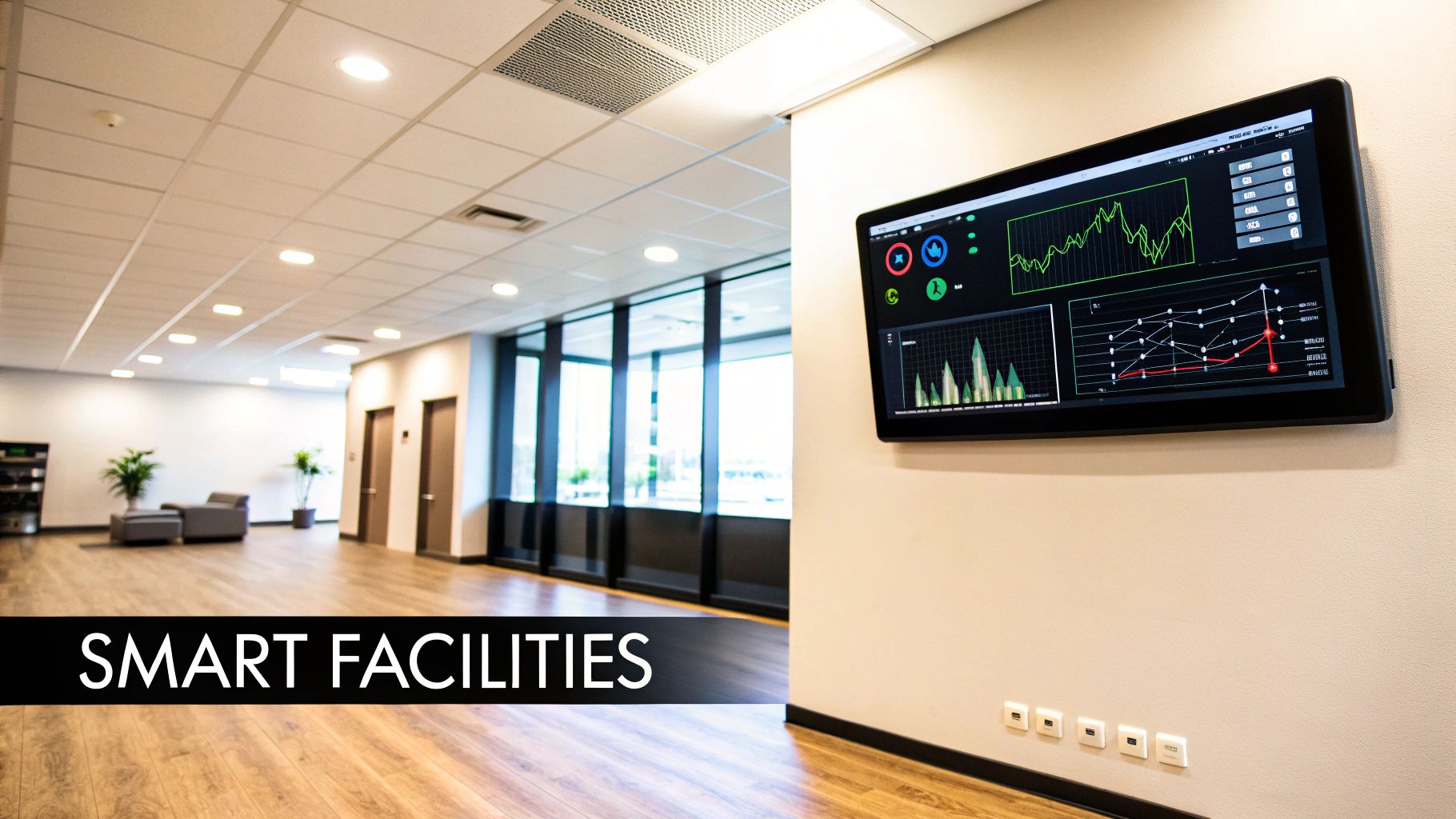
Try to think of your office as a living, breathing thing. Technology acts as its nervous system, constantly sending and receiving signals to keep everything running smoothly. When you team up with a tech-savvy outsourcing partner, you're essentially plugging into this advanced system without the headache and huge cost of building it from scratch.
The Rise of the Smart Building
The real magic behind this shift? Internet of Things (IoT) sensors. These tiny, connected devices are the eyes and ears of a modern building. They collect real-time data on everything—room temperature, how many people are in a meeting room, air quality, even how well a piece of equipment is performing.
They're like a building's personal fitness tracker, telling you things like:
- Which conference rooms are ghost towns, helping you make better use of your space.
- When a restroom actually needs cleaning based on traffic, not just a rigid schedule.
- If an HVAC unit is suddenly guzzling energy, flagging a problem before it fails.
All this information flows into a central hub, letting facility managers get ahead of issues instead of just putting out fires all day.
Predictive Maintenance: From Reactive to Proactive
This stream of data unlocks one of the biggest leaps forward: predictive maintenance. In the old days, maintenance was either done on a fixed schedule (whether it was needed or not) or when something broke down. Predictive maintenance is a total game-changer. It's like having a check-engine light for your entire office.
By using artificial intelligence (AI) to comb through sensor data, these systems can spot subtle warning signs that a person would never catch. A tiny change in a motor's vibration, for instance, could predict a massive HVAC failure weeks down the road. This allows you to schedule repairs exactly when needed, avoiding expensive downtime and emergency call-out fees.
Predictive maintenance transforms facility operations from a constant fire-fighting exercise into a finely tuned, strategic function. It means fewer disruptions for your team and a longer lifespan for your critical building assets.
The impact of smart building tech is real and measurable. Providers using IoT and AI are shifting from reactive to predictive models, and the results speak for themselves. They can now reduce unplanned downtime by up to 20 percent compared to traditional methods. If you want to dive deeper into the numbers, check out this in-depth facilities management report.
Digital Twins: Virtual Replicas for Real-World Wins
Another mind-blowing tool making its way into the field is the digital twin. This is an exact virtual copy of your physical workspace, constantly updated in real time with data from all those IoT sensors. It’s not just a fancy 3D model; it's a living, breathing simulation of your office.
With a digital twin, a facility manager can:
- Test Changes Virtually: Wonder how a new office layout might impact airflow or foot traffic? You can see the results before moving a single desk.
- Simulate Emergencies: Run evacuation drills or test fire-suppression systems in the virtual world to make sure they'll work when it counts.
- Optimize Energy Use: Hunt down "energy vampires" and fine-tune your lighting and climate control to slash utility bills.
This technology gives businesses an incredible edge, letting them continuously improve their space and manage risks without disrupting day-to-day work. Through facility management outsourcing, even smaller companies can tap into these powerful tools. For more insights on business operations and strategy, feel free to explore the articles on the Seat Leasing BPO blog. It’s all about making sure your workspace isn’t just functional today, but ready for whatever comes next.
Finding the Right Partner: A Vendor Selection Checklist
Choosing a facility management provider isn't just about hiring a vendor—it’s more like bringing on a business partner. This is the team that will directly shape your daily operations, your employees' experience, and ultimately, your bottom line. Rushing this decision often leads to service gaps and headaches down the road. A thoughtful choice, on the other hand, can become a powerful strategic advantage.
Think of this checklist as your guide to vetting potential partners. It's built to help you look past the sales pitch and ask the tough questions, covering everything from technical skills to how well they'll fit with your company culture. The aim here is to find a partner who is set up for long-term success with you from day one.
Assessing Core Competency and Industry Experience
Let's be clear: not all facility management providers are created equal. You need a partner who truly understands the unique challenges of your industry, whether you’re in tech, healthcare, or retail. Start by digging into their track record.
A provider with deep experience in your sector already knows the compliance standards, regulations, and operational quirks you deal with every day. That background knowledge saves you an incredible amount of time and reduces risk because they won't be learning the ropes on your dime.
Ask some pointed questions to see if they really know their stuff:
- Industry-Specific Experience: Can they show you case studies or give you references from companies like yours?
- Service Specialization: Do they have a proven track record in the specific services you need most, like managing critical IT infrastructure or providing specialized cleaning for a sensitive environment?
- Problem-Solving Scenarios: Ask them to walk you through how they handled a major crisis for another client, like a sudden power outage or a serious security breach. Their answer will tell you a lot.
Evaluating Technology and Scalability
Your business isn't static, and your facility management partner needs to keep pace. A provider still relying on outdated spreadsheets and manual checklists is going to hold you back. Look for a partner who invests in modern technology to make things more efficient and transparent.
Their tech should give you a clear window into how things are running. More importantly, their whole operation must be flexible enough to scale with you, whether you’re opening a new office, adding a hundred new team members, or even consolidating space.
A key part of vetting a provider is ensuring their operational model can adapt to your growth. Scalability isn't a "nice-to-have"—it's a fundamental requirement for a successful long-term partnership in facility management outsourcing.
The Importance of Clear Communication and Reporting
Even the most technically skilled provider is useless if you can't get a straight answer from them. Clear communication and transparent reporting are non-negotiable. From the very beginning, you need to know exactly who to call, how to track progress, and what to expect from their updates.
During your evaluation, really press them on their communication plan:
- Dedicated Point of Contact: Will you have a single account manager who knows your business inside and out? Or will you be shuffled around a call center?
- Reporting Cadence: How often will you get performance reports? What key metrics will they include? Make sure they track what actually matters to you.
- Issue Resolution Process: What's their official process for escalating and solving problems? You want to see a clear, documented plan, not just vague promises.
A solid structure here ensures everyone is on the same page and holds the provider accountable. If a potential partner gets fuzzy on the details about their reporting, it might be a red flag that they aren't confident in what they can deliver.
If you're ready to start this conversation with a potential partner, you can reach out to our team of experts to discuss your specific needs.
Facility Management Outsourcing in Action
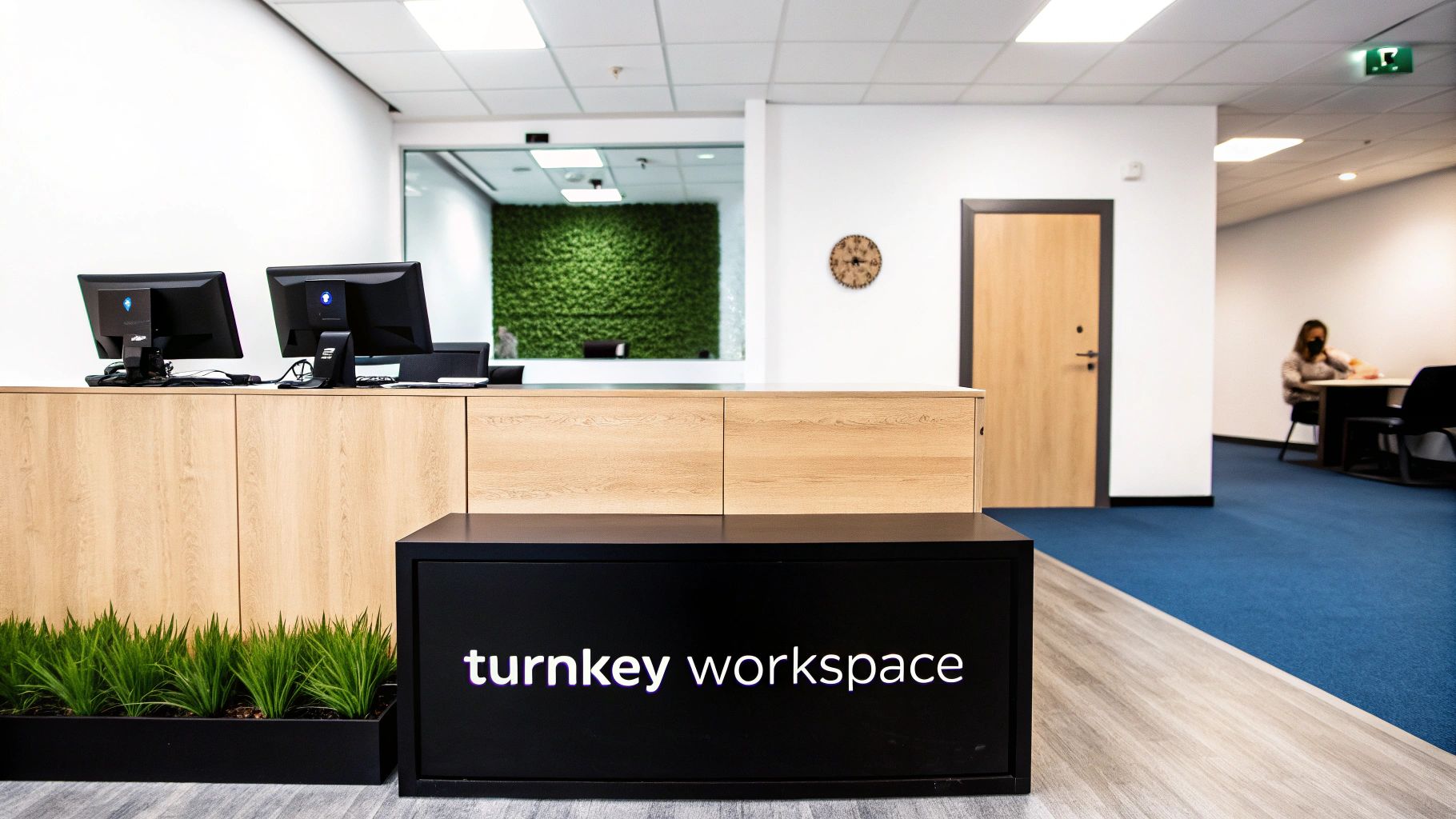
The theory behind facility management outsourcing is solid, but seeing it work in the real world is what really makes the benefits click. Let's move past the abstract and look at how different businesses are using this strategy to overcome specific hurdles and accelerate their growth.
These examples really highlight how outsourcing isn't just a simple service you buy; it's a strategic tool you can shape to fit your company's size, stage, and goals. It’s all about finding the right operational setup to support where you’re headed.
The Lean Tech Startup
Picture a small, scrappy tech startup. They have a game-changing idea but are running on a tight budget. The last thing they can afford is to sink precious capital into a long-term lease, office furniture, and IT infrastructure. It's a non-starter.
Instead, they turn to a fully serviced workspace provider. This single move gives them an instant, professional office without the crippling upfront costs. Their monthly fee covers it all—high-speed internet, security, even daily cleaning. This allows them to project a polished image and attract top talent from day one, all while keeping their cash free for what truly matters: developing their product and getting it to market.
The Growing Small Business
Now, think about a small-to-medium business (SMB) that's hitting a major growth spurt. They’ve outgrown their current office, but the thought of getting tangled in commercial lease negotiations, managing a construction fit-out, and hiring an in-house facilities team is a nightmare. It would pull their focus completely away from their core business.
By outsourcing their facility management, they can move into a larger, professionally managed space without missing a beat. Their provider takes care of everything—from sourcing the perfect location to making sure the new office is ready to go. This kind of agility lets the SMB grow its team without getting bogged down in real estate drama, ensuring a smooth transition during a pivotal time.
Outsourcing transforms the workspace from a logistical burden into a flexible asset. It allows companies to scale up or down with market demands, turning a fixed cost into a variable one that aligns with business performance.
The Efficient BPO Provider
Finally, let's look at a Business Process Outsourcing (BPO) company. In their world, operational efficiency is everything. Every minute their team spends on something other than serving clients is a hit to their bottom line. This is where a fully integrated outsourcing model truly shines.
Many BPOs now rely on turnkey solutions that bundle the workspace, IT infrastructure, security, and utilities into a single, predictable cost per employee. This is a central part of the model offered by Seat Leasing BPO, which enables BPOs to concentrate entirely on service delivery and client happiness. By handing off the entire physical environment, they sharpen their operational focus, gain total cost control, and build a powerful competitive edge. You can learn more at https://seatleasingbpo.com/.
Common Questions Answered
Diving into facility management outsourcing for the first time? It's natural to have questions. Let's clear up some of the most common ones so you can move forward with confidence.
Is Outsourcing Facility Management Just a "Big Company" Thing?
Not anymore. While huge corporations have been doing this for years, the game has completely changed. The old, rigid models that required massive scale are a thing of the past.
Today, flexible solutions—especially integrated models like seat leasing—bring top-tier infrastructure and professional support within reach for startups and small businesses. You can get all the benefits on a pay-as-you-go basis, which really levels the playing field. It means you can operate with the same polish and efficiency as a major competitor, but without the crippling upfront investment.
Does Outsourcing Mean I Give Up Control of My Own Office?
That's a common fear, but a good outsourcing partnership is about collaboration, not surrendering control. The secret to keeping the reins firmly in your hands is a well-crafted Service Level Agreement (SLA).
Think of the SLA as your rulebook. It's a clear, written agreement that spells out every expectation, performance metric, communication protocol, and who's responsible for what. It ensures your partner operates exactly to your standards.
You set the vision and the standards for your workspace; your provider handles the day-to-day execution to make it happen. Plus, with managed service or hybrid models, you can keep the most critical functions in-house while handing off the rest. The aim here isn't to lose control—it's to gain an expert partner who makes sure your office perfectly supports your team and your company culture.
How Do We Even Get Started With This?
Kicking things off is more straightforward than you might think. It all begins with a little internal homework.
- Do a Quick Internal Audit: First, get a real handle on what you're spending on your facility, from rent to repairs. Just as important, estimate how much time your team loses on non-essential tasks, like wrestling with the printer or coordinating with the cleaning crew.
- Pinpoint Your Biggest Headaches: What are the things that drive you crazy? Is it the spotty Wi-Fi, the never-ending maintenance calls, or the sheer administrative drain of juggling a dozen different service providers?
- Find the Right Partners: Armed with this info, start looking for providers who know your industry or specialize in businesses your size. A vendor checklist is your best friend here—use it to compare what they offer, what their clients say, and the tools they use.
- Build the SLA Together: Don't sign anything until you've collaborated on a rock-solid SLA. This document is your blueprint for success, detailing every single responsibility and metric to ensure everyone is on the same page from day one.
Ready to turn your workspace from an expense into a genuine advantage? Seat Leasing BPO offers flexible, fully managed office solutions that let you focus on what truly matters—growing your business. Discover how our turnkey services can save you up to 80% on traditional office costs today!