The business process outsourcing landscape in the Philippines has evolved into a sophisticated, technology-driven powerhouse that continues to dominate the global market. As the bpo ph industry reaches unprecedented heights in 2026, companies worldwide are recognizing that the Philippines offers far more than cost savings. The nation has transformed into a strategic capability hub where enterprise-grade infrastructure, highly skilled talent, and cutting-edge technology converge to deliver exceptional business outcomes. Understanding the current state of bpo ph operations is essential for organizations seeking competitive advantages through intelligent outsourcing partnerships.
The Current State of BPO PH in 2026
The Philippine BPO sector has achieved remarkable milestones this year, with revenues reaching $42 billion and employment figures approaching 2 million workers. This growth trajectory demonstrates resilience despite global economic uncertainties and technological disruptions that have challenged traditional outsourcing models.
Key industry metrics for 2026:
- Total export revenues: $42 billion
- Total employment: 1.98 million professionals
- Year-over-year growth: 5-7%
- Average client satisfaction rating: 89%
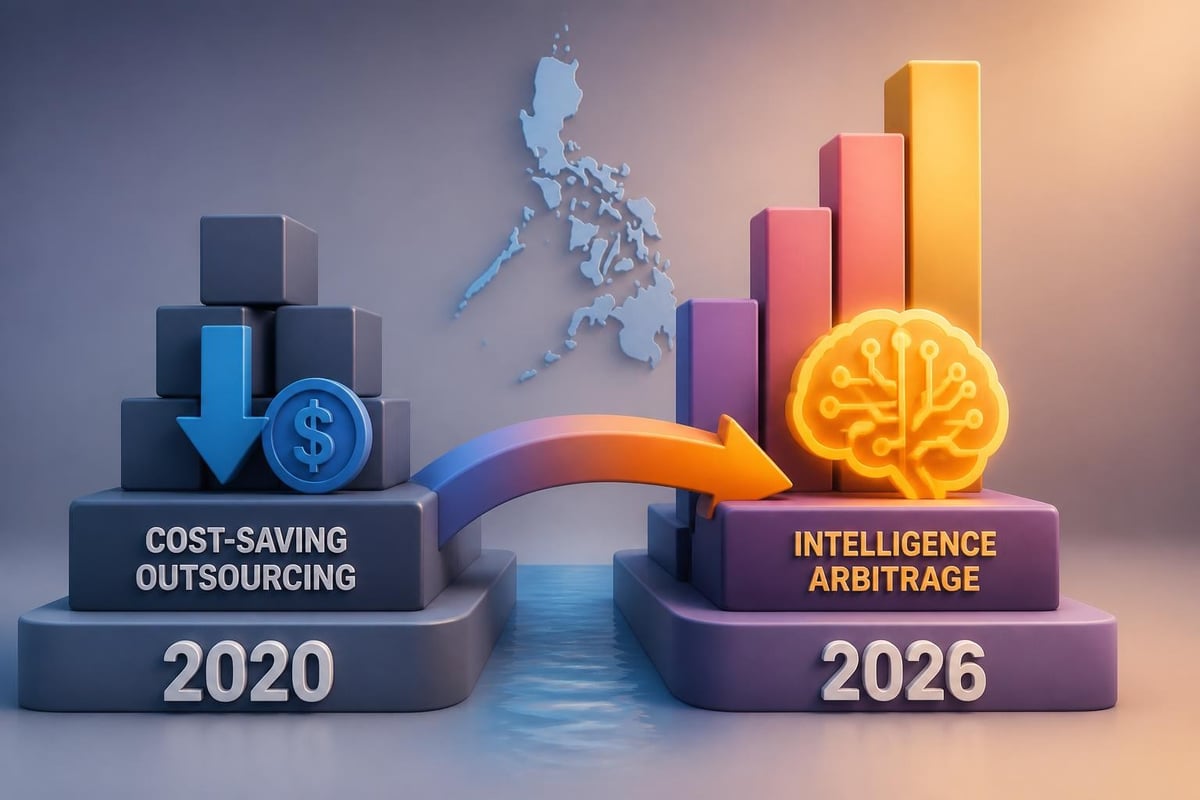
The bpo ph ecosystem has successfully navigated the transition from cost-arbitrage positioning to what industry experts now call "Intelligence Arbitrage." This strategic shift emphasizes value creation through advanced analytics, specialized domain expertise, and AI-augmented service delivery rather than simply offering lower labor costs.
Economic Impact and Market Position
The bpo ph sector contributes approximately 7.5% to the nation's GDP, making it one of the most significant economic drivers in the Philippines. The industry's impact extends beyond direct employment, creating multiplier effects across real estate, transportation, food service, and technology sectors.
| Metric | 2024 | 2025 | 2026 |
|---|---|---|---|
| Revenue (USD billions) | 38.2 | 40.0 | 42.0 |
| Employment (millions) | 1.61 | 1.68 | 1.98 |
| GDP Contribution | 6.8% | 7.2% | 7.5% |
International clients from the United States, United Kingdom, Australia, and increasingly from European markets continue to expand their footprint in the Philippines. The Philippine BPO sector’s 4% employment growth in 2025 demonstrates sustained demand despite automation concerns.
Why BPO PH Leads Global Outsourcing
Several interconnected factors explain why the bpo ph industry maintains its competitive edge in an increasingly automated business environment. These advantages go beyond traditional cost considerations to encompass strategic capabilities that align with modern enterprise requirements.
Talent Pool and Educational Infrastructure
The Philippines produces approximately 500,000 college graduates annually, with strong concentrations in business administration, information technology, engineering, and healthcare-related fields. This steady pipeline of educated professionals provides bpo ph companies with access to talent that combines technical competency with customer service excellence.
English proficiency remains a cornerstone advantage. The Philippines ranks among the top countries globally for business English proficiency, with neutral accent patterns that resonate well with Western clients. Cultural affinity with American and British business practices further enhances communication effectiveness.
Educational advantages supporting bpo ph:
- 95% literacy rate among working-age population
- Widespread English fluency from primary education
- Growing specialization in IT, healthcare, and finance programs
- Continuous professional development infrastructure
Infrastructure and Connectivity
Modern bpo ph operations benefit from substantial investments in digital infrastructure. Metro Manila, Cebu, Clark, and Davao have established themselves as Tier 1 outsourcing destinations with carrier-grade connectivity, redundant power systems, and disaster recovery capabilities that meet or exceed international standards.
Internet connectivity has improved dramatically, with average speeds reaching 150-200 Mbps in major business districts. Multiple fiber optic backbones ensure redundancy, while submarine cable systems connecting to international networks provide latency rates comparable to domestic U.S. connections.
For businesses requiring immediate operational capability, call center for rent solutions provide enterprise-grade facilities with pre-installed technology infrastructure, eliminating months of setup time and capital expenditure.
AI Integration and Technology Adoption
The intersection of artificial intelligence and bpo ph operations represents one of the most significant transformations in the industry's evolution. Rather than viewing AI as a threat, Philippine outsourcing providers have embraced it as an enhancement tool that elevates human capabilities and creates new service categories.
AI-Augmented Service Models
Leading bpo ph companies now deploy AI across multiple operational layers. Natural language processing enhances customer interactions, predictive analytics optimize workforce management, and machine learning algorithms improve quality assurance processes. The Philippine BPO industry’s achievement of $40 billion in 2025 was directly attributed to these technological enhancements.
Agent training times have decreased by 30-40% through AI-powered simulation and real-time coaching systems. This efficiency gain allows bpo ph providers to onboard talent faster while maintaining quality standards, creating competitive advantages in time-to-market for new service launches.

The Agentic AI Challenge
While AI adoption has accelerated growth, the Philippine BPO industry faces an agentic AI reality check as autonomous systems become more sophisticated. Enterprise clients with advanced technology infrastructure increasingly deploy AI agents for routine transactions, while small and medium-sized businesses continue relying on human-delivered services.
This bifurcation has prompted bpo ph providers to develop hybrid delivery models that combine human expertise with AI capabilities. Complex problem-solving, emotional intelligence, and strategic decision-making remain human domains, while AI handles data processing, initial customer screening, and pattern recognition tasks.
Service Diversification Beyond Traditional Call Centers
The evolution of bpo ph extends far beyond voice-based customer support into specialized, high-value service categories that require domain expertise and analytical capabilities.
Emerging Service Categories
Finance and Accounting Outsourcing (FAO): Philippine providers now handle complex financial operations including management accounting, financial planning and analysis, and treasury functions for multinational corporations.
Healthcare Information Management: Medical coding, claims processing, and health information management services leverage the Philippines' strong healthcare education infrastructure and strict compliance orientation.
Data Science and Analytics: Advanced analytics teams in bpo ph facilities provide business intelligence, predictive modeling, and data visualization services that inform strategic decision-making.
Creative and Digital Services: Content creation, digital marketing, graphic design, and social media management represent rapidly growing segments that capitalize on Filipino creativity and cultural awareness.
| Service Category | Market Share | Growth Rate | Average Value |
|---|---|---|---|
| Voice Support | 42% | 2-3% | Standard |
| Technical Support | 18% | 8-10% | Medium-High |
| FAO | 15% | 12-15% | High |
| Healthcare BPO | 12% | 10-12% | High |
| Creative Services | 8% | 15-18% | Medium |
| Data Analytics | 5% | 20-25% | Very High |
Geographic Distribution and Hub Development
Bpo ph operations have expanded beyond traditional Metro Manila concentration into strategic hubs across the archipelago. This geographic diversification reduces risk, accesses talent in provincial areas, and provides cost optimization opportunities.
Major BPO Hubs
Metro Manila remains the largest concentration with approximately 60% of total industry employment. The National Capital Region offers unmatched infrastructure density, talent availability, and proximity to government agencies and corporate headquarters.
Cebu has emerged as the second-largest hub, known for excellent connectivity, lower operating costs compared to Manila, and a distinct cultural identity that appeals to certain client segments. The Queen City of the South now hosts over 150,000 bpo ph workers.
Clark Pampanga benefits from special economic zone status, master-planned infrastructure, and proximity to international airport facilities. The former U.S. military base has transformed into a technology and outsourcing center with modern facilities and streamlined regulatory environments.
Davao City represents the fastest-growing provincial hub, offering political stability, strong local government support, and access to Mindanao's untapped talent pools. Multi-lingual capabilities including Japanese and Mandarin create niche advantages.
Infrastructure Considerations by Location
- Power reliability: 99.9% uptime in major hubs with N+1 redundancy
- Internet connectivity: Carrier-grade fiber with multiple providers
- Transportation: Proximity to residential areas and public transit
- Safety and security: 24/7 security protocols and emergency response systems

Regulatory Environment and Government Support
The Philippine government has implemented supportive policies that strengthen the bpo ph industry's competitive position while ensuring sustainable growth and workforce development.
Key Regulatory Frameworks
The Department of Information and Communications Technology (DICT) coordinates digital infrastructure development, while the Philippine Economic Zone Authority (PEZA) administers tax incentives for registered enterprises. The CREATE Act has modernized the incentive structure, providing predictable benefits while encouraging regional expansion.
Government initiatives supporting bpo ph:
- Tax holidays for new registered enterprises
- Reduced corporate income tax rates for qualifying activities
- Simplified foreign ownership regulations for support services
- Enhanced data privacy frameworks aligned with international standards
- Skills development programs through TESDA partnerships
The Philippine Data Privacy Act of 2012, as amended, provides comprehensive data protection frameworks that align with GDPR and other international standards. This regulatory maturity gives clients confidence when entrusting sensitive information to bpo ph providers.
Cost Efficiency and Value Proposition
While the bpo ph industry has moved beyond pure cost-arbitrage positioning, financial advantages remain significant factors in location decisions. Total cost of ownership calculations consistently favor Philippine operations when considering quality-adjusted output.
Comparative Cost Analysis
Labor costs in the Philippines remain 50-70% lower than equivalent positions in North America, Australia, or Western Europe. However, the value proposition extends beyond wage differentials to encompass reduced infrastructure investment, faster scaling capabilities, and operational flexibility.
| Cost Component | Philippines | U.S. Domestic | Savings |
|---|---|---|---|
| Agent Salary (annual) | $6,000-$9,000 | $32,000-$45,000 | 75-80% |
| Facility (per seat/month) | $200-$350 | $800-$1,200 | 65-75% |
| Technology Infrastructure | $50-$80 | $150-$250 | 60-70% |
| Management Overhead | $800-$1,200 | $2,500-$4,000 | 65-70% |
Real estate costs in provincial hubs offer additional optimization opportunities. Companies expanding beyond Metro Manila can achieve 30-40% reductions in occupancy expenses while maintaining quality infrastructure and talent access.
Workforce Development and Retention
The sustainability of bpo ph operations depends on effective talent management strategies that address recruitment, development, and retention in competitive labor markets.
Training and Development Programs
Leading bpo ph providers invest 3-5% of revenue in comprehensive training programs that develop both technical competencies and soft skills. Structured career progression pathways reduce turnover by providing clear advancement opportunities from frontline agents to subject matter experts, team leaders, and operations managers.
Typical training progression:
- Pre-employment assessment and orientation (1-2 weeks)
- Product and process training (2-4 weeks)
- Nesting period with intensive coaching (2-3 weeks)
- Continuous development and specialization (ongoing)
- Leadership development for high performers (selected participants)
Advanced providers incorporate microlearning platforms, gamification, and peer mentoring to enhance engagement and knowledge retention. The integration of AI-powered training tools has reduced time-to-competency by 35% compared to traditional classroom methods.
Retention Strategies
Industry-wide attrition rates have stabilized at 25-30% annually, down from 40-50% in previous years. This improvement reflects enhanced workplace cultures, competitive compensation packages, and meaningful career development opportunities.
Successful retention programs emphasize work-life balance, mental health support, and recognition systems that acknowledge individual and team achievements. Flexible scheduling arrangements, wellness programs, and performance-based incentives create differentiated employer brands in competitive markets.
Risk Management and Business Continuity
Philippine bpo ph providers have developed sophisticated business continuity and disaster recovery capabilities that ensure service resilience during various disruption scenarios.
Geographic Risk Mitigation
The Philippines' location in a typhoon-prone region has driven extensive investment in weather-resistant infrastructure, backup power systems, and distributed operating models. Major providers maintain multiple sites across different geographic zones, ensuring operational continuity even during severe weather events.
Modern facilities incorporate:
- Structural reinforcement exceeding building code requirements
- Generator capacity supporting 72+ hours of autonomous operation
- Flood mitigation through elevated locations and drainage systems
- Communication redundancy via multiple carrier networks and satellite backup
Cybersecurity and Data Protection
As bpo ph operations handle increasingly sensitive client data, cybersecurity infrastructure has become a critical differentiator. Enterprise-grade providers implement multi-layered security architectures that include network segmentation, endpoint protection, encryption standards, and continuous monitoring systems.
Regular third-party audits verify compliance with ISO 27001, SOC 2, PCI-DSS, and HIPAA standards depending on service categories. Comprehensive statistics on the Philippine BPO industry highlight the sector's commitment to security and compliance frameworks that meet international standards.
Future Outlook and Strategic Positioning
The trajectory of bpo ph operations points toward continued evolution into higher-value services that combine human expertise with technological capabilities. Industry forecasts project sustained growth through 2030, with particular strength in specialized domains requiring cultural intelligence, complex problem-solving, and strategic thinking.
Emerging Opportunities
Omnichannel customer experience: Integration of voice, chat, email, social media, and emerging communication channels into seamless customer journeys.
Industry-specific solutions: Deep vertical expertise in healthcare, financial services, technology, and retail sectors creating specialized service offerings.
Automation consulting: Philippine providers helping clients design and implement intelligent automation strategies that optimize human-technology collaboration.
Global business services: Expansion beyond support functions into strategic activities including market research, competitive intelligence, and innovation support.
The comprehensive guide to the Philippine BPO industry emphasizes this transition toward Intelligence Arbitrage as the defining characteristic of the sector's next growth phase.
Organizations considering bpo ph partnerships should evaluate providers based on technological sophistication, domain expertise, cultural alignment, and demonstrated ability to deliver measurable business outcomes rather than focusing solely on cost metrics.
The bpo ph industry's transformation from cost-driven outsourcing destination to strategic capability partner reflects broader shifts in how global businesses approach operational excellence and competitive advantage. Success in this environment requires infrastructure that supports immediate productivity, technological sophistication, and talent development systems that continuously enhance capabilities. Seat Leasing BPO provides the secure, scalable workspace solutions that enable businesses to leverage the Philippines' outsourcing advantages without the complexity and capital investment of building independent facilities, delivering enterprise-grade environments where teams can focus on performance rather than operational logistics.