You sign a seat leasing agreement because it solves the obvious problems fast. You get desks, internet, IT support, and a ready-to-use office without tying up cash in a traditional buildout. Then the less obvious question lands on your desk: if your team handles customer data, payment details, health information, or cross-border work from that shared space, who is responsible for compliance?
That's where many founders get blindsided.
In a shared BPO or seat leasing environment, regulatory adherence isn't something the provider “takes care of” for you, and it isn't something your company can ignore because you're still small. It sits in the overlap between your business processes and the provider's infrastructure. If you don't define that boundary early, you inherit risk without noticing it until an audit, a client security review, or an incident forces the issue.
Defining Regulatory Adherence in a Shared Workspace
Regulatory adherence in a shared workspace means your company consistently operates in line with the laws, industry rules, and contractual obligations that apply to your data, your people, and your services, even when the underlying office, network, and support systems are shared with other tenants.

That definition matters because founders often treat compliance like paperwork. It isn't. It's operational. It affects who can access systems, where data is stored, how visitors move through the office, how incidents are logged, and what evidence you can produce when a client asks hard questions.
By 2023, Gartner projected that more than 65% of the world's population would have their personal data covered by privacy regulations, up from 10% previously, and organizations now manage an average of 11 regulations, up from 5 in 2016 according to Avatier's overview of regulatory compliance history and future scope. For a startup founder, that means your “simple” workspace decision now sits inside a much larger compliance environment than it did a few years ago.
Why shared environments change the risk
A private office gives you a narrower control boundary. A shared office expands it.
You may rely on the provider for physical access control, internet connectivity, endpoint support, visitor handling, CCTV, power continuity, and help desk workflows. Those are business conveniences. They're also compliance dependencies.
Practical rule: If another company controls part of the environment your staff uses, that company affects your compliance posture whether your contract says so clearly or not.
Adherence is a process, not a setup task
Founders often ask, “What do we need to put in place before move-in?” That's the wrong timeline. Regulatory adherence starts before move-in, but it continues through onboarding, daily operations, vendor changes, client audits, and incident response.
If you need a practical way to think about that overlap between governance, controls, and exposure, it helps to mitigate enterprise risk with Logical Commander Software and similar risk frameworks that force you to map responsibilities instead of assuming them.
The Hidden Costs of Non-Compliance for Startups
Most startups worry about fines first. That's understandable, but it's rarely the first pain they feel.
The first pain is usually friction. A prospect sends a security questionnaire and your team can't answer basic questions about access logs, data handling, or subcontractor controls. An investor asks who is responsible for compliance inside your workspace. A client asks whether your shared environment isolates their information from other tenants. Suddenly, revenue slows down because your operations team can't prove what's already supposed to be under control.
For small firms, the burden is heavier than many founders expect. Businesses with fewer than 20 employees face annual regulatory costs of $6,975 per employee, nearly 60% higher than larger firms, and 51% of small businesses cite licensing, certification, and permit requirements as growth barriers according to Lucinity's analysis of compliance cost pressures on small businesses.
The shared responsibility trap
A seat leasing provider may manage the facility. That doesn't mean the provider assumes your regulatory obligations.
If your staff collects personal data, your company still owns how that data is used. If your agents process card payments, your company still needs controls that match your payment obligations. If your team supports healthcare workflows, your company still has to protect sensitive data properly. The provider may support your compliance. The provider does not automatically replace it.
Startups frequently make expensive mistakes here:
- They assume infrastructure equals compliance. Secure internet and managed devices help, but they don't answer who approved access, who reviewed incidents, or who trained staff.
- They treat the lease as an operations document only. It's also a control document. If the agreement is vague about security responsibilities, breach notification, audit support, and data handling, the gaps become your problem later.
- They forget location changes create compliance changes. A distributed team using multiple shared sites can trigger overlapping rules, client expectations, and local obligations that never appear in a simple desk rental conversation.
A provider can lower your operational burden and still leave you fully exposed if responsibilities aren't documented.
Where the real cost shows up
Non-compliance creates hidden costs in places founders care about immediately:
| Risk area | What it looks like in practice |
|---|---|
| Sales | Security reviews stall because you can't document workspace controls |
| Operations | Teams improvise processes because no one defined approved handling procedures |
| Legal | Contracts get delayed while customers push for stronger data and audit clauses |
| Reputation | A small incident becomes a trust problem because records are incomplete |
The founder's job isn't to become a lawyer. It's to make sure the business can answer, with evidence, who is responsible for what.
Core Regulatory Areas for Shared Workspaces
The easiest way to handle regulatory adherence in a flexible workspace is to sort the problem into a few practical domains. Don't start with a giant list of laws. Start with the business activities happening inside the workspace.
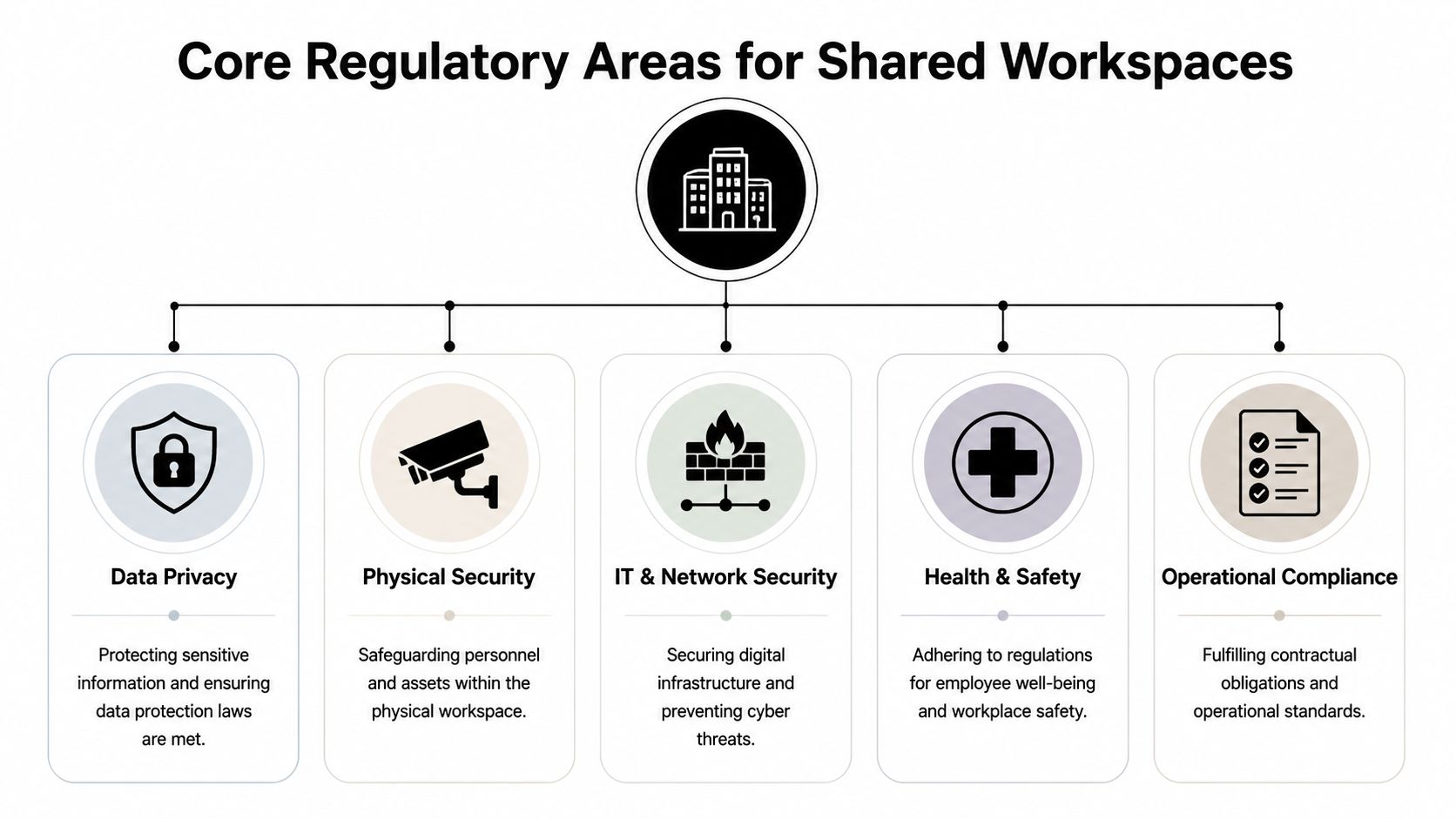
Data privacy and confidentiality
If your team handles customer records, employee data, support tickets, or client files, privacy rules apply to how that data is collected, accessed, stored, and shared. In a shared workspace, the main risk isn't just cyberattack. It's accidental exposure through shared devices, shared printers, open desks, weak role separation, or poor offboarding.
A useful reference point is this tekRESCUE data privacy regulation guide, which breaks down how managed infrastructure and compliance expectations intersect.
Privacy obligations also show up in your own public commitments, including your privacy policy. If your internal practice doesn't match what you disclose externally, you've created unnecessary legal and commercial risk.
Physical security
This area gets overlooked because it feels less technical. It shouldn't.
Who can enter the floor? Are visitors escorted? Can another tenant see whiteboards, paperwork, or unattended screens? Are badges disabled quickly when someone leaves? Physical control failures often become privacy failures.
For founders, physical security is where the provider's maturity matters most. If the front desk process is loose, if server or network equipment is accessible, or if cleaners and contractors move freely without protocol, your compliance posture is weaker than your policies suggest.
IT and network security
This is usually the first area buyers ask about and the one most often answered too vaguely.
A shared workspace needs clear network boundaries, endpoint management rules, administrator access limits, logging, and incident handling discipline. It also needs a clean answer to a basic question: can one tenant's issue spill into another tenant's environment? If no one can explain the separation, assume the answer isn't good enough.
Health and safety
Health and safety matters even when your business isn't regulated like a hospital or a bank. Startups still need a compliant workplace for staff, contractors, and visitors. In a shared environment, that includes emergency procedures, workstation suitability, cleanliness standards, and incident reporting.
This area also affects continuity. If the workspace can't manage a building issue cleanly, your ability to serve clients suffers.
Operational compliance
This is the least glamorous category and often the one that causes the most friction. It includes licensing, permits, recordkeeping, contractual obligations, and service-specific controls promised to customers.
A founder should ask one blunt question: “What have we promised clients that depends on this workspace operating a certain way?” That question usually uncovers the actual compliance scope faster than reading a regulation summary.
Practical Controls and Governance for BPO Tenants
Good compliance programs don't start with a policy binder. They start with controls that match actual risk in the environment your team uses every day.
In shared BPO settings, the strongest baseline is usually an ISO 27001-aligned information security management approach. According to Diligent's guidance for startup compliance programs, expert-level compliance in shared environments often means implementing ISO 27001-compliant ISMS practices, using controls such as multi-factor authentication and role-based access control, and automation tools can reduce audit preparation time for certifications like SOC 2 by up to 70%.

Technical controls that actually matter
Some controls look impressive in a client presentation but do very little in daily operations. Others prevent most of the mistakes that trigger incidents.
Focus on these first:
- MFA on every critical system. Shared offices increase the odds of credential misuse. MFA reduces the damage from exposed passwords.
- RBAC tied to job function. Don't give broad system access because the team is small. In a seat leasing setup, role separation matters more, not less.
- Managed endpoints. Laptops used in shared workspaces should follow one standard for updates, encryption, device lock settings, and approved software.
- Logging for access and changes. If you can't show who accessed a system or changed a setting, your controls are weaker than they look.
- Data segregation. Tenant data, client data, and internal admin data shouldn't sit in one loose pool.
Administrative controls founders skip
The technical layer gets attention because it feels concrete. Administrative controls decide whether those technical settings are used consistently.
A workable governance stack includes:
A responsibility matrix
Define what your company owns, what the workspace provider owns, and what is shared. Put it in writing.Joiner, mover, leaver procedures
Access failures often happen during hiring changes and departures. Build one repeatable process.Incident reporting rules
Staff should know exactly where to report a lost device, a suspicious email, an unescorted visitor, or an overheard disclosure.Vendor and subcontractor review
If the provider relies on third parties for IT, maintenance, or security, ask how those relationships are governed.
You can also review what's typically bundled into a managed setup through a provider's workspace inclusions and operational support model, because compliance gaps often hide inside “standard services” that no one examined closely.
The most common control failure in a shared office isn't a missing tool. It's an undefined owner.
Physical habits that support compliance
Physical controls don't need to be dramatic. They need to be enforced.
- Screen discipline matters in open-plan layouts.
- Clean desk rules reduce accidental exposure.
- Secure storage is still necessary if paper records exist at all.
- Visitor handling should be documented, not improvised.
- Badge and access review should happen regularly, especially after team changes.
If your controls depend on “people just being careful,” you don't have a control. You have a hope.
Your Compliance Implementation Roadmap and Checklist
Founders get stuck when compliance feels too large to start. The fix is to separate immediate decisions from later maturity work.

Day one essentials
Before your team settles in, review the lease and operating documents like a compliance buyer, not just a tenant.
Check for security responsibilities, data incident notification, audit support, visitor handling, equipment ownership, and limits on provider liability. If those topics are silent or vague, ask for clarification before you rely on the environment.
Also identify one internal owner. Not a committee. One person who coordinates compliance questions, evidence collection, and provider follow-up.
First 30 days
Use the first month to establish your minimum viable compliance program.
Mapping what data you handle, where it moves, what systems the team uses on site, and which access rights each role needs is essential. Keep it simple, but write it down. This is also the right point to turn on MFA everywhere, enforce device standards, and document onboarding and offboarding steps.
A practical training program helps here, especially one focused on what staff should do inside a shared environment. If you need a useful framework for building that discipline, this actionable guide to compliance success is a solid reference for turning policy into repeatable staff behavior.
Ongoing governance
Many startups fade at this stage. They set controls once and stop looking.
That doesn't work in a shared BPO environment because tenants change, teams grow, workflows shift, and client requirements evolve. Build a light review rhythm. Recheck access, review incidents, test whether your process still matches reality, and update your documentation when operations change.
Here's a practical checklist you can use internally.
| Phase | Action Item | Key Consideration |
|---|---|---|
| Day One | Review lease, service scope, and security clauses | Confirm who owns physical security, network controls, and breach notification |
| Day One | Name a compliance owner | One accountable person prevents gaps between ops, IT, and leadership |
| First 30 Days | Map regulated data and workflows | Identify customer, payment, employee, and sensitive records handled on site |
| First 30 Days | Implement MFA and role-based access | Access should follow job need, not convenience |
| First 30 Days | Document onboarding and offboarding | Shared environments need tighter account and badge discipline |
| First 30 Days | Verify provider evidence availability | Ask what logs, reports, and support they can provide for client reviews |
| Ongoing | Review access and incidents regularly | Small issues become audit findings when they repeat |
| Ongoing | Refresh staff training | Teams forget rules faster than founders expect |
| Ongoing | Reassess after client, location, or workflow changes | New services often create new compliance obligations |
Video walkthroughs can also help your internal owner explain the process to managers and team leads:
Real-World Scenarios in Seat Leasing Compliance
Founders usually understand compliance faster when they see where shortcuts fail.
Fintech startup handling card data
A fintech support team moves into a shared workspace and assumes the provider's managed internet is enough. The team starts taking payment-related calls and storing supporting details in connected systems. No one checks how network traffic is separated, and no one schedules the scans required for that environment.
That's the wrong approach.
For fintech tenants, PCI-DSS v4.0 requires quarterly vulnerability scans, and the risk of handling issues after an incident can be far higher. As Revenstrat's startup compliance guidance notes, proactively tracking these requirements can prevent costs that are 5x higher than dealing with a breach reactively. The right move is to verify segmentation, define who owns scan scheduling, and document evidence before the first client audit request arrives.
Healthcare support team working with sensitive records
A healthcare-focused BPO hires quickly and puts agents into a flexible office footprint. Staff can access sensitive records from desks near other tenants. Vendor contracts are generic. Risk review never happens because leadership assumes the provider's security measures cover the basics.
They don't.
For healthcare workflows, HIPAA requires risk assessments that identify exposure to protected health information. In practice, that means reviewing physical layout, screen privacy, access rights, vendor obligations, and incident reporting. If the provider supports any part of the environment affecting those records, that relationship should be documented accordingly.
Distributed team across multiple seats
A software company has staff rotating through different shared locations. Leadership focuses on productivity and ignores the administrative side. Different sites use different local practices for attendance, contractors, and equipment handling. Nothing is centralized.
This usually doesn't fail in one dramatic event. It fails in fragments. One site mishandles records. Another applies inconsistent worker rules. A client asks for evidence and gets three different answers.
A better model is to centralize standards, train site leads, and maintain one operating baseline across locations. If your team needs examples and broader operating context, reviewing practical articles on a provider's workspace operations blog can help surface issues early, but your company still needs its own written controls.
Shared space doesn't remove responsibility. It increases the number of places responsibility can get lost.
Choosing a Compliance-Ready Seat Leasing Partner
A seat leasing provider should reduce operational load without creating audit pain.
That means you should evaluate providers the way an experienced procurement or compliance lead would, even if your company is still small. Ask for specifics. Certifications matter, but responsiveness, documentation quality, and support during customer reviews matter just as much.
According to RegEd's 2025 to 2026 regulatory activity update, 58% of organizations conducted 4 or more audits in 2025, and 62% of compliance officers spent 1 to 7 hours weekly tracking regulatory changes. That tells you two things. Audits are frequent enough to shape normal operations, and manual tracking still consumes too much time.
Questions worth asking before you sign
Use a short, direct screening list:
What security or compliance documentation can you provide?
Ask for policies, control summaries, or evidence packages that support client reviews.How do you separate tenant environments?
Don't accept vague language about “secure infrastructure.” Ask how access, systems, and support boundaries are managed.What happens if there's an incident?
You need notification paths, named contacts, and a clear response process.Can you support customer audits and questionnaires?
Many providers look fine operationally but struggle when your enterprise client sends a detailed review.How are changes communicated?
Workspace changes, subcontractor changes, or network changes can affect your compliance obligations.
What a mature provider looks like
A compliance-ready provider doesn't just say “we're secure.” The provider can explain controls in plain language, produce evidence without delay, and work with your team when customer requirements become more detailed.
That operational maturity is a competitive advantage. It saves your team from turning every sales cycle into a scramble for missing documentation.
Frequently Asked Questions on Regulatory Adherence
If the provider has a data breach, am I still liable
Potentially, yes. If your company controls the data or promised clients specific protections, you may still have contractual, regulatory, or notification duties. Review your contracts, define responsibilities in writing, and make sure incident cooperation is documented before anything goes wrong.
Does general business insurance cover regulatory issues
Don't assume it does. Coverage often depends on the policy language, the type of incident, and the jurisdiction involved. Ask your broker specific questions about privacy events, cyber incidents, regulatory investigations, and third-party service provider failures.
How do I stay compliant if employees use seats in different countries
Treat each location as a business change that needs review. Check privacy obligations, employment rules, client contract terms, and data handling practices for that location. Standardize your internal controls so every site follows one approved operating model.
Can I rely on the provider's certifications alone
No. A provider's certifications can support your compliance posture, but they don't replace your own obligations. You still need internal policies, access governance, training, and documentation tied to your actual business activities.
What's the first thing to fix if nothing is documented
Start with ownership. Name one internal lead, map your regulated data, and document what the provider controls versus what your company controls. Most compliance cleanup gets easier once that line is clear.
If you want a flexible workspace partner that helps you operate efficiently while supporting stronger compliance discipline, explore Seat Leasing BPO. Their model is designed for companies that need ready-to-run office infrastructure, backend support, and room to scale without the drag of traditional office setup.