Growth starts to feel messy before it looks impressive. One month you're handling customer support, onboarding, vendor issues, and admin work with a small team. The next month, founders are answering operational questions at night, managers are patching broken processes in spreadsheets, and overhead starts climbing faster than revenue.
That's usually the moment businesses realize the problem isn't just workload. It's delivery design.
The models of service delivery you choose determine who does the work, where it happens, how fast you can scale, how much control you keep, and how much operational drag you accept. Pick the wrong model and you'll spend the next year hiring around bottlenecks. Pick the right one and the business gets room to grow without adding chaos.
Why Your Service Delivery Model Defines Your Growth
If your team feels stretched, that's not a staffing problem alone. It's usually a sign that your service delivery model no longer fits the business you're trying to build.

A lot of founders treat delivery structure as a back-office detail. That's a mistake. It decides whether you need long leases, full-time specialists, outsourced partners, shared infrastructure, or some mix of all of them. It also decides how quickly you can launch a new function when demand spikes.
That matters more now because the field is broader than most operators assume. Modern service delivery has expanded to nine contemporary models: Traditional In-Person, eCommerce, Subscription, On-Demand, Mobile Application, Franchise, Direct-to-Consumer, Virtual Service, and Hybrid, according to service delivery notes on contemporary models.
Why this becomes a growth bottleneck
Early-stage businesses often build operations by improvisation. One person handles support. Another person figures out IT. A freelancer patches design work. Someone on the leadership team becomes the default escalation path for everything nobody owns.
That works for a while. Then it doesn't.
You don't need a more heroic team. You need a model that matches your stage.
Practical rule: If founders are repeatedly pulled into routine delivery problems, the operating model is too dependent on individuals and not structured enough to scale.
The real decision
When you're choosing among models of service delivery, you're really deciding three things:
- Where you want control: Keep more in-house if the function is core to customer experience or compliance.
- Where you need speed: Use more flexible delivery if the business needs capacity fast.
- Where you can't afford waste: Shift fixed costs into variable costs when preserving cash matters more than owning every layer.
Growing businesses don't fail because they lack options. They fail because they pick a delivery structure built for a different size, budget, or pace of growth.
Understanding the Core Service Delivery Models
Most discussions of models of service delivery are too abstract. Let's make them practical.
The simplest way to think about each model is this: who owns the work, who owns the infrastructure, and who carries the operational burden.
In-house delivery
This is the classic model. You hire your own people, manage your own tools, run your own processes, and absorb the full cost of operations.
It's like cooking in your own kitchen. You control ingredients, timing, quality, and standards. You also buy the equipment, pay the rent, clean up the mess, and fix the stove when it breaks.
Use it when the function is tightly tied to your brand, product knowledge, or regulated workflows.
Outsourcing and BPO
Business process outsourcing shifts execution to an external provider. That provider may handle customer support, back-office work, IT support, finance operations, or specialized administrative functions.
This is closer to ordering from a restaurant. You're not building the kitchen. You're paying for a service outcome.
The trade-off is obvious. You reduce internal burden, but you need stronger vendor management and tighter expectations. In BPO settings, that usually means formal performance standards and clearly documented handoffs. If you want a grounded example of how providers structure outsourced technical support, this overview of comprehensive IT maintenance for Austin businesses is useful because it shows what businesses often expect from a managed external partner rather than an internal team.
Managed services
Managed services sit between pure outsourcing and full internal ownership. You still set business priorities, but a specialist provider manages a defined function on an ongoing basis.
Think of it as a meal-kit subscription rather than restaurant takeout. Someone else standardizes and supports the process, but you still shape how it fits your business.
This works well for IT, cybersecurity, help desk operations, and infrastructure support, where consistency matters more than custom daily intervention.
Public-private and partnership models
Some businesses operate through partnerships where responsibilities are split between internal teams and external operators. In some sectors, this looks like formal public-private collaboration. In commercial environments, it often looks like strategic co-delivery.
This model makes sense when no single organization wants to carry the full delivery load alone. It can improve access to capabilities that would be expensive or slow to build internally. It also introduces complexity because accountability can blur fast if roles aren't explicit.
Hybrid delivery
Hybrid models combine multiple delivery channels rather than forcing one model onto every function. That might mean keeping strategy and quality oversight in-house while using external capacity for support, infrastructure, or overflow work.
This is the model I recommend most often for startups and SMBs because it reflects operational reality. Not everything deserves the same level of ownership.
Research indicates that organizations using hybrid delivery models integrating onshore, nearshore, and offshore components can achieve substantial financial improvements through strategic resource allocation, as noted in this overview of hybrid service delivery economics.
The best delivery model isn't the one with the most control. It's the one that protects control where it matters and removes burden where it doesn't.
A simple way to classify your options
Use this quick lens when you're evaluating choices:
- Own everything internally if the work is core, sensitive, and hard to standardize.
- Outsource execution if the work is repeatable and performance can be measured cleanly.
- Use managed services if the function needs stable oversight but not daily internal management.
- Use hybrid structures if your business is growing fast and different functions need different levels of ownership.
If you want a broader view of how operators think about flexible service structures, the articles in this service delivery blog library are worth browsing for practical context.
A Head-to-Head Analysis of Your Options
Most SMBs don't need theory. They need a clear trade-off table.
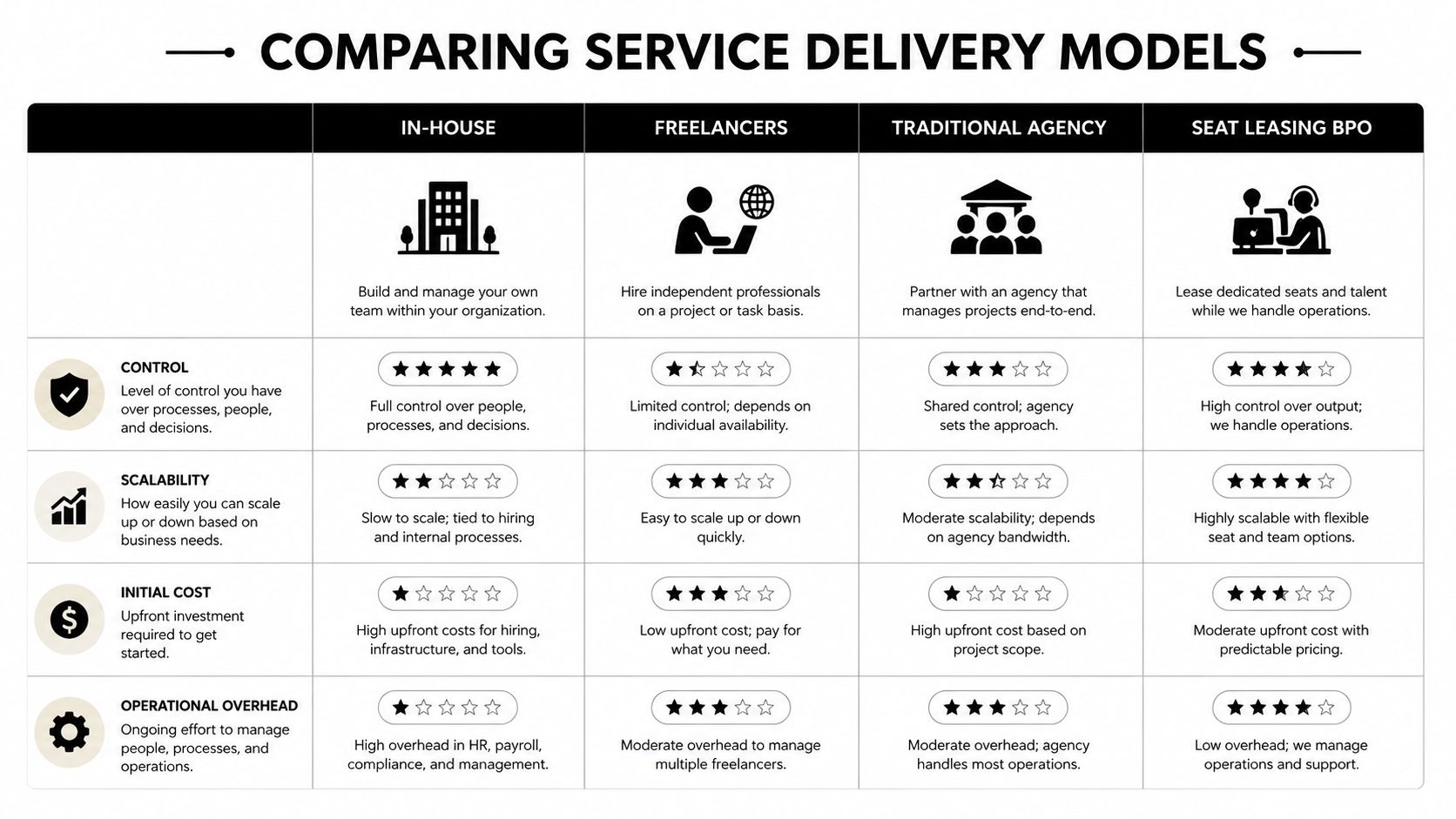
Service Delivery Model Comparison
| Model | Cost Structure | Control Level | Scalability | Best For |
|---|---|---|---|---|
| In-house | Higher fixed cost, internal staffing and tools | Highest | Slower | Core operations, proprietary processes, sensitive work |
| Freelancers | Variable cost by project or task | Moderate to low | Flexible but fragmented | Short-term needs, specialist gaps, early-stage execution |
| Traditional Agency | Contracted external spend | Moderate | Moderate | Campaign work, specialized delivery, defined scopes |
| Managed Services | Recurring operating expense | Moderate to high within scope | Strong for stable functions | IT, support, infrastructure, ongoing technical operations |
| Seat Leasing BPO | Shared operational cost with bundled infrastructure and support | Moderate with defined controls | High | Fast-growing teams needing flexible capacity and managed setup |
| Hybrid | Mixed fixed and variable cost | Selective control | High | SMBs balancing speed, cost discipline, and strategic oversight |
What the table actually means
In-house gives you the cleanest authority chain. It also gives you hiring delays, management overhead, systems procurement, and less flexibility when demand changes.
Freelancers are fast but inconsistent at scale. You can solve a short-term talent gap this way, but you can't build dependable operations on a patchwork of individual contractors unless someone internally owns coordination full time.
Agencies can work when the output is bounded. They're less useful when your business needs operational continuity rather than campaign-based deliverables.
Where SMBs usually get stuck
There's a research gap here. Existing research often gives minimal guidance on cost-effectiveness comparisons for small businesses and startups, even though evidence from other sectors shows that multi-contact interventions were 97% more effective than minimal ones, according to this review discussing the evidence gap for SMEs. That doesn't hand you a direct workspace decision, but it does support a practical point. Lighter-touch delivery isn't automatically smarter just because it looks cheaper upfront.
When a model saves cash but creates daily coordination friction, it isn't efficient. It's just underbuilt.
My blunt view
For most growing businesses, the bad choice is committing too early to a heavy in-house structure or staying too long with scattered freelancers. Both create drag for different reasons.
A better path is usually one of these:
- Managed services when the function is technical and standardized
- Hybrid delivery when some control must stay inside
- Seat leasing BPO when speed, predictable operations, and lower infrastructure burden matter more than owning every asset
That isn't ideology. It's an operating decision based on cash discipline and execution speed.
A Deep Dive Into the Seat Leasing BPO Model
Seat leasing BPO works because it solves a problem most startups and SMBs hit at the same time. They need operational capacity quickly, but they don't want the capital burden and management sprawl that come with building everything themselves.

This is a hybrid operating model in essence. You get physical workspace capacity plus backend support layers that would otherwise force you into separate vendor relationships, internal hires, and long setup cycles. For a growing company, that changes the math fast.
The appeal isn't just cheaper office access. It's operational consolidation. Instead of stitching together facilities, connectivity, IT support, and day-to-day office readiness on your own, you use an environment designed to carry those burdens for you.
Why the model is efficient
The strongest operational logic behind seat leasing BPO is the tiered service delivery architecture. In this structure, Tier 1 handles basic requests, Tier 2 handles more specialized issues, and Tier 3 handles exceptions or center-of-expertise problems. The evidence-based principle is direct: the greatest efficiency comes from driving work to the lowest possible tier, which is why this framework is so valuable in seat leasing BPO operations, according to ScottMadden's service delivery model paper.
That matters because it reduces the need to involve expensive specialists in routine issues.
What this looks like in practice
For a business using this model, the workflow is cleaner than people expect:
- Routine requests such as onboarding, seat allocation, or standard billing questions get handled at the lowest-cost layer.
- Technical issues like connectivity, cybersecurity, or infrastructure support move to specialist teams.
- Complex exceptions escalate only when they require policy interpretation or expert intervention.
That's how the model protects efficiency without pretending every request deserves the same level of labor.
A quick overview helps if you want to visualize how this type of setup is packaged for clients in a real operating environment:
Where it fits best
Seat leasing BPO is strongest when your business needs to scale a team, launch a support function, or establish a delivery footprint without locking itself into a traditional office buildout.
It's especially useful for:
- Support-heavy teams that need seats, systems, and predictable environments fast
- SMBs entering a new market without wanting full infrastructure ownership
- Companies with uneven growth that need flexibility more than permanence
The model can also be compelling because forward-looking providers frame it around substantial cost efficiency. In that context, the model has been tied to up to 80% cost savings compared to traditional arrangements, as described in this breakdown of service delivery model economics.
That doesn't mean it's right for every function. If the work is highly proprietary or culturally sensitive, keep more of it in-house. But if your pain is operational overhead, seat leasing BPO is one of the most practical models of service delivery available.
How to Choose the Right Service Delivery Model
Most businesses don't need more options. They need a filter.
The right choice comes from answering a few hard questions accurately. Not aspirationally. Not based on how you think a bigger company would operate. Based on what your business can support right now.

Start with the function, not the vendor
Ask this first: Is this function core to your competitive advantage?
If the answer is yes, you should lean toward internal ownership or a tightly managed hybrid model. If the answer is no, stop romanticizing control. You probably need efficiency and reliability more than ownership.
Then ask whether the work is standardized. Repeatable processes are easier to outsource or place under managed service structures. Messy, evolving, judgment-heavy work usually needs stronger internal oversight.
Use this decision checklist
What happens if this function fails for one day
If failure creates direct customer harm, legal exposure, or major revenue disruption, you need clear escalation paths and stronger controls.Do you need to scale headcount quickly
If growth could outpace internal hiring, flexible models make more sense than building fixed internal capacity too early.Is your biggest constraint cash or coordination
If cash is tight, avoid heavy upfront infrastructure commitments. If coordination is already a mess, don't add a fragmented vendor stack.Can you define success in concrete terms
If you can't describe response expectations, resolution standards, and ownership boundaries, you're not ready to outsource the function well.
Don't skip the SLA test
Many businesses become careless at this stage. In BPO environments, formal Service Level Agreements define response time, resolution time, and availability, and they form the contractual foundation between providers and clients, as explained in this service delivery overview focused on SLAs.
If a provider can't translate its promise into an SLA, you don't have a delivery model. You have marketing.
Decision filter: If you can't measure the service, you can't manage the provider.
A practical matching guide
Here's the short version:
| If your business needs | Best-fit direction |
|---|---|
| Tight control over core execution | In-house |
| Short-term specialist help | Freelancers |
| Ongoing technical oversight | Managed services |
| Fast deployment with flexible operational support | Seat leasing BPO |
| Balance of control and cost discipline | Hybrid |
Don't choose based on what sounds refined. Choose based on what removes friction without creating a new management problem.
Service Delivery Models in Action
A bootstrapped SaaS company needs a customer support team running quickly. It doesn't want to sign a traditional office lease, source infrastructure, and supervise every support function internally while the product is still changing. That company is a strong fit for a flexible BPO setup tied to managed workspace support. The point isn't prestige. It's speed and reduced operational burden.
A small law firm has different needs. Client confidentiality, tight process control, and specialized workflows matter more than rapid capacity expansion. That firm should keep most delivery in-house and use outside partners sparingly for non-core support.
Three common fits
- An e-commerce brand with seasonal swings will often benefit from hybrid delivery. Keep brand and escalation ownership internal, but add external capacity when ticket volume spikes.
- A professional services firm with scattered vendor headaches is usually better served by managed services for IT and infrastructure.
- A growing operations team opening in a business district may prefer an environment like Building 24 in Cebu IT Park if location readiness and setup speed are the primary constraints.
Good operators don't ask, “Which model is best?” They ask, “Which model fits this function, at this stage, with this level of risk?”
That question leads to better decisions almost every time.
Building a Resilient and Scalable Operation
The smartest companies don't treat service delivery as a fixed identity. They treat it as an operating choice that should change when the business changes.
That is the primary takeaway from comparing models of service delivery. In-house works when control is the priority. Managed services work when stable expertise matters more than internal ownership. Hybrid models work when you need selective control and better cost discipline. Flexible environments such as seat leasing can be the right answer when speed, infrastructure support, and scalability matter most.
What resilient operators do differently
They review delivery choices with the same seriousness they apply to hiring, pricing, and product strategy.
They also look for operational patterns that transfer well across contexts. If you want an example of how shared services logic can reduce friction across regions and teams, this case on streamlining global support workflows is worth reading for the organizational design lessons alone.
The standard to aim for
A resilient model does three things:
- Protects the core so your differentiators stay under the right control
- Absorbs growth without forcing major reinvention every quarter
- Keeps overhead honest so expansion doesn't erode margins
If your current setup can't do those three things, it's time to redesign it.
Frequently Asked Questions About Service Delivery
Can I combine different models of service delivery
Yes, and you probably should. Most growing businesses operate best with a hybrid structure. Keep core work close, outsource standardized functions, and use managed support where specialist maintenance matters.
How do I move from in-house to outsourced delivery without disruption
Start with one function that has clear workflows and measurable outputs. Document the process, define the SLA, set escalation rules, and run a controlled transition rather than a full switch all at once.
What hidden costs should I watch for in a BPO contract
Watch for vague scope, unclear escalation ownership, change request fees, and weak service definitions. If response time, resolution time, and availability aren't written clearly, the contract leaves too much room for dispute.
If you're weighing flexible operating options and want a practical next step, explore Seat Leasing BPO. It's a strong fit for businesses that want to scale without carrying the full burden of traditional office infrastructure, backend support setup, and long-term lease commitments.