Costs rarely blow up all at once. They creep. A few extra software seats. A lease that made sense two years ago. A full-time hire doing work that only needs ten hours a week. Three vendors billing for overlapping services. By the time you feel the pressure in cash flow, the problem usually isn't one bad decision. It's a stack of unattended ones.
That's why most advice on how to reduce business expenses misses the mark. It focuses on generic trimming instead of sequence. In practice, sequence matters more than slogans. You start with the biggest fixed costs, separate productive spend from dead weight, and prioritize cuts that improve cash flow fast. Then you fund slower efficiency moves from the savings.
A disciplined business doesn't cut everything. It cuts what no longer earns its keep.
Your Starting Point The Ruthless Expense Audit
Rising costs create a dangerous reflex. Owners start asking every department to “spend less” without first identifying where the money goes. That usually leads to small cuts in visible categories while the largest leaks stay untouched.
Start with a 30-day expense audit. Pull every recurring payment, every lease obligation, every payroll line, every contractor invoice, every software subscription, and every vendor contract into one working sheet. If you're a smaller operation, a clean version of this process looks a lot like effective expense management for self-employed, especially if spending is still mixed across cards, reimbursements, and ad hoc purchases.

Sort costs by economic value
Don't start with accounting labels alone. Start with decision labels.
Use these three buckets:
- Good costs. Spending that directly supports revenue, delivery capacity, retention, or speed. Core sales tools, customer support capacity, and production systems often belong here.
- Questionable costs. Spending that may be useful but hasn't been tested recently. Layered software, underused agencies, oversized office space, and redundant approvals often land here.
- Bad costs. Pure overhead with no clear return. Duplicate tools, idle seats, vanity subscriptions, and processes kept alive because nobody owns the clean-up.
That distinction matters. Cost reduction done well preserves output. Cost cutting done badly starves it.
Practical rule: If a cost disappeared tomorrow, would revenue slow, delivery fail, or customers notice? If the answer is no, it belongs near the top of your review list.
Find the top three cash leaks
Most businesses don't need a forensic project before they act. They need to identify the top three categories where money leaves fastest and value returns slowest. In growing firms, that's usually some version of real estate, payroll structure, and technology sprawl.
A useful shortcut is to review six to twelve months of spending so you can see patterns instead of one-off noise. Then rank expenses by two filters: total spend and reversibility. The categories that are both large and fixable deserve attention first.
Here's a simple audit lens:
| Audit question | What you're looking for |
|---|---|
| Which costs recur monthly with little scrutiny? | Auto-renewing software, service retainers, telecom, workspace overhead |
| Which costs are fixed but underutilized? | Excess office space, idle licenses, full-time roles with part-time demand |
| Which costs create admin drag? | Too many vendors, manual approvals, duplicate systems |
| Which costs improve speed or margin? | Core systems worth protecting |
During downturns, disciplined operators don't freeze. They reallocate. A McKinsey survey found that 67% of senior executives increased investments in automation to control costs, and historical data cited there shows adopters reduced labor by 20% to 30% on average according to CNB's summary of cost reduction strategies.
That doesn't mean you automate first. It means you audit first so you know what deserves automation and what should be removed.
If you want an external benchmark for what mature operators review regularly, spend a few minutes with the Seat Leasing BPO blog. The useful lesson isn't the format. It's the operating mindset: infrastructure and overhead should earn their place every month.
Slash Real Estate Overhead Immediately
Real estate is one of the most expensive ways to look stable while hurting cash flow.
A traditional office ties up money in rent, deposits, fit-out, furniture, internet, electricity, maintenance, security, and IT setup before the space does anything productive. That model can work when headcount is stable and space utilization is high. Many growing businesses don't have either.
The problem with slow real estate savings
Lease renegotiation sounds sensible. Sometimes it works. But it's slow, and speed matters when margins are thin. Many cost-reduction plans also treat automation and office strategy as if they live on the same timeline. They don't.
According to CBIZ on cutting costs without sacrificing growth, automation can take 12 to 24 months to show returns, while managed office solutions provide immediate overhead relief and cash flow flexibility. That difference is operationally important. A business under pressure may not have the luxury of waiting for long-payback savings.
When a company needs relief now, the right question isn't “what saves the most eventually?” It's “what improves cash flow this month without breaking operations?”
What works faster than renegotiation
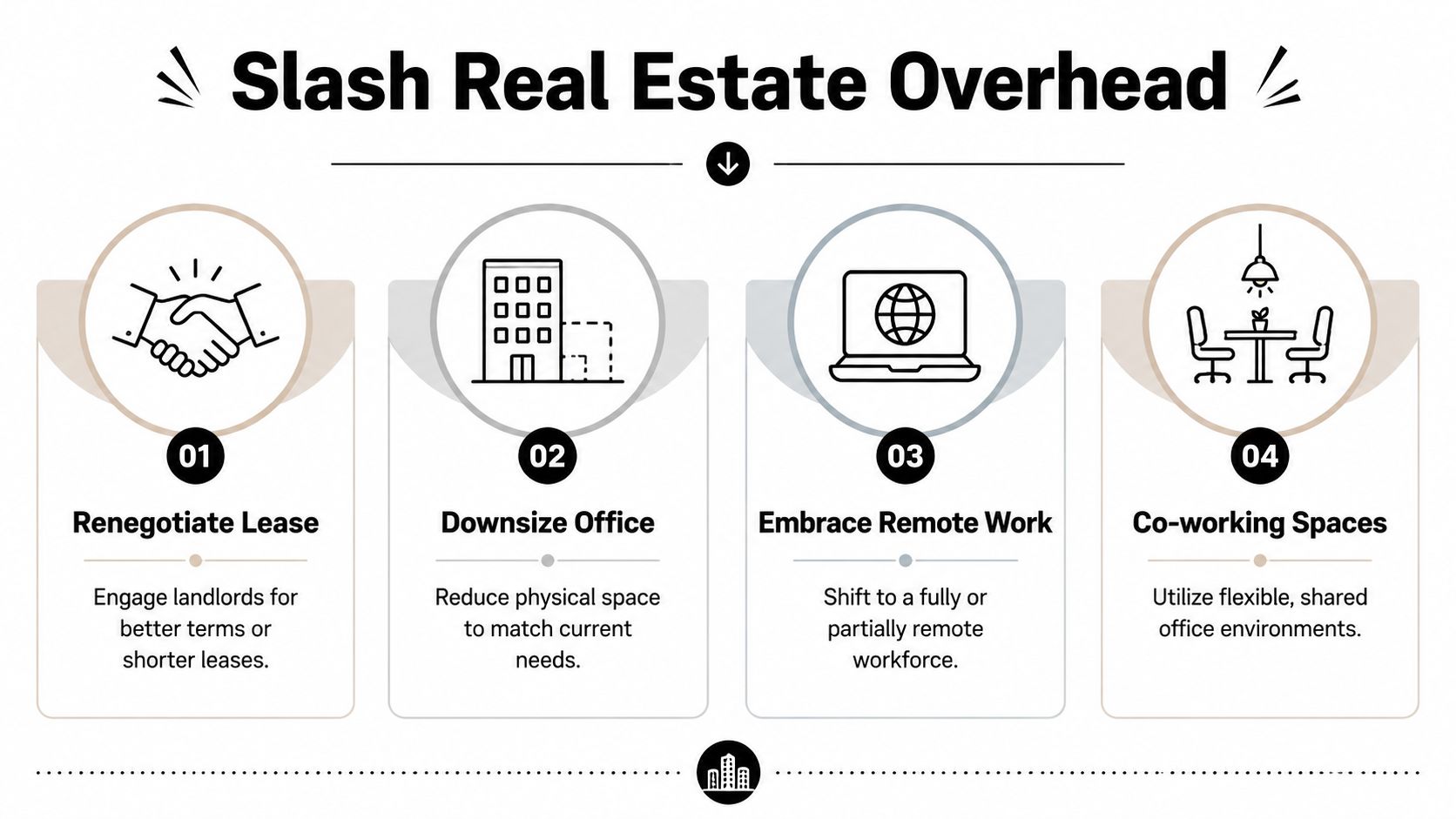
There are four realistic moves most businesses can make:
- Renegotiate the lease if you still need the location and the landlord is motivated.
- Downsize the footprint if utilization no longer justifies the square footage.
- Shift part of the team remote if work can be delivered without a fixed desk for every employee.
- Use managed workspace or seat leasing when you need operating capacity without carrying infrastructure yourself.
The fourth option is the one many companies overlook because it doesn't fit the old office ownership mindset. But for a growing team, it changes the cost structure from fixed and front-loaded to flexible and operational.
Traditional office versus seat leasing
Here's the practical comparison.
| Cost Breakdown: Traditional Office vs. Seat Leasing BPO (Per Employee/Month) | Traditional Office | Seat Leasing BPO |
|---|---|---|
| Rent allocation | Paid directly by tenant | Included in managed seat cost |
| Fit-out and furniture | Business funds setup | Typically bundled into workspace package |
| Internet and utilities | Separate recurring bills | Typically bundled |
| IT infrastructure | Internal setup and maintenance | Often managed as part of service |
| Security and facility management | Separate cost center | Usually included |
| Contract flexibility | Longer commitment | More flexible terms |
| Speed to operational readiness | Slower setup | Faster deployment |
The point isn't that every traditional office is wrong. The point is that many companies are still paying for permanence when what they need is capacity.
The business case becomes stronger when you remove capital spending from the equation. The publisher's operating model is built around that trade-off. Seat Leasing BPO's Building 24 workspace is an example of a managed setup designed to reduce the need for separate infrastructure, utilities, and office support. In the publisher background provided for this piece, that model can deliver up to 80% cost savings compared with traditional office arrangements.
Decide based on cash flow, not preference
Owners often defend office costs emotionally. “We need our own place.” Maybe. But many businesses really need one of two things: somewhere for a delivery team to work now, or a lighter overhead base while demand catches up.
Use this decision filter:
- Keep a traditional office when utilization is consistently high and the space is a real operating asset.
- Shrink it when teams are hybrid and empty desks outnumber active ones.
- Replace it with a managed model when preserving cash matters more than controlling every facility detail.
If you're serious about how to reduce business expenses, real estate is one of the few categories where one decision can reshape the P&L immediately.
Optimize Your Staffing Model for Flexibility
Payroll is usually the largest expense, but the goal isn't cheap labor. The goal is the right labor structure.
A lot of businesses carry fixed salary costs for work that isn't consistently full-time, then wonder why margins compress. The issue usually isn't talent quality. It's role design.

Keep core roles in house and flex the rest
Protect the work that defines your edge. That usually includes revenue ownership, customer relationships, product judgment, and high-trust operational oversight.
Everything else deserves a harder look. Functions like bookkeeping support, overflow customer service, after-hours coverage, recruitment coordination, basic design production, and technical maintenance often don't need to sit inside a full-time payroll structure year-round.
A practical staffing model usually has three layers:
- Core employees for work tied directly to strategy, quality, and accountability
- Specialists on demand for projects requiring narrow expertise
- Outsourced support for repeatable non-core functions
That mix lowers fixed commitments without forcing the business to operate understaffed.
What to outsource and what to keep
Use this quick screen before moving a function outside:
| Function type | Better kept internal | Often suitable for outsourcing |
|---|---|---|
| Revenue-critical work | Yes | Rarely |
| Sensitive strategic planning | Yes | Rarely |
| Standardized support tasks | Sometimes | Often |
| Work with uneven demand | Sometimes | Often |
| Specialist technical tasks | Sometimes | Often |
The mistake is outsourcing core judgment. The other mistake is keeping every support function internal because “that's how we've always done it.”
If your team is debating the boundary, this comprehensive guide on staffing gives a useful framework for deciding what belongs in-house versus outside partners.
Build variable capacity on purpose
The healthiest staffing models absorb spikes without forcing permanent cost increases. That means designing capacity before you need it.
For example:
- A finance lead can stay internal while transaction processing moves to external support.
- A small operations team can keep ownership while contractors handle implementation bursts.
- A sales organization can keep account executives in-house while outsourced teams support scheduling, research, or back-office admin.
Later in the workflow, it helps to see how teams think about this in live operations:
A blended model also pairs naturally with flexible workspace support. If you need distributed staffing plus managed infrastructure, Seat Leasing BPO sits in that middle ground between hiring everything internally and carrying the full burden of your own office and support stack.
The smartest labor savings usually come from changing the mix of labor, not from squeezing the people doing the work.
Curb Runaway IT and Software Spending
Software spending expands because no single subscription looks fatal on its own. Then finance adds them up and finds a stack of tools with overlapping features, inactive users, and workflows that still require manual effort anyway.
This category deserves more rigor because it contains both obvious waste and genuine efficiency gains.

Start with a SaaS cleanout
Pull a full list of subscriptions by card statement, AP ledger, and department reimbursement records. Then review each tool against four questions:
- Is it being used?
- Does another tool already do the same job?
- Is the company paying for more seats than active users need?
- Would a lower-tier plan support the same outcome?
You'll usually find three classes of waste quickly: shelfware, duplicate products, and oversized plans. Support software is especially prone to this. If your team uses Zendesk or similar platforms, strategies for Zendesk license optimization are a good example of the kind of review discipline most companies should apply across their stack.
Automate where labor is repetitive
After the cleanout, move to process automation, allowing IT to stop being just a cost line and start becoming a margin tool.
According to BDC guidance on reducing business expenses, automating backend processes like seat allocation and IT provisioning can reduce labor and overhead by 20% to 40%. The same source notes that using RPA for contract signing can save 70% of administrative time, and cloud migration can reduce hardware capital expenditure by 50%.
Those are meaningful gains, but only when the process is stable enough to automate. Don't automate chaos. Standardize first.
Operating principle: Remove unnecessary steps before you digitize them. Otherwise you just make bad process faster.
Move infrastructure from ownership to consumption
On-premise hardware often lingers because nobody wants the migration project. But financially, owned infrastructure has a habit of creating hidden costs through maintenance, replacement cycles, downtime handling, and specialist support.
Cloud and SaaS models shift that spending pattern. You give up some control, but you gain flexibility and cleaner cost visibility. For smaller businesses and shared work environments, that trade usually makes sense.
Focus on these areas first:
- Billing and invoicing workflows that still rely on manual handoffs
- Provisioning and access management for new users and role changes
- Contract routing and approvals that live in inboxes
- Reporting and spend visibility across finance and operations
Treat every tool as either a platform or a passenger
Some systems are foundational. ERP, accounting, support, CRM, identity management. Others are passengers riding on top of them. The passengers should justify their fare.
A lean IT budget follows a simple hierarchy:
| Category | Keep and optimize | Question aggressively |
|---|---|---|
| Core system of record | Yes | No |
| Compliance or security essential | Yes | No |
| Nice-to-have productivity layer | Maybe | Yes |
| Duplicate analytics or reporting tool | Rarely | Yes |
That's how to reduce business expenses in technology without damaging the business. Cut software clutter. Fund automation that removes labor friction. Shift infrastructure toward variable cost where practical.
Master Procurement and Supplier Negotiations
Procurement waste usually hides inside habit. The company orders from the same vendors, pays the same terms, accepts annual increases, and never tests the market because operations are busy.
That's expensive complacency.
Consolidate first, negotiate second
Negotiation works better when you have a stronger position. Consolidation creates an advantage.
According to Brex on cost reduction strategies, businesses that consolidate with fewer vendors often cut procurement costs by 15% to 20%, while also simplifying invoicing and improving service levels.
That result makes sense operationally. Fewer vendors mean cleaner purchasing controls, less administrative overhead, and more volume in the relationships that remain.
Start with categories where multiple vendors provide similar inputs: office supplies, software resellers, packaging, maintenance, recruiting services, and routine professional support.
A simple supplier review process
Use a three-pass review:
- Pass one, list every supplier. Include annual spend, contract term, renewal date, payment terms, and owner.
- Pass two, group overlaps. If three vendors solve the same problem, you likely have bargaining power or duplication.
- Pass three, rank by savings potential. Prioritize large spend, easy substitution, and poor service history.
Then decide which suppliers fall into these groups:
| Supplier type | Action |
|---|---|
| Strategic and high-performing | Protect relationship, negotiate on terms not just price |
| Useful but replaceable | Bid competitively |
| Low-value and administratively heavy | Consolidate or remove |
Use a negotiation script that respects the relationship
Good procurement leaders don't bluff. They prepare.
A practical script sounds like this:
We're reviewing our spend across this category and narrowing the number of suppliers we use. We'd like to keep working with partners who can support sharper pricing, better payment terms, or bundled service. If we increased share of wallet with you, what could you do on rate, invoicing simplicity, and support response?
That opening does three things. It signals seriousness, offers upside, and keeps the conversation commercial instead of adversarial.
If the vendor won't move on price, ask for something else that matters:
- Extended payment terms
- Bundled services
- Volume discounts
- Waived implementation or service fees
- Better support commitments
- Simplified billing
Price matters. So do terms, invoice clarity, responsiveness, and the cost your team carries when a vendor is hard to manage.
The biggest mistake here is negotiating line items while ignoring total supplier complexity. Sometimes the cheaper vendor costs more because your staff spends more time fixing their misses.
Building a Leaner More Resilient Business
A business gets leaner in two ways. It spends less. It also becomes harder to destabilize.
That second point matters more. A company with lower fixed obligations, cleaner systems, and flexible capacity can handle volatility better than one with the same revenue but a bloated cost base.
The operating model that holds up
The strongest cost discipline comes from repeating a few habits:
- Audit regularly so recurring spend never becomes invisible
- Favor flexible infrastructure over capital-heavy commitments when demand is uncertain
- Design staffing in layers so fixed payroll reflects core work, not every possible task
- Use automation selectively where repetition is high and process is stable
- Treat procurement as a margin lever instead of a clerical function
None of this is glamorous. It's effective.
What works and what usually fails
The companies that improve margins without damaging delivery tend to make structural changes. They resize offices, simplify vendors, remove duplicate software, and redesign workflow. The ones that struggle usually make symbolic cuts. They freeze small discretionary items while leaving the largest commitments untouched.
Here's the practical distinction:
| Weak cost cutting | Strong cost management |
|---|---|
| Across-the-board trimming | Prioritized cuts by size and speed |
| Protecting legacy overhead | Challenging every fixed commitment |
| Cutting tools without process redesign | Simplifying process first |
| Keeping every function full-time | Matching labor model to demand |
| Negotiating price only | Negotiating total commercial value |
Cash flow improves when decisions get faster
One underappreciated benefit of leaner operations is decision speed. Fewer vendors mean fewer approvals. Simpler systems mean less administrative drag. Flexible workspace and staffing models reduce the need for long planning cycles before action.
That's why how to reduce business expenses isn't really a budgeting question alone. It's an operating design question.
A resilient business doesn't chase low cost for its own sake. It builds a cost structure that gives management room to move.
If you're under pressure right now, start where savings are largest and fastest. Don't begin with symbolic austerity. Begin with fixed overhead that no longer matches how the business runs.
If your team needs immediate overhead relief without taking on a traditional office buildout, Seat Leasing BPO is worth evaluating as a practical operating model. It gives businesses access to managed workspace, IT infrastructure, and essential facility support in a way that can reduce upfront capital strain and improve flexibility while the company focuses on revenue and delivery.