Grand View Research projects the global business process outsourcing market will keep expanding through the end of the decade, but market size is the least useful signal when choosing an offshore partner. The key question is structural fit. Companies that offshore outsource well usually start by picking the right operating model for the work, the compliance load, and the amount of control they want to keep.
That is the angle for this guide. It is not a generic vendor directory. It is a practical look at seven offshoring models, from full-service BPO firms and enterprise transformation providers to startup-focused operators and the seat leasing offshore team model at Seat Leasing BPO, which gives companies infrastructure without handing over day-to-day management.
I have seen the same mistake across support, back-office, and technical functions. Teams compare logos, rates, and country locations before they define who owns hiring, QA, security controls, workforce management, and process design. Then the relationship gets strained for predictable reasons. A large managed provider can bring coverage, reporting discipline, and procurement maturity. It can also add layers, slow decision-making, and push smaller accounts to the back of the queue. A lighter partner may move faster and give operators more control, but it often requires stronger internal management.
Start with the work, then match it to the model. High-volume customer service, regulated workflows, rapid headcount growth, and build-operate-control setups each call for something different. The seven companies in this article represent those differences clearly, which makes them useful not just as providers to consider, but as reference points for how offshore outsourcing is structured.
1. Seat Leasing BPO
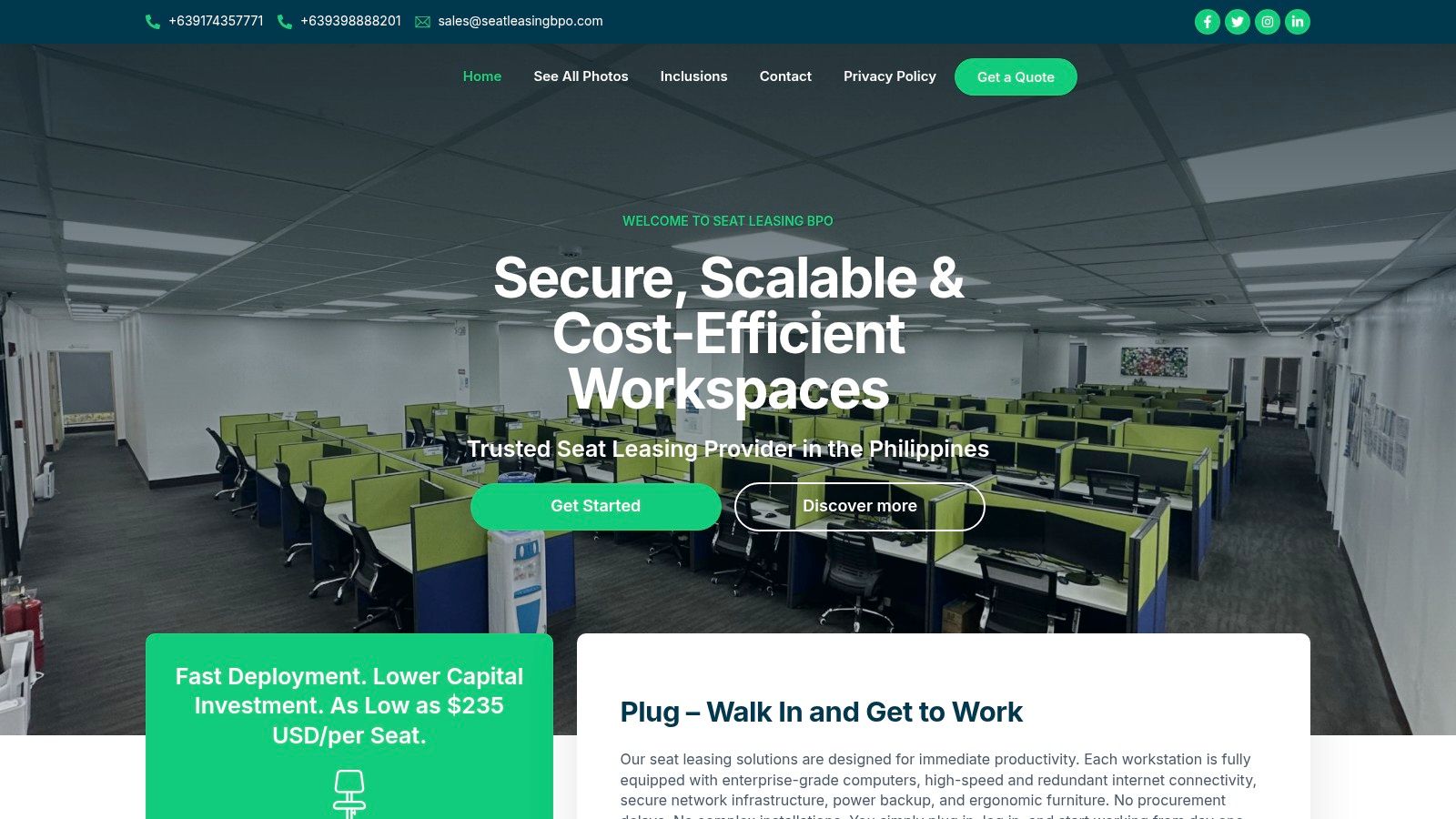
Seat Leasing BPO is the most interesting option on this list if you want offshore cost advantages without surrendering operational control. Instead of handing your customer support or back office to a giant managed service provider, you lease ready-to-run seats, infrastructure, and support, then build your own team on top of that foundation.
That model solves a problem most outsourcing guides barely touch. Offshore operations often come with hidden infrastructure and compliance burden, and one gap analysis notes that companies frequently underestimate the extra overhead required to manage offshore operations beyond headcount savings (Scalearmy analysis of offshore outsourcing gaps). In my experience, it's these overlooked aspects that often surprise first-time offshore teams. The labor math looks great. Then IT controls, redundancy, connectivity, access policy, and local operations start piling up.
Seat Leasing BPO positions itself as the shortcut around that mess. Its offer is straightforward: plug-and-play workspace, managed IT, cybersecurity support, power, and connectivity, with pricing that starts at about $235 per seat and claimed savings of up to 80% versus traditional offices, according to Seat Leasing BPO.
Why this model works
The appeal isn’t just cost. It’s speed and control together. If you already know how to hire, train, and manage your people, this structure lets you preserve your own culture, QA standards, and workflows instead of adapting to a provider’s operating model.
A few practical strengths stand out:
- Fast start-up path: Ready-to-use seats and enterprise hardware reduce the time between contract and go-live.
- Business continuity built in: The setup includes 1G network infrastructure, redundant UPS, diesel generator backup, and multi-ISP internet.
- Security posture for serious buyers: Seat Leasing BPO lists a dedicated cyber team, next-generation firewalls, IDS/IPS, quarterly vulnerability scanning, role-based access, plus ISO 27001:2022, SOC 2 Type I and II, and ISO 9001:2015.
- Better fit for dedicated teams: This works especially well when you don’t want shared-agent service and you do want your own managers, playbooks, and reporting cadence.
Practical rule: Choose seat leasing when your process is your competitive edge, and choose full-service BPO when process management is the burden you want to remove.
Where buyers should push harder
This isn’t a perfect fit for every buyer. The geographic concentration in the Philippines can be a major advantage if that location works for your language, shift, and hiring requirements. But firms that need multi-country redundancy or region-specific support should verify how much flexibility exists.
I’d also push for detail before signing. Ask for uptime commitments, incident response terms, onboarding timelines, minimum seat commitments, and exactly what is and isn’t included in the monthly fee. Public testimonials and deep SLA detail appear limited, so due diligence matters more here than in a giant public enterprise contract.
For founders, BPO operators, and corporate teams that want offshore infrastructure without building a facility from scratch, Seat Leasing BPO can be a smart middle path. It’s one of the clearest examples of a “build your own team, don’t build your own office” model.
Website: Seat Leasing BPO
2. Concentrix
Concentrix represents a different offshoring model from seat leasing. This is the managed scale play: a provider built to run customer operations across channels, languages, and functions with its own process discipline already in place. For buyers that need CX, technical support, trust and safety, analytics, and workforce management under one contract, that matters.
It also comes with weight. Concentrix usually makes more sense once the work is defined, volumes are real, and leadership wants operating consistency more than day-to-day flexibility. Early-stage teams still changing policies every few weeks often struggle inside a large BPO structure, even if the provider has startup programs like The Nest.
Best fit and trade-offs
Concentrix tends to fit companies that have already proven demand and now need a machine that can absorb complexity. I usually point clients here when they need multi-market coverage, formal QA, layered reporting, and management depth that would take years to build internally.
The trade-off is straightforward:
- You get operating maturity: recruiting, training, scheduling, QA, and escalation paths are already established.
- You get broader service scope: support, moderation, back-office work, and adjacent customer operations can sit with one vendor.
- You lose some speed in decision-making: approvals, change requests, and solution design often take longer than they would with a smaller partner.
- You buy through a sales process: pricing is typically custom, so forecasting takes more work upfront.
That makes Concentrix less of a simple vendor choice and more of a commitment to a specific operating model. If your goal is to remove management burden from your internal team, that can be a good trade. If your goal is to test scripts, redesign workflows weekly, or keep tight founder-level control over execution, a lighter model often performs better.
A practical way to evaluate this is to map your current volatility. If ticket mix, staffing assumptions, and service levels are still shifting, start with flexibility. If those inputs are stable, a larger managed provider can improve consistency. Teams comparing this route with infrastructure-first options can review offshore outsourcing articles from Seat Leasing BPO to clarify whether they need managed delivery or the environment to run their own team.
Large BPOs work best when your process is stable enough to standardize and important enough to scale.
Website: Concentrix
3. Teleperformance
Teleperformance, now often branded as TP, fits buyers who need coverage at scale across regions, channels, and hours of operation. In this list of seven offshoring models, TP represents the global enterprise option: a provider built to absorb volume swings, staff across markets, and keep service running even when one location hits disruption.
That matters for a specific kind of operator. If your customer support function spans multiple countries, requires business continuity planning, or needs 24/7 coverage, a smaller offshore partner can become a constraint. TP is usually considered when redundancy, governance, and operational depth rank above close founder oversight or highly customized workflows.
Where TP tends to win
TP’s Cloud Campus approach is a good test of whether you need a vendor or a true delivery system. Remote offshore work succeeds or fails based on execution details: endpoint controls, attendance management, QA calibration, supervisor coverage, coaching cadence, and data-handling rules. Large providers tend to have those layers already built.
That model tends to fit teams that need:
- Follow-the-sun coverage: useful for brands serving customers across time zones without handing off work awkwardly between vendors.
- Continuity planning across locations: helpful if outage risk, political disruption, or labor concentration is a real operating concern.
- Structured remote management: stronger for programs that need documented controls, consistent reporting, and formal escalation paths.
- Large-scale hiring capacity: practical when demand can spike faster than an internal team can recruit and train.
The trade-off is control. TP can be effective, but it rarely feels lightweight. Buyers should expect formal procurement, custom pricing, and slower changes once a program is live. For a mature operation, that may be acceptable. For an early-stage company still rewriting macros, changing staffing assumptions, or testing channel mix every month, it usually creates drag.
I usually advise clients to ask one blunt question: do you need resilience more than flexibility? If the answer is yes, TP belongs on the shortlist. If the answer is no, another offshoring model in this list will likely fit better. Teams sorting through that choice can compare managed delivery with infrastructure-first setups in these offshore outsourcing planning articles.
Website: Teleperformance
4. TTEC
Large outsourcing programs often break down at the handoff points. One vendor runs agents, another owns the tech stack, and a third handles analytics or automation. TTEC is built for buyers who want those pieces under one operating model.
That makes TTEC a distinct offshoring option in this list. It sits between a classic labor-led BPO and a pure consulting firm. The appeal is less about finding the cheapest seat and more about reducing coordination overhead across customer support, digital workflow design, reporting, and platform decisions.
Why some teams choose TTEC over simpler offshore setups
TTEC tends to make sense when the operating problem is structural. A company may have fragmented support tools, inconsistent QA, unclear ownership of metrics, or too many internal teams touching the same customer journey. In that situation, buying labor alone usually does not fix much.
Its TTEC Engage and TTEC Digital mix gives buyers a way to combine service delivery with CX technology, automation, and process design in one program. That can shorten decision loops and make accountability clearer, especially for enterprise teams that are tired of vendor finger-pointing.
The trade-off is straightforward. Integration usually costs more up front and requires more planning.
A practical screen I use with clients is simple:
- Choose TTEC if you want one partner responsible for operations, tooling decisions, reporting logic, and workflow improvement.
- Choose another model if you only need offshore headcount to plug into an existing support stack.
- TTEC fits better when compliance, documentation, and formal governance matter to the business case.
- TTEC fits worse when the team is still changing processes every month and wants a lighter, faster vendor relationship.
Every extra vendor adds another approval path, another reporting format, and another place for accountability to blur.
TTEC usually works best for mid-market and enterprise buyers, especially US-based teams that want tighter control over the full customer operation without building that management layer internally. Smaller companies can still use it, but they should go in with clear eyes. If flexibility, speed of change, and low starting cost matter more than integration, another offshoring model on this list will usually be a better fit.
Website: TTEC
5. TaskUs
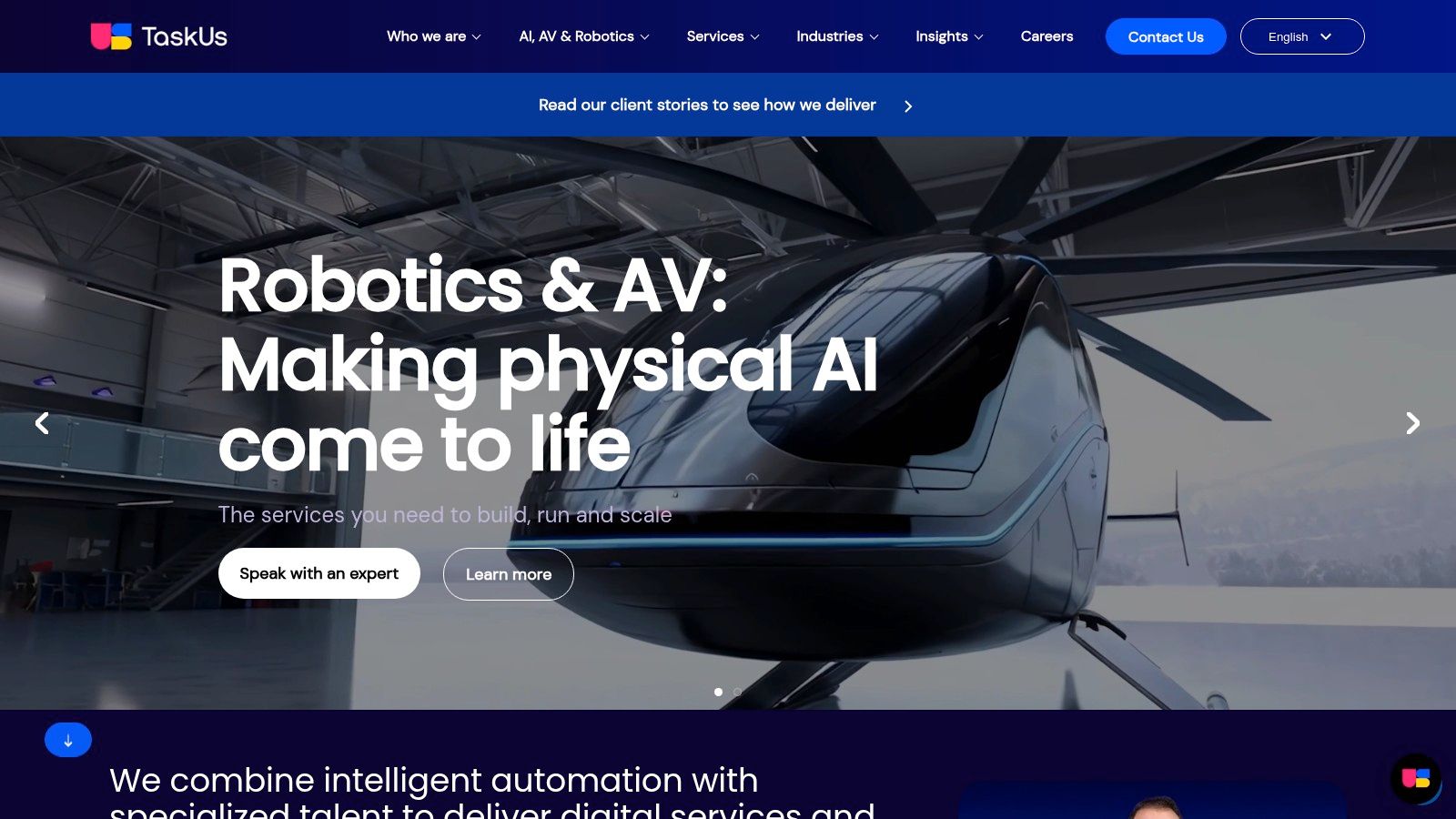
TaskUs is one of the clearer examples of a different offshoring model in this list. It is not built around generic scale first. It is built around digital operations that change fast, require frequent policy updates, and break when the delivery team cannot keep up with the product.
That makes it a strong fit for internet businesses with messy operating reality. Creator platforms, marketplaces, gaming companies, ecommerce brands, and app-based services often need teams that can handle trust and safety, content moderation, queue spikes, back-office exceptions, and customer experience work without months of process redesign. Traditional BPOs can cover some of that scope, but many are still optimized for stable workflows and mature scripts.
I usually place TaskUs in the specialist tier of offshore outsourcing. This is the model companies choose when the work is operationally sensitive and changes often, not when the overriding consideration is the cheapest possible labor.
A useful comparison is large-platform moderation. Major tech companies have long used outside partners to run portions of content review and policy enforcement at scale. The lesson for buyers is practical. Once policy interpretation, escalation logic, and QA calibration become core to the operation, vendor selection stops being a headcount decision and becomes an operating model decision.
TaskUs tends to perform best when a company already knows what needs to be outsourced, but needs a partner that can absorb change without constant friction. It tends to perform worse when the job is simple, repetitive, and price-driven. In those cases, a lower-cost regional provider or seat leasing setup may produce the same service level for less.
The trade-off is familiar. Specialized partners usually start faster in complex environments, but they can become expensive if the client leaves workflows loose and keeps exception rates high.
A practical screen:
- Choose TaskUs if the program involves trust and safety, moderation, digital CX, or other policy-heavy work that changes often.
- Choose another model if the core need is basic voice support, straightforward back-office processing, or low-cost coverage for stable tasks.
- TaskUs fits better when your internal team can define escalation paths, QA rules, and policy updates clearly.
- TaskUs fits worse when your operation is still improvising week to week and expects the vendor to create the operating system from scratch.
One question separates strong buyers from weak ones here. Ask who owns policy change rollout in practice: your internal team, the vendor operations lead, or both together. If that answer is vague, delivery quality usually slips within a quarter.
Website: TaskUs
6. SupportNinja
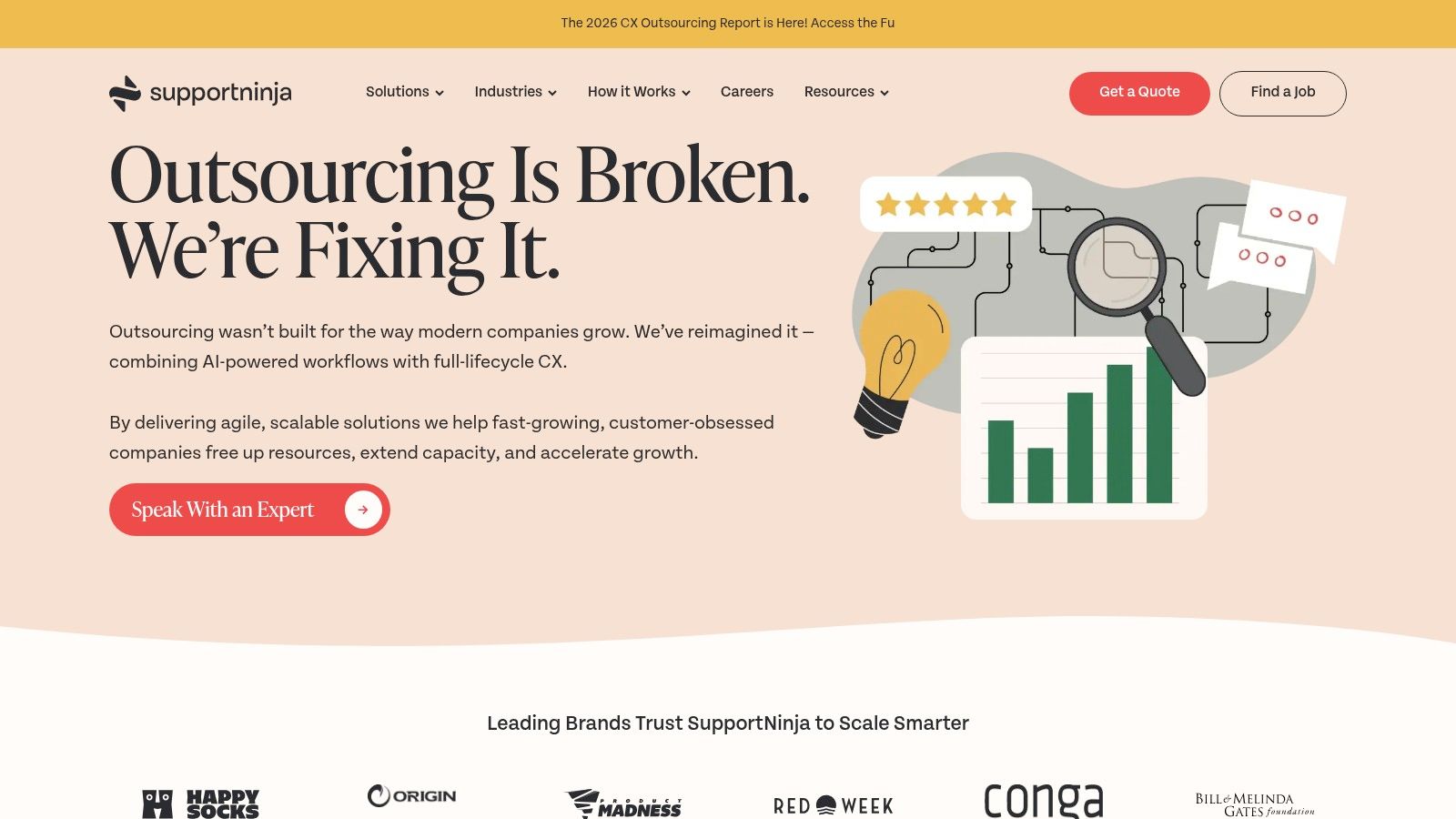
SupportNinja fits a specific offshoring model well. It serves companies that need more structure than freelance staffing, but do not need the heavy governance, procurement layers, and transformation scope that come with large enterprise BPOs.
That middle ground matters.
In practice, many startups and SMBs do not fail at offshoring because labor is offshore. They fail because they buy the wrong operating model for their stage. SupportNinja is better understood as a managed partner for growing teams that want customer support, technical support, moderation, back-office help, finance and accounting support, or AI data work without building a complex vendor management system around it.
Its edge is not sheer scale. It is usability. The service tends to be easier to scope, faster to explain internally, and simpler for lean operators to manage after launch.
Where this model works best
I usually recommend SupportNinja to teams that already know the function they want to outsource, but need a partner that can add process discipline without burying them in enterprise ceremony. That is a different bet from hiring a giant provider to redesign operations across multiple business units. It is also a different bet from seat leasing, where the client often owns more of the day-to-day management system.
The trade-off is straightforward. SupportNinja can be a strong fit for buyers who want managed delivery with clear boundaries. It is less compelling for companies that need deep consulting, complex systems integration, or highly customized governance across regulated global operations.
Work type still matters more than branding. Offshore teams perform best when tasks are documented, quality standards are explicit, and exception handling is predictable. If the process changes weekly, the provider will spend more time chasing ambiguity than improving output. If the workflow is stable, this model can ramp efficiently and stay manageable for a small internal team.
Buy this model for clarity and execution, not for enterprise transformation.
I would screen SupportNinja on four points before signing. Ask who writes the SOPs, how QA is calibrated, what the escalation path looks like in the first 90 days, and how quickly team leads can adjust staffing if volumes swing. Those answers usually reveal whether you are buying a practical operating partner or a polished sales story.
For regulated or sensitive work, push further on auditability, access controls, data handling rules, and contract language. SupportNinja can be a sensible option in the startup-to-midmarket range, but the burden is still on the buyer to match the provider to the actual risk of the function.
Website: SupportNinja
7. Accenture
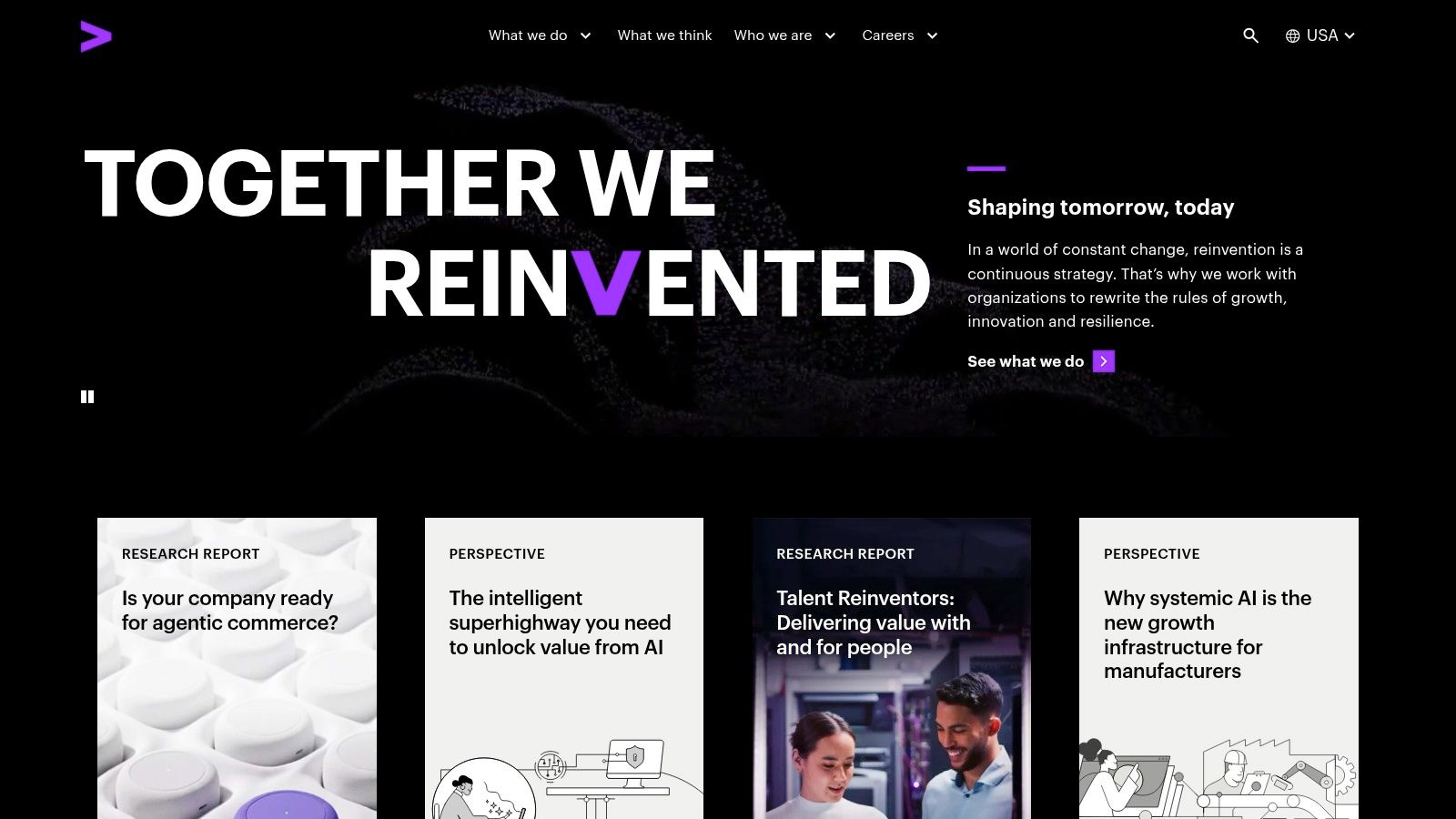
Accenture is the transformation-heavy option on this list. When a company wants consulting, process redesign, technology integration, analytics, and managed operations inside one relationship, Accenture becomes a serious contender. Smaller teams often overbuy here. Large enterprises with tangled operations often don’t.
The benchmark for this kind of mature offshore delivery is not “can they hire people cheaply?” It’s whether they can operate to demanding standards at scale. One cited case notes that Citigroup’s long-running IT offshoring program eventually delivered annual cost avoidance and savings exceeding $1 billion, while maintaining SLA uptime and incident-resolution targets comparable to onshore operations. The same case reports MTTR within 4 hours and 99.9% platform availability for core banking systems, with strong governance and controls as the foundation (Western Outsourcing case discussion of Citigroup offshoring).
The enterprise lesson
That case captures why Accenture’s model exists. In regulated environments, outsourcing fails when leaders treat offshore teams as isolated cost centers. It works better when the offshore operation is embedded in enterprise architecture, monitoring, change control, and compliance routines.
Accenture tends to be useful in these scenarios:
- Multi-tower operating models: customer ops, finance, supply chain, analytics, and industry-specific back office.
- Transformation plus run-state delivery: redesign the process, then operate it.
- Regulated enterprise environments: where governance and integration matter as much as labor economics.
The downside is predictable. Procurement takes longer, contracts are more involved, and the solution may feel oversized if you only need a compact offshore support team.
Website: Accenture
Top 7 Offshore Outsourcing Providers Comparison
| Provider | Implementation Complexity 🔄 | Resource Requirements ⚡ | Expected Outcomes / Impact 📊⭐ | Ideal Use Cases 💡 | Key Advantages ⭐ |
|---|---|---|---|---|---|
| Seat Leasing BPO | Low, plug‑and‑play, fast deployment | Low capital; provider supplies seats, network, power | High operational readiness; cost savings claimed up to ~80% | Startups/SMBs, remote teams, regulated ops in Philippines | Managed end‑to‑end IT/security and formal certifications |
| Concentrix (The Nest) | Medium, enterprise processes; customizable programs | Moderate–high, custom quoting, multilingual staffing, integration | Strong CX quality and scalability; 24/7 omnichannel coverage | Startups to enterprise needing rapid multilingual ramp | Global footprint, AI‑enabled operations, startup program |
| Teleperformance (TP) | Medium–High, mature, process‑driven Cloud Campus model | High, global infrastructure, distributed remote workforce | High resilience and coverage; fast ramp and talent scale | Mid‑market/enterprise requiring follow‑the‑sun support | Global scale, proven remote operating framework |
| TTEC | Medium, platform + managed services integration | Moderate–high, CXaaS platform, analytics, integration effort | Measurable CSAT and cost impact; consolidated tooling | US orgs seeking integrated tech + operations partner | CXaaS approach, managed optimization and analytics |
| TaskUs | Low–Medium, startup‑friendly with rapid stand‑up | Moderate, premium positioning, global sites, AI capabilities | High digital CX quality; scalable trust & safety operations | Digital‑native startups/scaleups needing speed & quality | Embedded automation/agentic AI; trust & safety expertise |
| SupportNinja | Low, flexible engagement models (TaaS/MaaS) | Low–moderate, offshore teams, clear frameworks | Faster stand‑up; predictable vendor management; AI data support | Startups/SMBs needing flexible teams and AI data enablement | Transparent engagement models; startup/SMB focus |
| Accenture (Operations/BPS) | High, transformation + multi‑tower outsourcing | Very high, consulting, tech, global delivery, long procurement | Significant transformation and measurable enterprise outcomes | Large enterprises needing complex transformation + managed services | Combines consulting, technology and BPO at scale |
Your Next Move How to Choose Your Offshore Outsourcing Model
Offshoring decisions usually fail for one reason. Leaders choose a vendor category before they define the operating model.
That is the main takeaway from the seven providers above. They do not represent one market with minor pricing differences. They represent distinct ways to run offshore work. Full-service BPOs such as Concentrix, Teleperformance, TTEC, and Accenture reduce execution burden, but they also give the provider more influence over staffing, workflows, reporting, and day-to-day management. Providers such as TaskUs and SupportNinja sit in a more flexible middle ground, often giving fast deployment with less enterprise weight. Seat leasing is a different model altogether. You control the team. The provider handles the facility, IT, and support environment.
The choice depends on what you are trying to protect.
If the function is standardized, volume-heavy, and governed by clear service levels, a managed BPO can be the right call. It usually fits large support environments, back-office processing, and programs that need fast ramp-up across multiple regions. You get operating maturity, workforce management, and process discipline without building all of it internally.
If customer experience, product nuance, or workflow design is part of your competitive edge, more control usually matters. In those cases, a hybrid structure often works better. A seat leasing partner supplies the workspace, connectivity, security controls, and business continuity setup. Your team keeps direct ownership of hiring, training, QA, and culture.
I have seen companies save money with both models. I have also seen companies create expensive friction by choosing the wrong one. A fully managed provider can look efficient on paper and still slow down iteration if every process change has to move through account management layers. A self-managed offshore team can preserve speed and product context, but only if leadership is ready to run recruiting, coaching, performance reviews, and daily oversight with discipline.
Geography matters less than governance. Time-zone overlap helps, but it does not fix weak SOPs, poor QA design, or unclear escalation paths. The better selection framework is simple: decide which work should be outsourced, who should manage it, how performance will be measured, and how much operating control your business can afford to give up.
If your next step includes workflow design, vendor evaluation, or internal alignment, it’s also worth reviewing how modern employee communication platforms support distributed teams once the offshore model is in place.
The best offshoring setup reduces cost, preserves service quality, and gives you a model you can repeat as the business grows.
If you want offshore scale without the cost and delay of building your own facility, Seat Leasing BPO is a practical place to start. It gives you secure, ready-to-run workspace, managed IT and cybersecurity, business continuity infrastructure, and the flexibility to build your own dedicated offshore team your way.