You’ve picked a business name, maybe shortlisted a bank, maybe even toured an office or asked for rates on a BPO seat lease. Then the practical question lands. What comes first in the Philippines?
For many founders, freelancers, and small operators, the answer is DTI. Not because it solves everything, but because it usually enables the next steps. If you’re operating as a sole proprietor and using a business name other than your personal legal name, DTI registration is often the first document other parties expect to see when you start acting like a real business.
That matters earlier than often anticipated. Landlords ask for business details. Banks ask for registration documents. Local permits depend on consistent business information. Flexible workspace providers also want to know who they’re contracting with. If you handle the DTI side cleanly, the rest of your setup gets easier.
What Is the DTI and Why It Matters for Your Business
The Department of Trade and Industry, or DTI, is one of the first government agencies a small business owner in the Philippines deals with. In practical terms, it’s where many sole proprietors formalize the name they’ll use in the market.

If you’re researching dti in the philippines, you’re probably in one of these situations:
- You’re launching a solo business and need a registered trade name before talking to clients.
- You’re testing a startup idea and want paperwork in place before leasing space.
- You’re entering from overseas and trying to understand which Philippine registrations affect hiring, location, and setup.
- You’re opening a service business and need a clean path from name registration to permits, tax registration, and operations.
The key mindset shift is this. DTI isn’t just a compliance chore. It’s part of your operating foundation. A registered business name helps you present a consistent identity to counterparties, and consistency is what keeps registrations, lease documents, invoices, and permit applications from conflicting with each other.
Practical rule: Register the business name you’ll actually use in contracts, billing, and permit applications. Rebranding after paperwork starts creates avoidable friction.
DTI also sits inside a wider business environment. If your next move is building a local team, this hiring guide for the Philippines is a useful companion because hiring decisions often follow the same operational sequence as registration and office setup.
One important limit. DTI registration is not the whole business launch. It doesn’t replace local government permits, tax registration, zoning checks, or sector-specific approvals. But if you skip it when your structure requires it, the rest of your launch tends to stall.
Understanding the DTI's Role Beyond Business Names
Many founders reduce DTI to a business name counter. That’s too narrow. In practice, DTI functions more like an operating system for commerce in the Philippines. It touches formation, market access, consumer protection, and the broader business climate that affects whether companies expand locally.
Why the agency matters to small operators
A startup owner usually meets DTI through registration. But the agency’s role extends further. It supports business activity, promotes trade, and shapes parts of the commercial environment that even small firms feel indirectly.
That bigger picture matters because founders often ask the wrong question. They ask, “How do I get the certificate?” The better question is, “How does this agency fit into the commercial system I’m entering?”
Here’s the practical view:
- For formation, DTI gives sole proprietors a formal route to use a business name.
- For market conduct, it helps enforce fair trade and consumer-facing rules.
- For business growth, it connects enterprises to programs, guidance, and trade-related infrastructure.
The business climate piece
One reason DTI carries weight is that it’s also tied to investment promotion through agencies under its umbrella. The Philippine Board of Investments recorded ₱1.26 trillion in investment approvals in 2023, the highest in its 56-year history, representing a 59% increase from 2022, according to the DTI Annual Report 2023.
That figure matters even if you’re a small founder, not a large investor. It signals that DTI is not operating at the edges of Philippine business. It’s part of the country’s main commercial infrastructure.
Businesses don’t deal with DTI only to satisfy paperwork. They deal with DTI because it sits at the intersection of legitimacy, growth, and market access.
What founders often miss
The agency’s different functions create practical effects:
| DTI role | What it means in real life |
|---|---|
| Business enablement | You get a formal path to establish and operate under a trade name |
| Trade support | You gain access to information and programs that can inform expansion decisions |
| Consumer and market oversight | Your business operates in a framework where compliance and representations matter |
This is why rushed registration often backfires. Founders treat DTI as a one-time filing, then discover later that business identity, business scope, and operational setup need to line up across multiple agencies and counterparties.
When that alignment is done early, everything after it tends to move faster.
How to Register Your Business Name with DTI
For most sole proprietors, the working tool is the Business Name Registration System, or BNRS. It’s the DTI platform that handles business name registration and renewal across different territorial scopes.
As of April 4, 2026, the BNRS had processed 467,777 total business name registrations, including 387,422 new registrations and 80,355 renewals, based on the DTI BNRS statistics page. That tells you two things. First, this is a mainstream process, not an edge case. Second, your application needs to be accurate because the system is built for standardized processing.
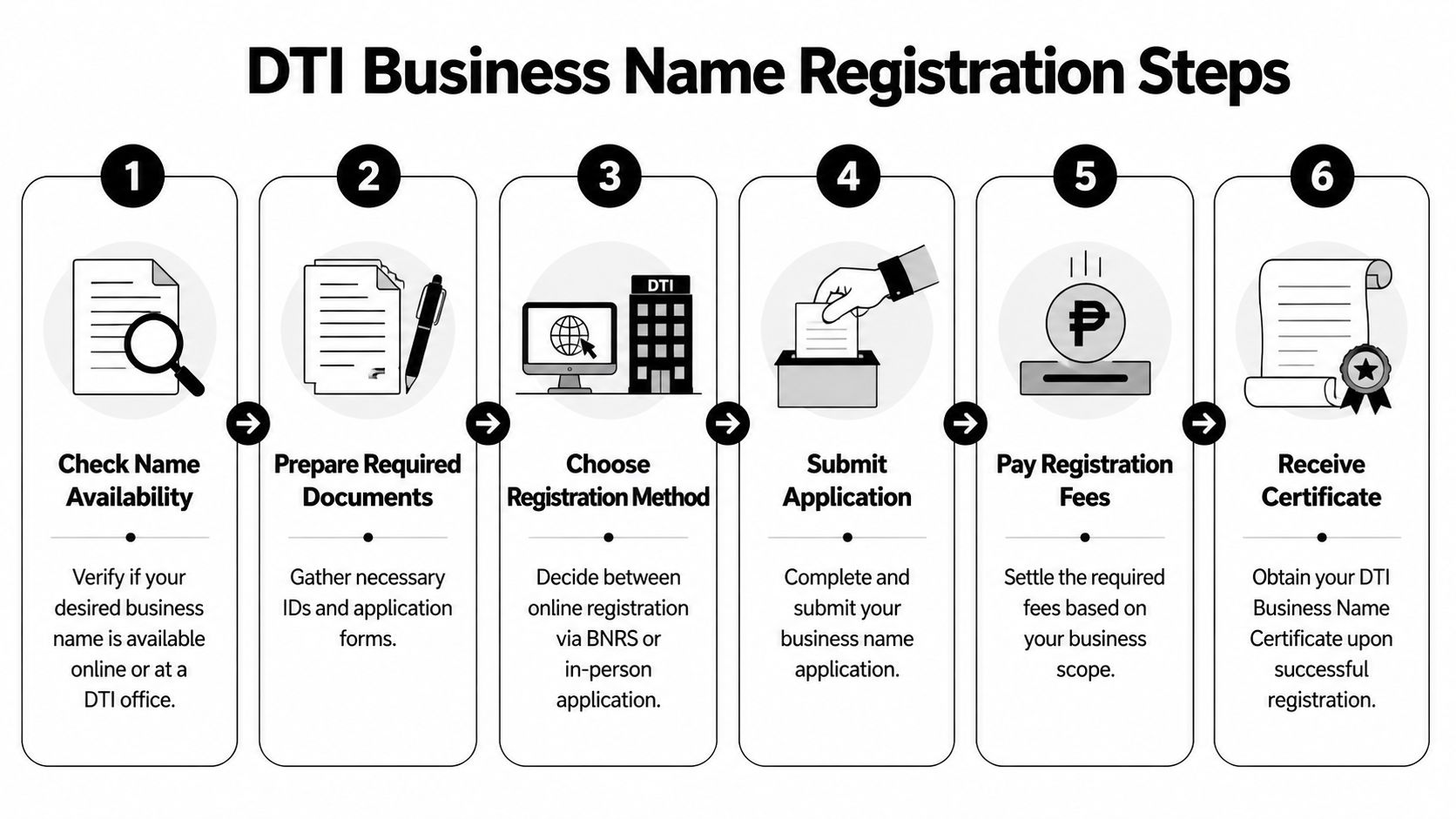
Start with the name, not the form
Most delays begin with the name itself. Founders get attached to branding before checking whether the name works in registration.
Use this sequence:
- List backup names. Don’t prepare only one option.
- Check availability in the BNRS workflow.
- Match the name to actual use. The registered name should be the one you plan to place on proposals, invoices, permits, and lease documents.
- Avoid unnecessary complexity. Fancy spellings and overly broad descriptors often create confusion later.
A practical test helps. If a landlord, a bank officer, and a tax officer all read the name, would they interpret it the same way? If not, simplify it.
Choose the right territorial scope
Founders often overbuy or underbuy. DTI’s territorial scope options include Barangay, City/Municipality, Regional, and National. The right choice depends on how broadly you intend to operate under that name.
The wrong way to choose is by ego. The right way is by footprint.
- Barangay works when the business is tightly local.
- City or Municipality fits a business serving one local government area.
- Regional makes sense when operations or market reach span a wider area within a region.
- National is usually the cleaner choice if you expect broader operations, remote selling, or expansion across locations.
For service businesses, especially those that may move from home-based work to coworking, then to a managed office or seat lease, scope planning matters. You don’t want your registration choice lagging behind your operating model.
Operational shortcut: If expansion is part of the near-term plan, choose a scope that won’t force an early administrative redo.
Complete the application carefully
At this stage, accuracy beats speed. Fill in the applicant details, business name, territorial scope, and business scope exactly as you intend to use them in later registrations and contracts.
One detail that deserves more attention is business scope classification. DTI uses standardized industry descriptors under the Philippine Standard Industrial Classification, often referred to as PSIC. For founders in service businesses, including BPO-related operations, this isn’t just clerical language. It affects how your activity is described across government-facing documents.
Check these points before submitting:
- Your personal details match your IDs
- Your business address is usable for the next steps
- Your business activity description is accurate
- Your chosen name is the same one you’ll use in the market
Payment and certificate release
Once the application is accepted in the system, you move to payment and then certificate generation. At that point, save digital copies immediately and keep a clean file set for later use.
Many founders often get sloppy. They download the certificate once, then struggle to retrieve it when opening a bank account or preparing a lease package. Keep organized copies in cloud storage and in a local file folder with your IDs and supporting documents.
DTI Business Name Registration at a Glance 2026
| Requirement / Step | Details | Estimated Cost (PHP) | Timeline |
|---|---|---|---|
| Name selection | Prepare primary and backup business names | Varies | Same day if prepared well |
| Scope selection | Choose Barangay, City/Municipality, Regional, or National | Varies | Same day |
| Applicant details | Provide consistent personal and business information | Varies | Same day |
| Business scope entry | Use the appropriate business activity classification | Varies | Same day |
| Payment | Pay the applicable registration fee in the BNRS process | Varies | Usually tied to application completion |
| Certificate download | Save and organize the issued DTI certificate | Varies | After successful processing |
I’ve left the cost cells as varies on purpose. The prompt doesn’t provide verified 2026 fee figures, so it’s better to stay precise about process and avoid inventing numbers.
What works and what doesn’t
What works:
- Choosing a name you can keep for years
- Matching registration details to later permit and lease documents
- Planning territorial scope around actual expansion
- Keeping a clean document trail
What doesn’t:
- Registering a name for branding only, then using a different one in operations
- Using an address that creates problems at the LGU stage
- Treating business scope as an afterthought
- Waiting to organize your certificate until someone asks for it
For a sole proprietor, DTI registration is simple on paper. In practice, the value comes from getting it aligned with what you’re about to do next.
Essential DTI Programs and Services for SMEs
Founders usually stop engaging with DTI once the certificate is issued. That’s a mistake. Several DTI-related services become useful right after registration, especially when you move from setup mode to actual selling.

Negosyo Center support and practical guidance
A common scenario: a founder gets the DTI certificate, then gets stuck on what local documents come next, how to frame the business activity, or whether a planned location fits the intended use. In such cases, local Negosyo Centers can help. They’re often the most practical point of contact for early-stage operators who need direction rather than abstract policy.
Use them for questions like these:
- Permit sequencing. Which document usually comes next in your locality.
- Business model fit. Whether your setup looks more like home-based operations, office operations, or a service site.
- Basic mentoring. Early guidance for founders who need structure.
Sales promotions and formal campaigns
Another common situation is a small retailer or service business that wants to run a giveaway, discount campaign, or bundled offer and assumes marketing can be improvised. It often can’t. Promotional activities may trigger separate compliance requirements, and founders should verify whether a permit is needed before launching public campaigns.
That’s one of the practical reasons DTI matters after registration. It remains part of the operating environment once you’re live.
Market intelligence through TRADELINE
For service firms, including outsourcing-oriented businesses, the most underused tool is data. The DTI TRADELINE Portal provides integrated access to real-time trade statistics and data analytics, allowing businesses to analyze export-import trends by region and identify high-growth industries requiring support services, according to the DTI TRADELINE Portal.
That matters more than it first appears. If you’re deciding where to locate a support team, which sectors to target, or how to position an admin or BPO service offer, TRADELINE gives you a structured starting point instead of pure guesswork.
A founder considering support services for exporters, for example, can use trade data to spot active sectors and think through where service demand may cluster. For more operations-focused reading around flexible workspace and outsourcing setups, the Seat Leasing BPO blog is a useful practical resource.
After you’ve looked at the numbers, this video gives helpful context on the broader SME and DTI environment:
Programs founders shouldn’t ignore
A few DTI-adjacent opportunities often deserve a second look:
- BMBE pathways for eligible micro businesses that want to explore available benefits.
- Local advisory channels for permit and compliance clarification.
- Trade and market information tools for businesses choosing sectors and locations.
- Promotional compliance guidance before running customer-facing campaigns.
The founders who use DTI well don’t stop at registration. They use it as a support layer for decisions that affect revenue, permits, and expansion.
Using Your DTI Certificate to Launch Operations
The paperwork takes on tangible form. A DTI certificate is often the document that turns a business idea into something other institutions will transact with.
The certificate doesn’t replace everything else. But it usually sits near the front of the stack when you move into permits, tax registration, banking, and property discussions.

Where the certificate starts to matter
In day-to-day consulting work, this is the point where founders realize registration and operations can’t be separated. Once you start asking for a commercial lease, applying for a local permit, or opening a business bank account, counterparties want proof that the business identity exists in a formal way.
Your DTI certificate typically helps support these next moves:
- LGU permit applications, where the registered business identity needs to match the local paperwork
- BIR registration, where consistency of name and address matters
- Banking setup, where the institution wants formal business documentation
- Office or workspace contracting, where the provider needs a legal contracting party
The office and seat-leasing issue
This is the gap most generic guides miss. Existing content on DTI often fails to explain how local regulatory frameworks interact with modern business models like seat leasing, particularly the interplay between DTI registration and LGU zoning requirements for virtual or flexible offices, as noted in this UNDP Philippines page discussing DTI-related business context.
That gap matters because many startups no longer begin with a traditional long-term office. They start with home-based operations, coworking, managed offices, or seat-leasing arrangements in different cities. The DTI certificate helps establish legitimacy, but it doesn’t automatically solve local zoning or address-acceptance issues.
A business address that works for DTI may still need separate validation when you deal with the LGU, the BIR, or a landlord.
That’s why founders should ask operational questions early:
- Will this address be acceptable for local permits?
- Is the workspace arrangement compatible with the business activity?
- Will the contracting documents match the registered business details?
- If operations expand into another city, what changes locally?
If you’re narrowing down a business identity before registration and launch, a strong naming framework helps. This guide to creative business domains is useful for founders who want their registered name, online brand, and customer-facing identity to fit together.
What actually works in practice
Good launches usually follow a clean sequence. Register the business name. Confirm the operational address strategy. Align local permit requirements. Then finalize the workspace or office arrangement.
Poor launches often do the opposite. The founder signs a workspace deal first, assumes the address will work everywhere, then discovers that the business model, zoning, or permit pathway needs adjustment.
If you’re evaluating what a managed workspace setup usually includes on the service side, review typical seat leasing inclusions and compare them against the permits and operational documents you’ll still need on your side.
The point isn’t that DTI solves operations. The point is that without the certificate, many operational conversations can’t even start properly.
Common Questions About the DTI Process
Is DTI the same as SEC
No. DTI is typically relevant for sole proprietors using a business name. SEC is the route associated with corporations and partnerships. Founders mix these up all the time, and the wrong assumption wastes weeks.
A simple rule helps. If you’re operating as one person under a trade name, you’re usually looking at DTI. If you’re forming a separate juridical entity with shareholders or partners, you’re usually in SEC territory.
What should I do right after getting the DTI certificate
Move quickly on the operational follow-through. In most cases, that means preparing for LGU permits, BIR registration, and any address-related compliance tied to where you’ll operate.
Handle these in order:
- Confirm your business address setup
- Check local permit requirements with the relevant LGU
- Prepare tax registration requirements
- Organize your document file for banking, leasing, and client onboarding
Many founders also require financial discipline in this area, rather than focusing solely on legal paperwork. A clean bookkeeping setup prevents problems once invoices and tax filings begin. This founder's guide to finance is worth reading early, before transactions start piling up.
Can I run a home-based business with only a DTI certificate
Usually, no. The DTI certificate alone is not the whole permission structure. Home-based operations can still involve local permit requirements, zoning questions, and tax registration. The exact practical outcome depends on your locality and your business activity.
This issue becomes more complicated if you later shift from home-based work to a flexible office or a multi-city operating model. Founders should expect the address and local compliance side to matter.
Does the DTI certificate let me sign a lease or service contract
It often helps, and many counterparties expect it, but it’s not the only document that may be required. Landlords, banks, and service providers may also ask for identification, tax documents, permits, or additional supporting papers depending on the transaction.
The important point is consistency. The business identity in your certificate should match the identity used in your contracts.
Do I need DTI if I use my own personal name
For some self-employed professionals, the practical answer can differ if they operate strictly under their legal personal name rather than a trade name. This is one of those cases where founders should verify the exact route that applies to their structure and activity before filing anything unnecessary.
What about renewal
DTI registration isn’t something to forget after printing the certificate. Renewal matters, and founders should track the validity period of their registration and keep business records current. Don’t wait until a bank, a client, or a permit renewal officer discovers that your registration details are stale.
Where do founders usually get stuck
The common bottlenecks are rarely inside the online form itself. They usually appear in one of three places:
- Name mismatch between registration and actual business use
- Address problems when moving into LGU or BIR steps
- Entity confusion between sole proprietorship and corporation setup
If you need help evaluating workspace-related next steps or operational setup questions after registration, you can start with the Seat Leasing BPO contact page.
If you're ready to move from registration to a workable office setup, Seat Leasing BPO offers flexible workspace solutions that can help startups and service businesses get operational without the burden of a traditional long-term lease.