More than 117,800 tech workers across 71 major companies gives Austin unusual corporate density for a market outside the traditional coastal hubs. That concentration shapes the city's economy in practical ways: hiring cycles tighten faster, supplier networks form earlier, and office strategy becomes part of operating strategy rather than a back-office decision.
For business leaders, investors, and job seekers, the top companies in Austin Texas matter because they influence far more than payroll totals. They set procurement expectations, absorb specialized talent, affect commute patterns, and determine where adjacent firms need to place teams to win contracts. Austin's current property market adds another layer. Strong startup formation has coincided with high office vacancy and broader interest in flexible occupancy models, creating an opening for support firms that want local presence without committing to a long lease too early.
That is the lens for this list. These seven companies are major employers, but they also function as anchors for broader operating systems made up of suppliers, recruiters, logistics providers, and professional services firms. In a market that rewards proximity and speed, flexible workspace options such as Seat Leasing BPO's workspace solutions can help vendors and support teams stay close to enterprise buyers while keeping occupancy costs variable. If your firm plans to enter Austin, serve its large employers, or reduce your commercial property taxes, the better strategy is usually the same: stay near demand centers, preserve flexibility, and expand only when contract volume justifies a fixed footprint.
1. Tesla, Inc.
Tesla sits near the top of Austin’s corporate hierarchy for a simple reason: few companies have reshaped the city’s operating profile as quickly. Its presence strengthened Austin’s position not just as a software hub, but as a market where advanced manufacturing, automation, logistics, and industrial hiring now interact in the same regional system.
That shift matters to three audiences at once. Business leaders see a larger addressable market for suppliers and specialized services. Investors see a city with more than one growth engine. Job seekers see demand extending beyond product roles into quality, procurement, facilities, compliance, and production support.
Why Tesla matters operationally
Tesla’s significance in Austin comes from ecosystem density. Large manufacturers pull in a wider ring of firms than office-led employers typically do, including tooling vendors, engineering contractors, staffing partners, freight operators, and environmental and safety specialists. Those relationships create recurring local demand, but they also raise the premium on response time, site access, and proximity.
For smaller firms, that changes real estate strategy. A supplier serving a fast-moving production environment often needs a local base that can open quickly, house project staff, and scale up or down with contract volume. Fixed office commitments can work against that model, especially when project timelines shift or procurement cycles lengthen.
A practical rule follows. In a manufacturing-centered ecosystem, occupancy should match workload volatility.
That is why flexible workspace has become part of operating efficiency, not just a real estate choice. Teams that need to stay close to major buyers while controlling overhead can use flexible workspace solutions from Seat Leasing BPO to establish a local presence without tying up capital in a long lease.
- Operational significance: Tesla expanded Austin’s corporate mix beyond traditional tech and increased demand for industrial and technical support functions.
- Supplier intensity: Its ecosystem rewards vendors that can place teams nearby and respond quickly during active production phases.
- Real estate implication: Flexible occupancy can be more efficient than conventional office space for contractors, service firms, and project-based support teams.
Pros: Strong ecosystem spillover, broad vendor opportunity, and clear relevance for firms tied to manufacturing, energy, and automation.
Cons: Enterprise sales cycles can be slow, vendor compliance standards are high, and smaller firms may need local presence before revenue becomes predictable.
Explore careers at Tesla.
2. Apple
Apple controls one of the largest corporate office footprints in Austin. That fact matters because real estate commitments usually reflect longer planning horizons than hiring cycles. For executives tracking the city’s business base, Apple’s presence signals that Austin serves as a strategic operating center, not a secondary outpost.
The company’s local role is different from a manufacturing anchor or a legacy enterprise employer. Apple strengthens the part of Austin’s economy tied to engineering, operations, supply coordination, and high-spec business support. Its footprint also puts pressure on the surrounding market. Vendors need to be close enough to respond quickly, but disciplined enough to avoid carrying excess fixed occupancy between projects.
That is where real estate strategy becomes operational strategy. Firms supporting enterprise accounts like Apple often rely on rotating implementation teams, compliance-sensitive workflows, and periodic bursts of demand. A managed workspace such as fully serviced office space at Building 24 can help those firms stay near major decision centers without committing capital to a large traditional lease.
What Apple signals to the Austin market
Large office commitments tend to attract specialized service providers. In Apple’s case, that includes technical recruiting, facilities support, enterprise IT services, logistics coordination, and other business functions that benefit from proximity to a major corporate tenant. The result is a tighter, more quality-sensitive vendor environment.
For job seekers, Apple’s local scale points to a market with durable demand for experienced technical and operational talent. For investors and business leaders, it points to a metro where premium employers can justify significant occupancy because they expect continued access to skilled labor and partner capacity.
- Operational significance: Apple reinforces Austin’s position as a center for high-skill corporate functions, especially in engineering and business operations.
- Supplier intensity: Service providers near Apple benefit from faster response times, but they also face stricter execution standards and longer enterprise procurement cycles.
- Real estate implication: Flexible, managed space can be more efficient for project teams and specialized vendors than maintaining permanent surplus office capacity.
Pros: Strong long-term market signal, access to premium talent, and meaningful opportunity for firms that support enterprise operations.
Cons: Competition for talent is intense, vendor requirements are demanding, and proximity alone does not guarantee contract wins.
Browse openings at Apple Careers.
3. Dell Technologies
Dell remains one of Austin’s largest corporate employers, and that scale matters for more than payroll. It gives the metro a durable center of gravity in enterprise technology, with steady demand for sales operations, IT services, procurement support, facilities management, and channel partnerships. For business leaders and investors, Dell is less a growth story than an efficiency story. Large, process-driven employers help stabilize local demand and create repeatable work for suppliers that can meet enterprise standards.
That operating model shapes Austin’s commercial real estate decisions. Dell’s ecosystem includes resellers, implementation partners, contractors, and project teams that need local presence without carrying excess long-term office capacity. In that setting, managed space can be a more efficient choice than a conventional lease, especially for firms staffing around product cycles, client rollouts, or temporary support programs. A flexible option such as managed workspace for enterprise support teams at Building 24 by Seat Leasing BPO fits that requirement because it gives adjacent firms speed, proximity, and cost control.
Dell also adds something distinct to Austin’s corporate mix. Apple strengthens the city’s premium talent profile. Dell strengthens its enterprise operating discipline. The difference matters. Markets anchored only by fast-scaling brands can become expensive and uneven. Markets with long-established enterprise employers tend to support deeper vendor networks, more predictable business services demand, and a wider range of mid-career roles.
Strategic view: Dell helps make Austin attractive to companies that sell into large organizations, because it reinforces the local market for enterprise procurement, partner management, and operational execution.
- Operational significance: Dell supports a mature B2B environment where process, compliance, and service reliability matter as much as innovation.
- Real estate implication: Suppliers and partner teams often benefit more from flexible, meeting-ready space than from maintaining permanently underused offices.
- Workforce effect: Dell broadens Austin’s job base beyond pure engineering by sustaining demand for sales, support, finance, and business operations talent.
Pros: Stable enterprise demand, a broad partner ecosystem, and strong local relevance for firms serving corporate IT and business operations.
Cons: Sales cycles can be long, procurement requirements are strict, and smaller vendors may face margin pressure.
See current roles at Dell Technologies in Austin.
4. Samsung Austin Semiconductor
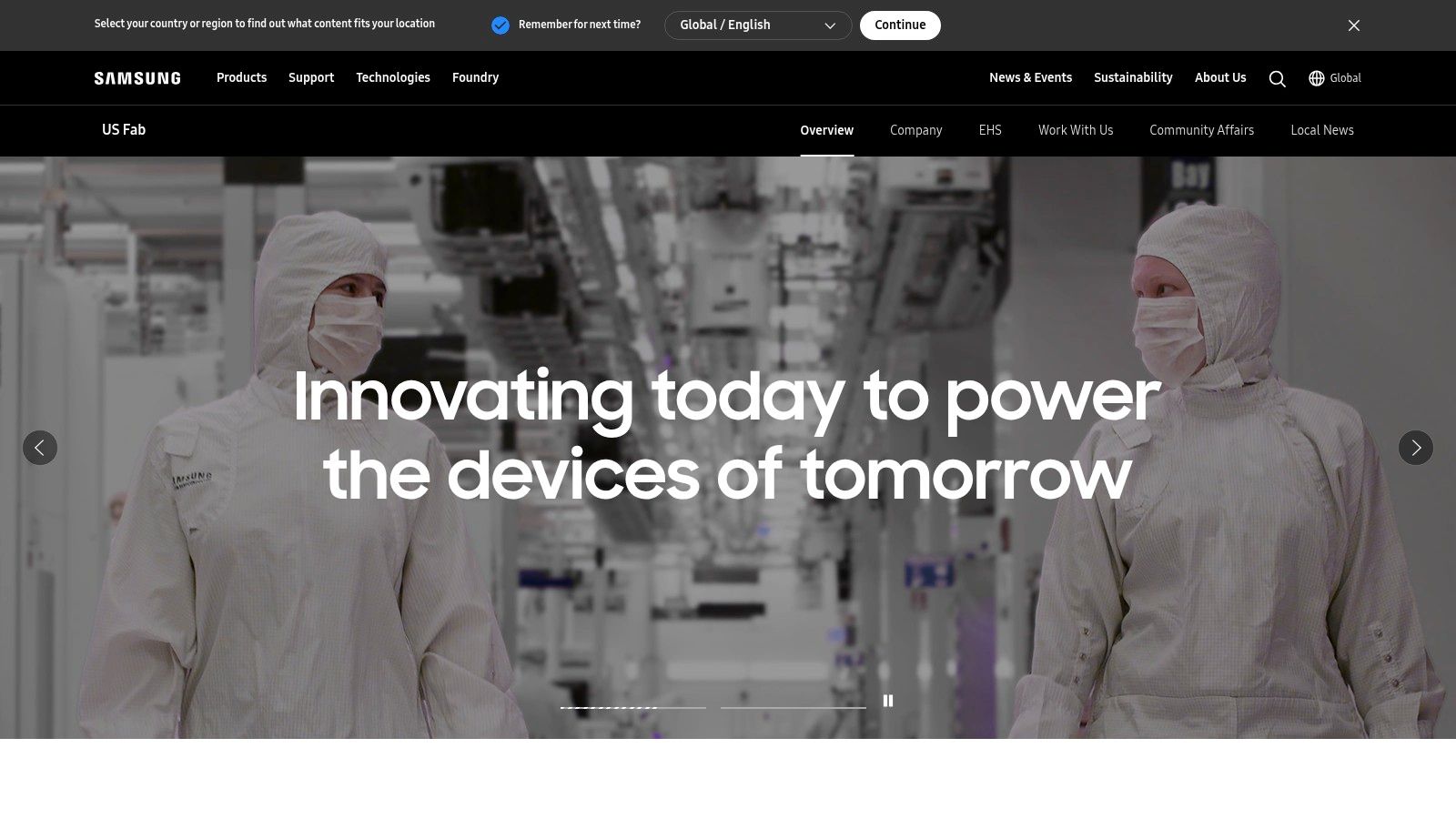
Semiconductor manufacturing ranks among the most capital-intensive operating models in Austin. That matters because companies built around fabs shape far more than direct employment. They influence supplier qualification standards, utility demand, logistics patterns, and the types of commercial space that remain viable around major production sites.
Samsung Austin Semiconductor stands out for that reason. Its presence signals that Austin is not only a software and corporate services market. It is also a city where advanced manufacturing requires precision, uptime, and a deep support network. For investors and business operators, that changes how the local economy should be read. Semiconductor employers tend to create tighter links between industrial operations, engineering talent, construction trades, equipment vendors, and specialized business services.
Austin’s company rankings, as noted earlier, show how important semiconductor-related employers are to the city’s corporate base. The larger point is strategic. In markets shaped by chip production, suppliers often need local coverage without committing to a traditional long-term office footprint.
That is where real estate strategy becomes practical, not cosmetic. A test equipment vendor, facilities contractor, or quality consulting team may need a small in-market presence near procurement and project activity, but demand can rise and fall with fab cycles. Fully managed workspace with included operational support services helps those firms stay credible and responsive while keeping fixed costs under control.
Why semiconductor ecosystems favor flexible execution
Semiconductor support work is uneven by design. Teams scale up for installation, maintenance, audits, process changes, and expansion phases, then contract once the project window closes. That makes permanent office commitments less attractive for many firms serving the sector.
The result is a distinct local opportunity. Austin benefits not just from large manufacturers, but from the ecosystem around them. Niche suppliers, field engineering teams, compliance specialists, and staffing partners often need fast deployment, short setup times, and professional client-facing space. Flexible occupancy can support that model better than underused conventional leases.
- Operational significance: Samsung reinforces Austin’s position as an advanced manufacturing market with high process discipline and demanding supplier standards.
- Real estate implication: Companies serving semiconductor clients often benefit from flexible, proximity-based space rather than large fixed offices.
- Ecosystem effect: The fab environment supports demand for engineering support, facilities services, logistics coordination, and specialized B2B vendors.
Pros: High-value technical work, durable supplier relationships, and strong spillover demand across industrial and business services.
Cons: Entry barriers are high, qualification cycles can be slow, and compliance expectations can strain smaller vendors.
View opportunities at Samsung Austin Semiconductor Careers.
5. Indeed
Indeed matters for a different reason. It reflects Austin’s strength in software, data, and platform businesses, not just hardware and manufacturing. That diversification is one of the clearest reasons the top companies in Austin Texas deserve attention from investors. The city isn’t dependent on one subsector. It supports multiple operating models at once.
Austin’s broader business environment reinforces that point. Existing market commentary notes that startup activity remains strong while many smaller firms increasingly prefer short-term workspace solutions rather than conventional leases, especially in a hybrid-work environment. That’s a useful lens for understanding companies like Indeed, which sit in a downtown, knowledge-heavy ecosystem where flexibility matters on both the talent and occupancy side.
A downtown anchor with ecosystem pull
Indeed’s local importance comes from concentration. Platform companies attract product managers, software engineers, sales teams, recruiters, and B2B vendors into the same orbit. Downtown firms also influence what kinds of space providers succeed nearby. Partners often need polished space for interviews, client meetings, and rotating project teams.
For businesses trying to work with downtown enterprise clients, a fully managed setup with core services included can reduce operational friction. That’s the appeal of reviewing what Seat Leasing BPO includes before signing a traditional lease.
Flexible workspace isn’t only about lowering rent exposure. In downtown Austin, it can also shorten setup time and help small firms look enterprise-ready faster.
- Features: Software and marketplace relevance: Indeed anchors Austin’s HR tech and platform economy.
- Features: Downtown gravity: Its presence supports nearby demand for client-ready, transit-accessible workspace.
- Features: Partnership potential: Service providers in data, hiring, and enterprise software can benefit from local proximity.
Pros: Strong brand adjacency, digital-first operating environment, and useful networking density.
Cons: Budget priorities can shift with labor-market conditions, and data-privacy scrutiny tends to be high.
Learn more at Indeed.
6. Whole Foods Market

Grocery retail employs thousands of people across Austin, and that scale matters for how the metro allocates talent, logistics capacity, and office demand. Whole Foods Market stands out in that system because it gives Austin a nationally recognized headquarters brand tied to food retail, merchandising, supply chain planning, and corporate operations.
That concentration adds strategic balance to a city often framed through software and semiconductors alone. A metro with credible employers across consumer retail, manufacturing, and enterprise tech tends to absorb shocks better than one dependent on a single hiring cycle or capital trend.
Whole Foods also matters because retail headquarters operate on a different cadence than product-led tech firms. Category management, seasonal promotions, supplier coordination, packaging decisions, sustainability standards, and store support all require repeatable execution across physical networks. That operating model creates demand for service providers that can stay close to decision-makers without taking on the cost of a large permanent office.
Austin’s real estate strategy becomes more practical than symbolic. Vendors supporting retail ecosystems often need small teams near corporate buyers, plus room for periodic meetings, training, and cross-functional reviews. Flexible workspace options such as Seat Leasing BPO fit that pattern well because they reduce setup time and fixed overhead while keeping companies present in the market.
Why Whole Foods still matters in Austin
Whole Foods remains one of Austin’s most recognizable corporate names because it connects the city to national decisions in retail operations and brand management. That creates openings for firms in facilities, compliance, packaging, analytics, procurement support, and consumer technology that want proximity to a large retail ecosystem.
For operators and investors, the signal is straightforward. Austin is not only a product-development hub. It is also a place where consumer businesses can coordinate headquarters functions, supplier relationships, and field operations from one market.
- Features: Headquarters relevance: Whole Foods reinforces Austin’s position as a base for national retail management and support functions.
- Features: Operational diversity: Its presence broadens the city’s employer mix beyond pure tech and adds resilience to the local economy.
- Features: Workspace fit: Retail suppliers and support teams often benefit from flexible, client-ready space rather than traditional long-term leases.
Pros: Strong brand recognition, durable relevance in consumer operations, and useful adjacency for suppliers serving retail headquarters.
Cons: Retail timelines can compress quickly, and procurement decisions may be shaped by parent-company processes and national vendor standards.
See office opportunities at Whole Foods Market careers.
7. CrowdStrike
Cybersecurity companies influence far more than hiring. They shape procurement standards, facilities requirements, vendor screening, and the operating discipline expected across a regional business network. CrowdStrike matters in Austin for exactly that reason. Its presence signals that the city can support security-sensitive enterprise work, not only software development and corporate administration.
That distinction has practical consequences for investors, suppliers, and job seekers. A market that attracts major cybersecurity employers usually develops stronger support capacity in compliance, secure IT operations, identity management, managed services, and incident response. Austin already benefits from a deep technical labor base, as noted earlier, and CrowdStrike adds a higher-trust layer to that talent ecosystem.
Workspace strategy is part of that equation.
Security-focused firms and the vendors that serve them tend to evaluate offices through an operational lens. Reliability, access control, network stability, visitor management, and business continuity planning carry more weight here than they do for a typical office tenant. For implementation partners, consultants, and specialized service providers, flexible workspace can reduce setup time while still meeting client expectations around professionalism and control. That is where options such as Seat Leasing BPO fit the Austin market. They give adjacent firms a way to establish a local presence quickly without taking on the full cost and delay of a conventional lease.
Cybersecurity spending often extends through a broader supplier chain than headlines suggest. The ecosystem includes audit support, legal services, channel partners, cloud specialists, recruiting firms, and project teams that need to be near decision-makers for part of the sales cycle, not forever. In a market where timing and credibility affect contract access, a managed office footprint can improve speed to market and preserve capital.
Security buyers often assess operating maturity as much as technical capability. Office setup, access controls, and service continuity can influence that impression.
- Features: Cybersecurity anchor: CrowdStrike strengthens Austin’s position in a high-trust segment of enterprise technology.
- Features: Operational signaling: Its presence raises expectations for compliance, resilience, and secure service delivery across nearby vendors.
- Features: Real estate relevance: Flexible, controlled workspace is often a better fit for cyber-adjacent firms than long-term office commitments.
Pros: Strong alignment with enterprise security demand, useful adjacency for specialized vendors, and positive spillover into Austin’s reputation for high-value technical work.
Cons: Sales cycles can involve strict diligence, and supplier requirements around security, documentation, and continuity are usually heavier than in general software markets.
Explore roles at CrowdStrike Careers.
Top 7 Austin Companies Comparison
| Company | Implementation Complexity 🔄 | Resource Requirements ⚡ | Expected Outcomes ⭐📊 | Ideal Use Cases 💡 | Key Advantages ⭐ |
|---|---|---|---|---|---|
| Tesla, Inc. | High 🔄, stringent procurement, NDAs, and facility access | Significant ⚡, engineering support, onsite compliance, large supplier scale | Access to high‑volume contracts and innovation partnerships 📊⭐ | Suppliers and project teams needing proximity to Gigafactory and flexible local presence | Strong ecosystem effects; large procurement volumes |
| Apple | High 🔄, long vendor qualification and strict security/compliance | High ⚡, enterprise‑grade processes and sustained R&D engagement | Stable, long‑term R&D and campus build‑out opportunities 📊⭐ | Professional services and hardware vendors supporting campus expansion | Predictable enterprise processes; multi‑unit opportunities |
| Dell Technologies | Medium 🔄, multi‑tier decision making but mature processes | Moderate ⚡, channel readiness, competitive pricing, SLA capabilities | Repeatable enterprise contracts and regional stability 📊⭐ | Channel partners and consultants scaling for sales cycles or projects | Established partner ecosystem; strong regional talent pool |
| Samsung Austin Semiconductor (SAS) | Very High 🔄, strict safety, cleanroom, and audit requirements | Very High ⚡, specialized technical capabilities and compliance resources | Multi‑year capital projects with stable, high‑value vendor demand 📊⭐ | Specialized contractors and technical suppliers serving fabs | Longstanding investment; consistent, large‑scale procurement |
| Indeed | Medium 🔄, digital‑first workflows with data/privacy diligence | Moderate ⚡, product/data integration skills and downtown presence | Access to HR‑tech collaborations and talent pipelines 📊⭐ | B2B partners, data/product teams, and services needing central location | Strong brand recognition; prominent downtown footprint |
| Whole Foods Market | Medium 🔄, procurement often aligned with Amazon standards | Moderate ⚡, sustainability/retail expertise and facilities support | Steady corporate projects and community‑aligned opportunities 📊⭐ | Sustainability‑oriented vendors and facilities/IT partners | Stable anchor tenant; values‑driven corporate identity |
| CrowdStrike | High 🔄, elevated security, privacy, and compliance demands | High ⚡, security‑cleared staff and secure operational environments | High‑value security partnerships and rapid integration opportunities 📊⭐ | Cybersecurity vendors and secure IT service providers | Security‑first procurement culture; high growth and partner integration |
The Future of Work in Austin Seizing Opportunity
Austin’s biggest companies don’t only create headline value. They create operating conditions. Apple’s real estate commitment, Dell’s employment scale, semiconductor occupancy, retail depth, and cybersecurity growth all point to the same conclusion: this is a market where proximity matters, but fixed overhead can become a strategic mistake.
That’s especially true in the current workspace environment. Existing Austin market commentary highlights rapid tech workforce growth from 2019 to 2023, strong startup funding in 2024, and high office vacancy in early 2025 alongside increased interest in short-term space solutions, all of which suggest a city where demand is real but occupancy strategies are being rewritten. For leaders entering Austin now, the question isn’t whether opportunity exists. It’s how to access it without carrying too much real estate risk.
The smart takeaway for suppliers, startups, and service firms is straightforward. Follow the corporate clusters, but don’t imitate the footprint of the giants you serve. Large enterprises can absorb long commitments. Most emerging firms can’t, and they don’t need to. What they need is fast deployment, reliable infrastructure, and enough flexibility to scale teams up or down as contracts change.
That’s why workspace strategy has become part of go-to-market strategy in Austin. A firm serving Tesla-adjacent manufacturing, Apple’s office ecosystem, Dell’s partner channels, downtown software platforms, or cybersecurity buyers can gain an edge by staying physically close while keeping capital free for hiring, onboarding, and delivery.
Austin will keep attracting attention because its economy is broad. It includes global tech, semiconductors, retail headquarters, and enterprise platforms in one metro. The companies on this list prove that. The firms that benefit most from that ecosystem won’t always be the largest. They’ll be the most adaptable.
If you want to build a presence near Austin’s biggest employers without the burden of a long-term lease, Seat Leasing BPO offers a practical path. Its flexible, plug-and-play workspace model is built for startups, BPOs, small teams, and corporate support functions that need professional infrastructure, managed IT, and room to scale without heavy upfront spend.