Regus office space can cost as little as $53 per month for basic access in the U.S. or climb past $53,000 per month for large premium suites. That spread is real, and it's why the cost of Regus office space can't be judged by the advertised starting price alone.
If you're comparing office options right now, you're probably staring at a clean headline number and wondering what your actual monthly bill will look like once your team moves in. That's the right question. In flexible workspace, the base rate tells you where pricing begins. It doesn't tell you what operating there will really cost.
For a small business owner, the risk isn't just overpaying on rent. It's signing up for a workspace model that looks flexible on day one, then becomes expensive once you add communications, meeting space, support services, and the contract terms needed to achieve the lowest rate. A branded office in a prime building can absolutely make sense. But only if you evaluate it the way an analyst would: as a total cost of ownership decision, not a marketing headline.
Decoding the Regus Pricing Models
A founder sees a Regus office advertised at an appealing monthly rate, assumes that number reflects the room, and starts budgeting around it. The quote often works differently. In many cases, Regus prices access through a mix of seat count, office type, service package, and term length, which means the headline figure is only one part of the cost structure.
That distinction matters because serviced office pricing is built around usage assumptions. A small private office is not always priced as a fixed piece of square footage in the way a conventional lease would be. The economics can change if the space is set up for one person versus multiple workstations, or if the agreement includes a higher service tier.
Why the pricing feels inconsistent
The model works more like buying access to a packaged workplace than renting raw space. You are paying for a combination of occupancy, flexibility, shared infrastructure, and administrative support. That gives small businesses a lower entry point than a conventional office lease, but it also makes quote comparisons less straightforward.
Two offices with similar dimensions can produce very different monthly totals. One quote may assume denser seating. Another may rely on a longer commitment to reach the advertised rate. A third may include only a basic service bundle, leaving communications, meeting use, or support functions to be charged separately later.
This is the core pricing issue many buyers miss. Regus is not only selling rooms. It is selling a stack of workspace services wrapped around those rooms.
Archived federal schedule materials for Regus describe packaged services tied to office occupancy, including connectivity and business support options such as telephony, cabling, mail handling, answering support, and office services, as shown in the archived Regus GSA pricing schedule. That helps explain why two quotes that appear similar at first glance can diverge once the service assumptions are visible.
Practical rule: If a quote is built around seats and service levels, ask for the pricing logic behind each workstation, the contract term supporting that rate, and which services are capped, metered, or excluded.
The three products most buyers compare
Most small businesses end up evaluating Regus through three workspace formats, each with a different cost profile:
Hot Desk
Shared workspace access with limited permanence. This is usually the lowest entry price, but it is also the weakest substitute for a true office.Dedicated Desk
A reserved workstation in a shared setting. It adds consistency, but it still does not solve privacy, branding, or enclosed meeting needs.Private Office
The closest match to a traditional office environment. It usually carries the highest base price, and it is also where the gap between advertised rent and real monthly spend becomes most important.
These categories matter because they are not just product names. They reflect different operating assumptions. A hot desk buyer is paying for occasional access. A private office buyer is closer to purchasing a bundled occupancy solution, where reception, internet, meeting use, administrative support, and contract terms can materially change the final bill.
What "included" usually means
The sales appeal is clear. A business can move in quickly without sourcing furniture, internet, front desk staffing, or mail handling from separate vendors. For some teams, that convenience reduces setup time and lowers the burden on management.
The financial mistake is to treat "included" as "fully covered for our use case."
In serviced office pricing, included often means included up to a limit, included only within a certain package, or included in a way that still leaves variable charges outside the base rate. That is why a low headline number can remain accurate in marketing terms while understating the true cost of occupancy.
For a small business owner comparing options, the better question is not whether Regus includes services. It is whether those services are priced transparently enough to forecast the monthly bill with confidence. The Seat Leasing BPO workspace insights blog is useful for comparing how different providers define inclusions, especially if you want an all-inclusive model rather than a quote that expands after add-ons are applied.
Key Factors That Determine Your Final Regus Cost
A founder sees a low monthly Regus rate online, builds a quick budget around it, and assumes the number is close enough for planning. The problem is that the advertised price is only one input. Final cost is shaped by four variables that change the usable price far more than many buyers expect: market, office configuration, contract structure, and service scope.
The first variable is location, but the issue is not just geography. It is revenue potential per square foot. A private office in a central business district is priced against higher local demand, stronger building prestige, and a customer mix that can absorb higher occupancy costs. Regus itself reflects those differences market by market across its office space listings by location, which is why a price from one city has limited value as a benchmark for another.
Size and layout come next. A one-person internal office with no client-facing use is a different cost category from a windowed suite sized for a five-person team. Square footage matters, but so does configuration. Corner offices, exterior views, furnished team rooms, and spaces near shared amenities often command higher rates because they are easier for operators to sell and easier for tenants to justify.
Contract length changes the monthly math in a less visible way. Lower rates often depend on longer commitments, while shorter terms preserve flexibility but raise the effective monthly cost. For a small business with uneven hiring visibility, that tradeoff deserves the same attention as the base rent. A discounted rate can still be expensive if it locks the team into more space or more months than it will use.
Service scope is where many comparisons break down. Two quotes can describe a "private office" and still represent different operating costs if one includes enough meeting room access, reception support, and internet capacity for normal business use while the other prices those items separately or caps them tightly. The better comparison is not office versus office. It is business-ready occupancy versus business-ready occupancy.
That distinction matters because Regus packages multiple products under one brand, from light-access workspace to more fully serviced private suites. Buyers who focus on the headline rate can end up comparing a minimal-access entry product against an all-in operating requirement.
A more useful framework looks like this:
| Cost driver | Why it changes your final bill |
|---|---|
| Market and building class | Prime districts and higher-profile buildings support higher pricing |
| Office size and configuration | More seats, better placement, and premium layouts raise the quote |
| Term length | Shorter commitments usually increase monthly cost |
| Included service limits | Meeting rooms, printing, mail handling, and support can shift spend outside base rent |
For budgeting purposes, the key question is simple. What does your team need every month to operate without extra purchases?
If the answer includes stable occupancy cost, predictable support, and clearly defined inclusions, compare Regus against providers that publish a more transparent list of what is covered. Seat Leasing BPO's workspace inclusions and all-inclusive service details make that type of comparison easier because the cost structure is built around operational use, not just a low entry quote.
This is why there is no reliable "average Regus cost" that helps much in practice. A meaningful estimate starts only after you match the office type, the city, the contract term, and the included services to the way your business works.
Beyond the Sticker Price Uncovering Hidden Fees
Most Regus guides stop at the list price. That's where the analysis usually fails.
The harder question is what happens after you ask for the setup a real business needs. A mailing address may not be enough. A solo founder may need live call handling. A small team may need recurring meeting room time, better IT support, or amenities that weren't part of the original quote.

The cheapest price is often a conditional price
Regus advertises low entry points in many markets, but comparisons and user discussions repeatedly point to the same issue: the initial quote can grow once required add-ons enter the picture. In one documented example, virtual office plans start at $90 to $125 per month, then rise to $150 to $250 when phone services are bundled. The same source notes that the lowest private office rates often require 24-month contracts. That's detailed in the Regus Minneapolis office space listing context.
That matters because many buyers don't discover the actual cost until they ask for a business-ready configuration rather than a marketing-ready one.
Add-ons change the effective monthly bill
Some charges aren't always optional in practical terms. A bare-bones setup might technically meet the advertised offer, but not the operating needs of a client-facing company.
Common cost-expanding areas include:
Phone and reception support
A basic address product can become much more expensive once you add the communication features many service businesses need.Premium amenities and support
Teams often assume these are baked in because the workspace is serviced. In reality, the usable package may sit above the entry-level listing.Scaling costs
A workspace that seems efficient for one or two people may become structurally expensive as headcount rises and the business needs more meeting access or additional support.
The Seat Leasing BPO inclusions overview is a useful checklist for this exact reason. It helps you compare what one provider includes by default against what another provider treats as an extra service layer.
If the quote sounds unusually low, don't ask only "What's included?" Ask "What would my team need to buy on top of this to operate normally by month one?"
The contract can become the fee
Long-term commitment isn't just a legal risk. It's a cost risk.
If the lowest rate only applies under a long contract, the business absorbs two hidden exposures. First, it may overcommit to space before headcount is stable. Second, it may lose negotiating power later if the setup becomes inconvenient to leave. That is why commitment traps matter more for startups, freelancers, and hybrid teams than for larger occupiers with predictable space needs.
A better way to read any Regus quote is to separate it into three layers:
- Advertised access price
- Operational add-ons your business needs
- Contract terms required to secure that price
Only after you combine those layers do you have the true monthly cost.
Calculating Your True Regus Cost A Practical Example
Take a five-person startup looking for a private office. The founder sees an attractive listing, likes the building, and assumes the quote will behave like a bundled monthly rent. That's the moment where budgets usually go wrong.
The startup doesn't need a luxury suite. It needs a practical workspace, occasional client meetings, and a professional front for calls and mail. On paper, that sounds simple. In practice, each of those needs can move the bill away from the original quote.
What the founder thinks they're buying
The founder starts with the office quote and assumes the monthly number covers the core operating setup. Then the team asks ordinary questions:
- Can clients call a business line?
- Is meeting space available for presentations?
- What happens if they need more support than the minimal package?
- Does the low rate require a long commitment?
Those aren't edge cases. They're normal operating requirements.
Where the monthly budget starts to move
A useful benchmark for add-on pressure comes from Regus's virtual and meeting products. A comparison found that basic virtual office plans average $90 to $125 per month, and bundling phone services can increase that to $150 to $250 per month. The same comparison found that meeting rooms for 8 to 10 people cost $109 per hour at Regus. See the Regus versus Pacific Workplaces comparison for those figures.
A founder budgeting a private office shouldn't assume those categories are irrelevant. They show how quickly support functions can carry premium pricing once they're needed.
Budget the office for how your team will work on a normal month, not for the narrowest version of the package shown in the ad.
Sample Regus Cost Breakdown for a 5-person private office
| Line Item | Quoted Monthly Cost | Actual Monthly Cost |
|---|---|---|
| Private office base rate | Advertised office quote | Advertised office quote |
| Phone and communication support | Not assumed in base quote | Add if business phone handling is required |
| Mail and admin handling | Often assumed included | Confirm service level and any limits |
| Meeting room use | Often overlooked | Use $109 per hour if the team books 8 to 10 seat rooms |
| Extra support and amenities | Rarely highlighted upfront | Confirm whether they're bundled or billed separately |
| Contract requirement | Treated as a footnote | Price may depend on accepting a longer term |
That table doesn't assign a fictional final total because the exact office quote, service bundle, and usage pattern vary by site. But it does show the budgeting mistake. Small businesses tend to model only the first line item. Regus bills are driven by the whole operating pattern.
The analytical lesson
The true cost of Regus office space isn't just "rent plus extras." It's the sum of base access, operational dependencies, and the pricing conditions attached to the contract.
If you're a five-person team, build your budget around three questions before you sign:
- What does the team need every month to function without workaround?
- Which of those services are limited, premium, or separately billed?
- What term commitment is required to make the quote work?
That simple discipline prevents the most common budgeting error in serviced offices: confusing entry price with usable price.
An Alternative to Regus How Seat Leasing BPO Delivers Savings
The strongest alternative to the Regus model isn't another premium coworking brand. It's a different operating philosophy.
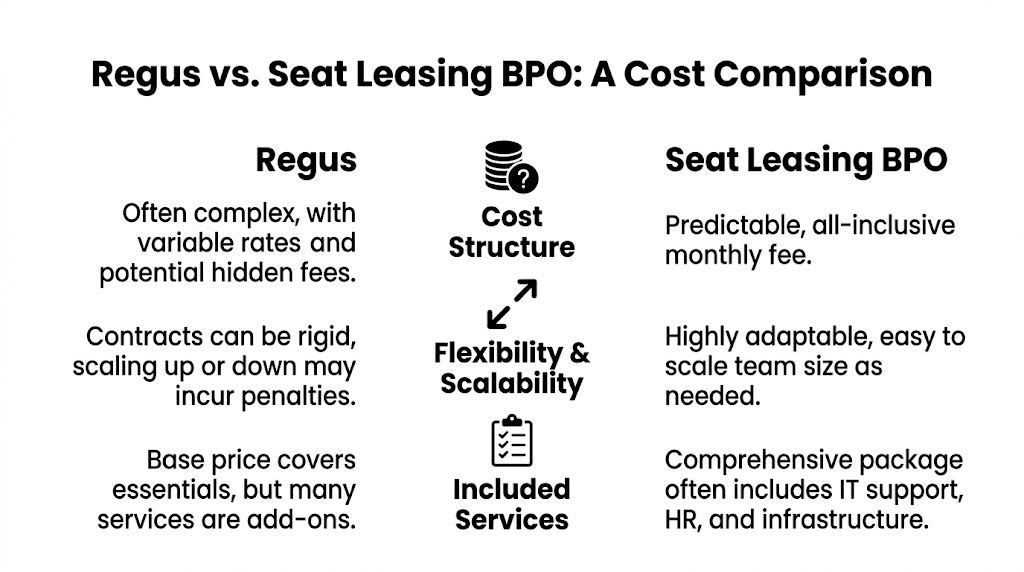
Regus is built around flexible access to branded workspace in many markets. That has clear value for companies that prioritize location prestige and network reach. But if your priority is cost predictability, operational simplicity, and rapid team deployment, a seat-leasing BPO model solves a different problem and often solves it better.
The key difference is what you're really purchasing
With Regus, the buyer often starts with space and then discovers the full operating cost through configuration. With seat leasing BPO, the buyer usually starts with the operating requirement itself: seats, connectivity, support, and business continuity.
That distinction matters for BPO providers, remote-hybrid teams, and small companies moving fast. If a team needs a ready-to-run environment instead of a prestigious address, then the value calculation shifts away from reception aesthetics and toward bundled infrastructure.
A documented comparison point is that Regus office access plans start at around $18 per person per day, while seat-leasing BPO models that handle backend IT, cybersecurity, and electricity can deliver up to 80% savings for teams scaling from 10 to 50 seats. Those figures are summarized in the Regus office access context for BPO and hybrid teams.
Why the all-inclusive model changes total cost
For a small business, cost predictability has financial value on its own. A single monthly fee is easier to budget than a low entry price surrounded by conditional services.
Seat-leasing BPO models usually appeal for three reasons:
More transparent operating costs
The business can model workspace spending without having to reverse-engineer every service dependency.Bundled infrastructure
IT, cybersecurity, internet, and electricity are treated as part of the operating environment, not as afterthoughts.Faster scaling
Teams that need to add seats quickly don't have to rebuild the office economics from scratch each time headcount changes.
This is especially relevant for operators who care less about a global office network and more about getting productive quickly with fewer administrative tasks.
Regus works best for one buyer profile
Regus is strongest when a company values branded office presence, wants access across many cities, and is comfortable managing the difference between base package and full operating setup. For that buyer, the premium can be justified.
But many small businesses don't fit that profile. They need a straightforward environment where the invoice matches the operational reality. That's where Regus can become less compelling.
Here's a clean comparison:
| Decision factor | Regus | Seat-leasing BPO model |
|---|---|---|
| Starting point | Workspace access and location | Operational readiness and seat capacity |
| Cost structure | Can be variable by product, term, and add-ons | More predictable when offered as an all-inclusive package |
| Support layers | Some services bundled, others depend on plan | Core infrastructure commonly treated as part of the package |
| Scaling | Possible, but terms and service needs can complicate cost | Better aligned to headcount-driven growth |
A premium office can be efficient for image-driven businesses. It can be wasteful for teams that mainly need secure, functioning, scalable seats.
The hidden strategic benefit
The biggest advantage of a seat-leasing BPO approach isn't just lower cost. It's lower management friction.
When a founder doesn't have to source separate internet arrangements, coordinate support vendors, or monitor whether the team's usage is drifting outside the included service envelope, they recover time and focus. For early-stage firms and outsourced operations, that matters almost as much as the invoice itself.
If you want to evaluate that model directly, Seat Leasing BPO lays out a workspace approach centered on all-in operating readiness rather than piece-by-piece office assembly.
The broader analytical point is this: the cheaper workspace isn't always the one with the lowest advertised number. It's the one with the lowest fully loaded cost for the way your team works.
Making the Smartest Workspace Decision for Your Business
A smart workspace decision starts with a simple shift in mindset. Don't ask, "What's the monthly price?" Ask, "What will it cost my business to operate there without friction?"
That question changes everything. It forces you to evaluate the cost of Regus office space as a TCO problem instead of a rent comparison. Once you do that, the trade-off becomes clearer. Regus offers brand familiarity, premium buildings, and broad location coverage. In return, you may take on a more complex pricing structure, premium support costs, and terms that don't always match an agile business.
A practical decision filter
Use this short filter before you sign any serviced office agreement:
Operational fit first
List what your team needs every month. Privacy, calls, meeting time, mail handling, IT support, and room to scale.Price conditions second
Check whether the attractive rate depends on a longer term, lighter usage, or a stripped-down package.Exit risk third
If the business changes in six months, will the agreement still make sense?
That last point gets overlooked most often. Flexibility isn't just the ability to move in quickly. It's the ability to keep costs aligned with the business after conditions change.
Prestige versus efficiency
For some firms, a central address and polished front desk are worth paying for. For others, those features are secondary to dependable infrastructure and a simpler invoice.
If you're still weighing how much space your team needs before choosing any provider, this ultimate office space planning guide is a helpful resource. It gives useful context for thinking through headcount, layout, and utilization before you commit to a fixed setup.
The clearest conclusion is this: Regus can be a good solution, but only when the business knowingly accepts the full cost structure. If your priority is predictable spend, fewer billing surprises, and an office model that behaves more like an operating platform than a menu of extras, then a seat-based, all-inclusive alternative is often the more disciplined financial choice.
If you're comparing office options and want a simpler, more transparent path, Seat Leasing BPO is worth a look. Their model is built for companies that want ready-to-use workspace, bundled backend support, and lower overhead without the burden of long leases or layered add-ons.