A lot of seat leasing operators start with the same assumption. Hire one salesperson, give them a rate card, ask them to “bring in clients,” and expect the pipeline to sort itself out.
That usually fails.
A seat leasing business doesn’t sell one thing to one kind of buyer. It sells flexibility to founders, operational readiness to BPO leaders, and risk reduction to facilities or operations teams. Each buyer responds to a different type of sales motion. If you use the wrong one, you don’t just lose deals. You waste inventory, slow occupancy, and drag revenue behind available capacity.
The better way to think about sales is as an engine made of choices. Who you target. How you reach them. How much education the deal requires. Where human involvement adds value and where it only adds cost. That matters even more now that Apollo’s analysis of sales types notes that in 2024, digital self-service sales accounted for 34% of total B2B revenue, the first time it became the leading B2B sales channel.
Choosing Your Sales Engine Not Just a Salesperson
A founder with empty seats often reacts by chasing activity. More calls. More messages. More meetings. But activity isn’t a sales strategy.
You need a sales engine that fits the business model. Seat leasing isn’t sold the same way as software, recruitment, or commercial real estate brokerage. The product is part workspace, part operations platform, part risk-transfer arrangement. That mix changes what kind of sales system works.
Start with the operating reality
A seat leasing business has a few hard constraints:
- Inventory expires daily. An empty seat this month can’t be stored and sold next quarter.
- Buyer urgency varies. A startup may need space next week. A corporate team may need reviews from operations, IT, finance, and legal.
- The offer includes services. Internet, cybersecurity, managed IT, and office readiness make the sale more complex than “renting desks.”
- Margin depends on fit. The wrong client creates support load, pricing pressure, and churn risk.
That’s why “just hire a closer” is usually the wrong move. First decide what motions you need, then hire for those motions.
Practical rule: Build the process before you scale the headcount.
Pick the motion before the role
For smaller buyers, a low-touch path often works best. For larger accounts, you need structured discovery, qualification, and stakeholder management. For both, enablement matters. If you’re tightening messaging, handoff, and content support, these sales enablement best practices are a useful reference because they force discipline around what reps need to move deals.
The sales engine also has to match the financial promise. If your model is built around reducing client overhead, the buying experience should reflect that. Too many manual steps, too many meetings, and too much proposal friction undermine the value proposition before the contract is signed. That’s one reason the operating logic behind Seat Leasing BPO makes sense. The commercial model works best when the sales path is efficient too.
The Foundational Sales Dichotomies B2B vs Inside Sales
Most confusion around sales types comes from mixing different categories together. One category answers who you sell to. Another answers how the sales conversation happens.
If you separate those two, the structure gets much clearer.

B2B, B2C, and B2G are not interchangeable
Seat leasing sits primarily in B2B sales. You’re selling to companies that need workspace, operational support, and flexibility. The buyer usually cares about productivity, deployment speed, overhead, and risk.
B2C sales is different. That’s a consumer buying for personal use. A freelancer renting a single workstation may look similar on the surface, but the buying behavior is still simpler, faster, and more individual than a company lease.
B2G sales appears when government offices, public institutions, or government-linked entities need workspace solutions. The process is more procedural, usually more documentation-heavy, and less forgiving of informal selling.
A practical way to frame it:
| Sales type | Typical buyer | What they care about | What usually fails |
|---|---|---|---|
| B2B | Founder, operations lead, HR, admin, procurement | Speed, fit, cost control, scalability | Overexplaining basic features and under-qualifying needs |
| B2C | Individual professional | Convenience, price, immediate usability | Long proposals and formal approval steps |
| B2G | Procurement or department stakeholders | Compliance, process, documentation, security | Casual follow-up and incomplete paperwork |
For seat leasing, the primary lesson is this: don’t let a consumer-style lead process spill into business accounts. A corporate buyer doesn’t want a casual tour and a generic quote. They want clarity on infrastructure, terms, transition, and operational reliability.
Inside sales usually fits better than outside sales
The second distinction is inside sales vs outside sales.
Inside sales happens remotely. Calls, email, LinkedIn, video meetings, proposals, follow-up. It’s efficient, repeatable, and easier to manage with a lean team.
Outside sales happens in person. Site visits, on-site walkthroughs, relationship-building meetings, and field selling. It’s slower and more expensive, but it matters when the physical environment itself is part of the decision.
For a seat leasing business, inside sales should usually be the default motion. The rep can qualify fit, confirm requirements, share seat options, and move buyers to a tour without burning time on weak opportunities.
Here’s where many teams go wrong:
- They use outside sales too early. A tour before qualification wastes staff time.
- They use inside sales too long. A serious enterprise account may need in-person stakeholder alignment before signature.
- They confuse responsiveness with pressure. Fast follow-up helps. Relentless nudging hurts.
A simple operating rule works well:
- Qualify remotely first
- Use tours as proof, not prospecting
- Bring field interaction in when decision risk is high
A short explainer helps if you’re training newer reps on these distinctions:
The best inside sales teams don’t avoid human connection. They reserve high-touch effort for the accounts where it changes the outcome.
Navigating Your Route to Market Channels and Methods
Once you know who you sell to and whether the motion is inside or outside, the next decision is route to market. Many operators often oversimplify the matter, stating, “We do outbound,” as if that answers anything.
It doesn’t.
You need to separate channel from method. Channel is who carries the offer to market. Method is how demand gets created or captured.

Direct sales and channel sales solve different problems
In direct sales, your own team sells the service. This gives you tighter control over messaging, qualification, pricing discipline, and handoff to operations. For larger BPO accounts or corporate satellite teams, direct usually works better because the deal often includes technical, contractual, and deployment questions.
In channel sales, a partner helps bring in business. For seat leasing, that could mean brokers, local business networks, relocation consultants, HR service firms, or ecosystem partners who already serve companies setting up teams.
The trade-off is straightforward:
- Direct sales gives control but costs more to build.
- Channel sales expands reach but can dilute positioning if partners only sell on price.
A practical split often looks like this:
| Route | Best use case | Main benefit | Main risk |
|---|---|---|---|
| Direct | Multi-seat, recurring, higher-complexity accounts | Better qualification and stronger deal control | Higher internal staffing load |
| Channel | Smaller accounts, overflow demand, local introductions | Faster access to opportunities you didn’t create yourself | Weak discovery and price-led selling |
Inbound and outbound should work together
Method is different from channel. You can run inbound and outbound inside either direct or partner-assisted motions.
Inbound sales means the buyer comes to you because your content, search visibility, referrals, or brand presence created demand. This works well for startups and smaller firms already looking for flexible space.
Outbound sales means your team reaches out first. That’s often necessary when targeting growing BPOs, companies opening a new market, or firms that haven’t started publicly searching yet.
The mistake is choosing one as a belief system. Strong teams usually use both.
Social selling is now part of the core mix
Social selling isn’t fluff for this category. Workspace decisions are still commercial decisions, but the trust-building often starts before a call. Zendesk’s sales statistics report that 78% of salespeople using social media outsell their peers. For a seat leasing provider, that matters because social channels let reps show responsiveness, credibility, and operational readiness before a formal conversation.
That doesn’t mean posting generic office photos and hoping someone messages you.
It means using social deliberately:
- For founders: share practical posts about speed, flexibility, and avoiding lease lock-in.
- For operations leaders: discuss deployment readiness, support coverage, and implementation smoothness.
- For enterprise buyers: highlight process maturity, professionalism, and how shared environments can still support secure, structured operations.
If your outbound email says one thing and your LinkedIn presence suggests something else, buyers trust neither.
The strongest route-to-market setups usually look like a matrix, not a lane. Direct plus inbound for warm demand. Direct plus outbound for named accounts. Channel plus referral partners for local reach. Social selling across all of it.
Advanced Sales Models for High-Value Engagements
Not every seat leasing opportunity deserves the same sales model. If you use a heavyweight enterprise process on a small buyer, you create friction. If you use a lightweight transactional process on a complex account, you miss the real buying criteria.
That’s why the most useful way to understand type of sales is by deal complexity and decision risk.
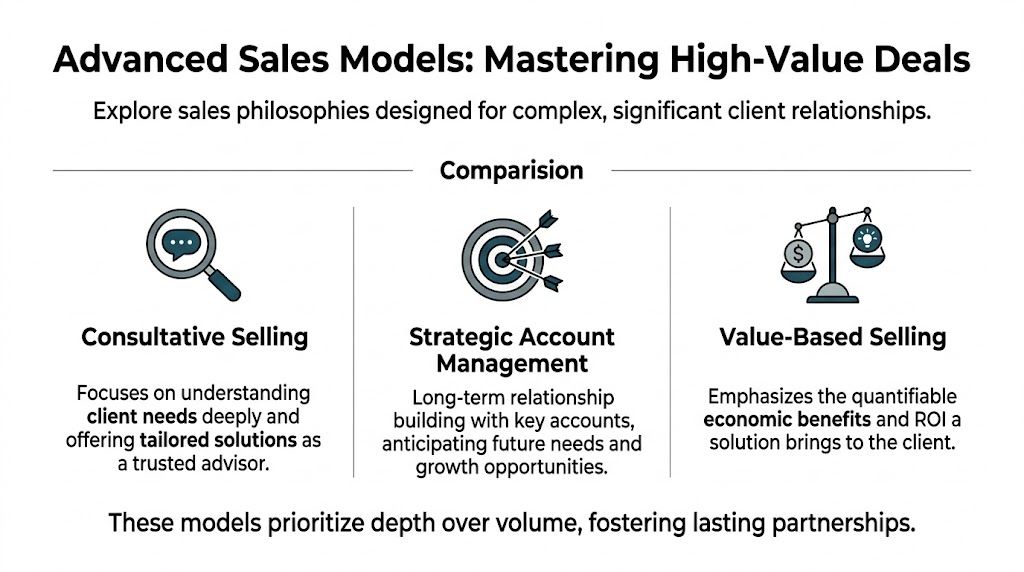
Transactional sales for simple, low-friction decisions
Transactional sales works when the buyer already knows what they need and the decision is small enough that they don’t need much guidance.
That can fit:
- a freelancer needing immediate workspace
- a tiny startup looking for a short-term setup
- a team that wants a fast answer on availability and inclusions
In this model, speed matters more than depth. The rep should confirm fit, answer practical questions, present a clean offer, and move toward commitment. Long discovery calls hurt more than they help.
What works:
- clear packages
- quick response times
- minimal back-and-forth
- simple qualification
What doesn’t:
- overloaded proposals
- broad “tell me about your business” discovery
- unnecessary approval layers on your side
Consultative sales for mid-market needs
Consultative sales fits when the buyer has a real operational need but hasn’t fully defined the best setup. This is common with growing firms that need multiple seats, support services, and room to expand or adjust.
Here the rep acts less like a closer and more like a diagnosis-driven advisor. The goal is to uncover what the client needs, not just what they initially ask for.
A good consultative conversation in seat leasing usually covers:
- Team shape. Who will sit there, and what functions are involved?
- Operational dependencies. What support, connectivity, or security expectations exist?
- Timing risk. Is the move urgent, phased, or dependent on another internal change?
- Flexibility requirements. Are they stabilizing, scaling, or testing a new market?
This model wins when the rep can translate needs into a practical operating setup. It loses when the rep jumps to pricing before fit is established.
The client’s first stated requirement is often incomplete. Good consultative sales finds the operational requirement underneath it.
Solution or enterprise sales for complex accounts
Enterprise or solution sales is different again. The buyer is often not just purchasing seats. They’re reducing setup burden, avoiding capital expenditure, managing a new team launch, or changing real estate strategy.
These deals usually involve multiple stakeholders. Operations may care about deployment. IT may care about infrastructure. Finance may care about cost structure. Leadership may care about speed and flexibility. One contact can open the door, but one contact rarely closes the deal alone.
A useful comparison:
| Model | Buyer situation | Sales style | Main success factor |
|---|---|---|---|
| Transactional | Clear need, low complexity | Fast and direct | Low friction |
| Consultative | Defined problem, evolving requirements | Discovery-led | Strong diagnosis |
| Solution or enterprise | High complexity, multiple stakeholders | Structured and multi-threaded | Stakeholder alignment |
Match effort to expected value
The wrong instinct is to “treat every lead like a big opportunity.” That sounds disciplined. In practice, it destroys sales efficiency.
A better rule is to match sales effort to expected value and complexity.
Use transactional when:
- the buyer is small
- the need is immediate
- the offer can be standardized
Use consultative when:
- the buyer has several needs that interact
- the seat count and support expectations need shaping
- the wrong fit creates service problems later
Use enterprise or solution selling when:
- legal, procurement, IT, or leadership will all influence the decision
- the deployment matters as much as the lease
- the client’s internal approval process is part of the sale
The mature sales team isn’t the one with the fanciest methodology. It’s the one that knows when not to overcomplicate a straightforward deal and when not to under-handle a complex one.
The Right Sales Motion for Each Seat Leasing Client
A seat leasing business usually serves several buyer groups at once. That’s where generic sales advice breaks down. The right sales motion for a founder renting a small setup is not the right motion for a BPO operator planning expansion. Geography alone also won’t save you. Two companies in the same district can need completely different messages, timelines, and commercial structures.
That’s why territory and segment design should start with business context, not just map pins.

Startups and freelancers need low-friction selling
Small buyers usually care about three things. Can they move fast, can they avoid overhead, and can they stay flexible if plans change.
For this segment, a low-touch, inbound-led, transactional motion is often best. The commercial experience should feel clean and easy.
That means:
- strong website pages with clear inclusions
- quick qualification forms
- fast response to inquiries
- lightweight tours or video walkthroughs
- straightforward proposals
The rep’s job isn’t to educate them on the entire category. It’s to reduce uncertainty and keep momentum.
A useful content path for this segment often includes operational details like what’s covered in the package, who the setup suits, and what move-in looks like. A page like workspace inclusions and service coverage does more sales work than many junior reps because it answers fit questions before the first call.
SMBs and growing BPOs need guided discovery
This segment is where a lot of revenue lives, and where sloppy selling causes the most avoidable losses.
An SMB or growing BPO usually doesn’t need a full enterprise process. But they do need more than a quick quote. Their questions tend to cluster around reliability, support, team growth, and how quickly they can become operational.
The right motion here is usually inside sales plus consultative selling.
A practical sequence looks like this:
Qualification call
Confirm team size, timing, current office arrangement, and key constraints.Needs review
Clarify seat mix, support expectations, internet and IT dependencies, privacy concerns, and growth scenario.Customized proposal
Show a practical fit, not a generic menu.Tour or live walkthrough
Use this to validate confidence, not to replace discovery.Commercial close and deployment handoff
Keep the transition from signed deal to setup tightly coordinated.
This is also the segment where handoff discipline matters most. If sales overpromises flexibility or under-specifies support requirements, operations inherits the problem.
Corporate offices need a high-touch solution sale
Larger companies often treat workspace as an operational decision, not just a property choice. Their internal buyers can include facilities, procurement, operations, IT, HR, or leadership. That means the sale has to be multi-threaded.
The strongest motion for this segment is usually a hybrid inside-and-outside, solution-selling approach.
Key differences from smaller deals:
- discovery needs stakeholder mapping
- commercial discussion needs stronger documentation
- site visits carry more weight
- risk handling matters as much as price
- follow-up has to be structured and consistent
You’re not only answering “How much does it cost?” You’re answering “Can this support our team with acceptable operational risk?”
Territory design should follow business triggers
A lot of sales teams still divide territories by city, district, or region and stop there. That’s too crude for flexible workspace.
The better approach is hybrid segmentation. This underserved-market analysis makes the core point well: traditional territory mapping fails flexible workspace models, and a fast-growing business in the same location will have very different needs from a stable one.
So instead of saying, “Rep A covers Makati and Rep B covers BGC,” build segments around signals such as:
- Lease transition. Companies nearing the end of a traditional office commitment.
- Rapid hiring. Teams adding headcount and needing room fast.
- Market entry. Firms testing a new geography without wanting full setup burden.
- Consolidation pressure. Businesses trying to reduce real estate overhead.
- Operational reset. Companies that need a ready environment after disruption or restructuring.
Good territory design answers who is most likely to need flexibility now, not just who sits inside a border.
A practical segment-to-motion map
| Client segment | Best sales motion | What to emphasize | What to avoid |
|---|---|---|---|
| Freelancers and startups | Inbound + transactional | Speed, flexibility, simplicity | Heavy discovery and slow quoting |
| SMBs and growing BPOs | Inside sales + consultative | Fit, support, expansion readiness | Generic proposals |
| Corporate and enterprise teams | Hybrid inside/outside + solution selling | Risk reduction, readiness, coordination | Single-threaded selling through one contact |
When teams get this right, they stop arguing about whether one type of sales is “best.” The answer is simpler. Different buyers require different motions, and a seat leasing business has to run several at once without letting them blur together.
Measuring Success KPIs for Your BPO Sales Engine
Sales teams love activity metrics because they’re easy to count. Calls made. Emails sent. Meetings booked. Those numbers have their place, but they don’t tell you whether your sales engine is healthy.
A seat leasing business needs metrics that connect selling activity to occupancy, speed, and account quality.
Track the numbers that diagnose movement
The first KPI to watch is sales cycle length. For this business, slow deals don’t just delay revenue. They leave seats idle and make forecasting less reliable.
The next is average contract value. You need this to understand whether your team is loading the pipeline with small, easy wins or building enough mid-market and enterprise value.
Then come stage conversion rates. These reveal where the process breaks:
- lead to qualified conversation
- qualified conversation to proposal
- proposal to site visit or commercial review
- review to signed agreement
If one stage drops sharply, don’t coach “closing harder.” Fix the specific issue. Bad targeting, weak qualification, poor packaging, pricing mismatch, or unclear handoff can all show up as conversion problems.
Pipeline velocity deserves executive attention
For this model, pipeline velocity is one of the most useful operating KPIs because it shows how quickly opportunities become revenue. ZoomInfo’s pipeline guidance notes that for BPO seat leases, top teams maintain a sales cycle under 45 days, and a 20% increase in velocity can lead to a 15-25% revenue uplift due to faster onboarding and reduced vacancy rates.
That’s not a vanity number. It has real operating consequences.
If velocity slows, one of three things is usually happening:
- the team is talking to poor-fit accounts
- discovery isn’t surfacing real requirements early enough
- commercial steps are creating delay after interest is already established
Use a KPI table that reflects segment reality
Here’s a practical scorecard.
| KPI | Target (Startup/SME) | Target (Enterprise/BPO) | Why It Matters |
|---|---|---|---|
| Sales cycle length | Faster, with minimal friction | Can be longer, but should stay controlled | Helps protect occupancy and forecast timing |
| Average contract value | Lower but easier to close | Higher and more strategic | Shows whether rep effort matches deal value |
| Stage conversion rate | Strong from inquiry to proposal | Strong from discovery to stakeholder alignment | Identifies where deals stall |
| Pipeline velocity | Needs to stay brisk | Needs discipline across multiple approvers | Connects sales movement to realized revenue |
| Qualification quality | Filter weak-fit small deals early | Prevent wasted enterprise pursuit | Keeps resources focused on real opportunities |
Read the metrics together
One number in isolation can mislead you.
High meetings with low proposals usually means weak qualification. High proposals with low closes often points to poor fit or pricing. Long sales cycles with strong close rates may be acceptable in enterprise, but dangerous in smaller segments where speed should be a core advantage.
A healthy dashboard doesn’t just report effort. It tells you where the commercial process is leaking.
Essential Outreach Templates and Objection Handling
The biggest outreach mistake in seat leasing is sounding like every other office provider. Buyers don’t need another message about “premium spaces” and “world-class amenities.” They need a reason to believe your setup fits the way they operate.
That starts with segmentation and message discipline. It also improves when reps review conversion patterns regularly. Pipefy’s sales analysis guidance notes that tracking stage conversion rates against historical trends can increase close rates by 22% and reduce sales cycle length by 20% in BPO services. In plain terms, when you know where deals are going wrong, your messaging gets sharper.
Email and LinkedIn templates that sound usable
If your team needs extra structure, these cold email templates for sales are a good reference point. They’re useful as a format guide, but the message still needs to be adapted to seat leasing realities.
Template for a startup founder
Subject: Flexible workspace for a team that may change quickly
Hi [Name],
I’m reaching out because teams in growth mode often need workspace without taking on a full office lease too early.
If your team needs a ready setup with business-grade support and room to adjust as plans change, it may be worth comparing that option against a traditional office commitment.
If this is relevant, I can send a short overview based on your current team size and timeline.
Best,
[Your Name]
LinkedIn message for an operations lead at a growing BPO
Hi [Name], I noticed your team is growing. When BPO teams need seats quickly, the biggest issue usually isn’t space alone. It’s getting a setup that’s operationally ready without adding internal setup burden.
Open to a brief exchange on what your team would need if you expand or move?
For more examples and positioning ideas, a company resource library like the Seat Leasing BPO blog is useful because it gives reps language they can adapt for different buyer concerns.
Objections that deserve direct answers
“It’s cheaper to stay remote.”
Response: It can be, if remote work isn’t creating coordination, security, supervision, or infrastructure problems. The real comparison isn’t rent versus no rent. It’s total operating efficiency versus hidden drag.“We’re worried about shared infrastructure.”
Response: That concern is valid. Don’t brush it off. Clarify what level of privacy, support, and operational control they need, then confirm whether the setup actually matches those requirements.“We need more flexibility than your contract allows.”
Response: Ask what flexibility means in practice. Headcount changes, term length, expansion options, or exit conditions are different issues. Most objections become manageable once the rep stops treating “flexibility” as one vague demand.“Send pricing first.”
Response: Share a range if needed, but don’t let the deal become price-only before fit is clear. Price without context invites comparison with offers that may not solve the same operational problem.
One rule for every objection
Don’t fight the objection. Diagnose it.
When reps rush into rebuttal mode, they usually miss whether the issue is real fit, poor explanation, internal politics, or pricing discomfort. Objection handling gets better when the rep treats resistance as missing information, not a challenge to win.
Frequently Asked Questions About Sales Models
What CRM and tech stack should a seat leasing sales team start with
Start lean. You need a CRM that tracks pipeline stages, follow-up tasks, notes, deal ownership, and reporting by segment. You also need calendar scheduling, email tracking, proposal management, and a clean way to record tours and next steps.
Don’t buy a large stack just because enterprise teams use one. A smaller sales operation usually gets more value from clean process discipline than from extra tools nobody adopts.
Who should you hire first
For most seat leasing businesses, the strongest first hire is not a pure closer. It’s a rep who can run inside sales with consultative discipline.
Look for someone who can qualify firmly, communicate clearly, write concise follow-up, and stay organized across several active opportunities. If they can only charm in meetings but can’t manage a pipeline, they’ll create noise, not revenue.
When should you shift from outbound-heavy to more inbound-led growth
Shift when your inbound engine starts producing qualified demand consistently enough that it lowers your cost of selling and improves fit.
Don’t abandon outbound too early. Outbound is often how you learn which messages work, which segments convert, and which objections repeat. Inbound gets stronger when it’s built from those real conversations, not marketing guesses.
If you’re building a seat leasing sales function and want a setup that fits startups, BPOs, and enterprise buyers without overcomplicating the process, Seat Leasing BPO is a strong place to start. Their model is built around flexible workspace, managed backend support, and faster operational readiness, which makes it easier to match the right sales motion to the right kind of client.