A manager cuts someone off in a tenant meeting. A team lead ignores a support message for hours, then replies with sarcasm in the shared chat. A client account manager claims a hot desk as “their” space and snaps at another company’s staff for using it. None of those moments looks serious on its own.
That’s why incivility in the workplace gets missed so often in flexible offices. Leaders wait for a formal complaint, a resignation, or a clear policy violation. By then, the culture has already shifted. People stop sharing ideas, avoid common areas, and work around one another instead of with one another.
In a multi-tenant workspace, the risks are greater. Different employers, different norms, different pressure levels, and constant proximity create friction fast. Traditional advice written for one-company offices often falls short. Shared environments need a sharper operating model, one that treats civility as part of service delivery, risk control, and community management.
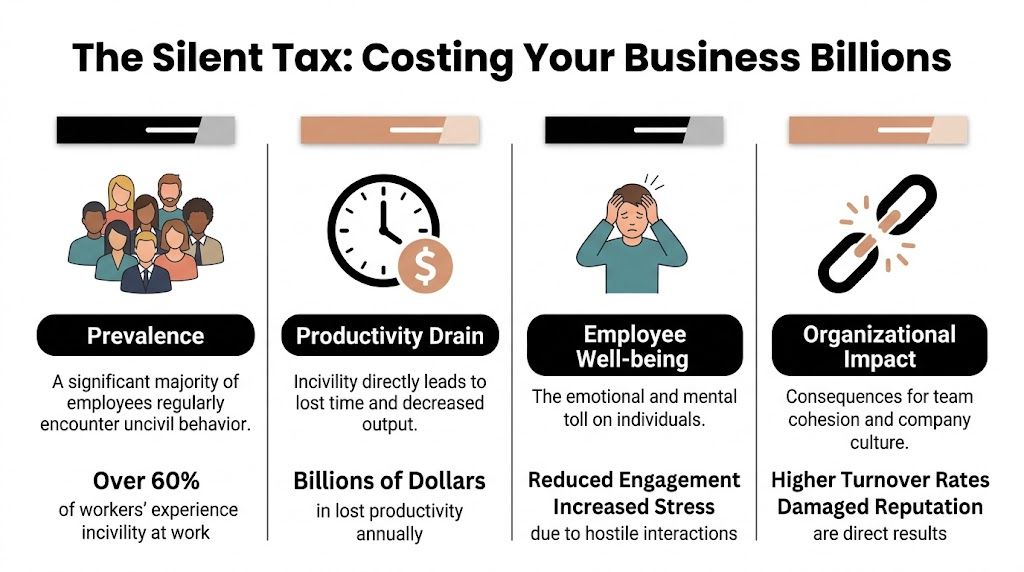
The Silent Tax Costing Your Business Billions
Incivility rarely starts with shouting. It starts with the small stuff people are told to ignore. The eye-roll in a stand-up. The dismissive “as I already said” email. The lunch invitation that somehow skips the same person every time. In a crowded workspace, those signals spread quickly because more people witness them, absorb them, and adjust their behavior around them.
Researchers often describe workplace incivility as low-intensity behavior that violates norms of mutual respect. That definition matters because it captures the gray zone. Many incidents aren't blatant enough to trigger immediate discipline, but they still damage trust. In practice, incivility works like repeated friction in a machine. Each incident seems minor. The cumulative wear is not.
What the macro data says
The scale is hard to dismiss. In Q3 2025, U.S. workers experienced or witnessed an average of 0.42 acts of workplace incivility per day, totaling over 70 million acts daily, and costing U.S. employers over $2.1 billion per day or $766 billion annually through reduced productivity and absenteeism, according to SHRM’s Civility Index abstract for Q3 2025.
That number should change how leaders classify the issue. This isn’t a “soft” topic. It’s an operating cost.
In a flexible workspace, the cost shows up in specific ways:
- Slower coordination: Teams hesitate to ask questions when prior interactions felt dismissive.
- Avoidance behavior: People reroute communication through intermediaries instead of speaking directly.
- Contaminated shared areas: Lounges, meeting rooms, and chat channels stop functioning as collaboration tools.
- Tenant dissatisfaction: One company’s unmanaged behavior becomes another company’s retention problem.
Why shared spaces feel the damage faster
A single-company office can sometimes absorb bad habits for longer because people know the chain of command, the culture, and the expected remedies. Multi-tenant spaces don't have that cushion. People work beside strangers, vendors, clients, and employees from other firms. That means one uncivil interaction can create uncertainty on two levels at once.
First, the target wonders whether speaking up is worth it. Second, everyone nearby wonders who owns the problem.
Practical rule: If a behavior makes people less willing to ask, contribute, or collaborate, treat it as a business issue long before it becomes a disciplinary one.
That’s the central mistake many operators make. They frame incivility as a personality clash instead of an environmental risk. In high-density offices, it’s closer to a systems problem. If leaders don't define acceptable conduct, monitor patterns, and intervene early, the space itself starts teaching people to withdraw.
Spotting Incivility From Overt Rudeness to Subtle Exclusion
Most leaders can identify open hostility. Fewer catch the quieter patterns that do more long-term damage in shared offices.
A tenant supervisor talks over a junior analyst during a floor huddle. No one says anything. Later that week, the same analyst stops volunteering updates in front of other teams.
Another example is even harder to flag. A startup founder regularly invites only certain people from neighboring companies into informal problem-solving chats in the pantry area. The excluded people hear the laughter, see the networking happen, and understand the message without a word being said.

Active disrespect
These behaviors are visible and easier to document.
Examples include:
- Condescending corrections: A manager answers a fair question with ridicule rather than clarity.
- Public put-downs: Someone critiques a person’s competence in front of peers or clients.
- Dismissive body language: Eye-rolling, scoffing, or visibly checking out while someone speaks.
- Micromanaging with contempt: Oversight delivered as suspicion rather than support.
In a BPO or shared operations floor, this kind of conduct travels fast. People nearby may not know the context, but they recognize status cues immediately. If the person being belittled is junior, new, or from another company, others often decide silence is safer.
Passive exclusion
Many workplaces fail at this point. They only act when the behavior is loud.
Watch for patterns like:
- Selective information sharing: One person consistently gets updates after decisions are already made.
- Informal gatekeeping: Key conversations happen in side chats, hallway clusters, or invite-only lunches.
- Social freezing out: A coworker is tolerated in formal settings but ignored in casual ones.
- Territorial behavior: Shared desks, meeting rooms, or pantry areas are treated as belonging to a favored group.
Passive exclusion is common in flexible spaces because the environment encourages informal contact. That’s usually a strength. It becomes a liability when access to information or relationships starts depending on who gets welcomed into the room.
Digital incivility
Physical proximity doesn't reduce online friction. It often multiplies it.
Common signs include curt replies, deliberate non-response, all-caps messages, message pile-ons, and using public channels to shame someone for a mistake that should have been handled privately. In mixed-tenant environments, digital incivility can also happen between companies using a shared platform for service requests, room bookings, or building concerns.
A useful test is simple. If the same message would sound disrespectful when read aloud in a meeting, it shouldn't be sent in chat.
Who gets silenced first
The biggest mistake is assuming incivility only hurts feelings. It also suppresses contribution. Research reported by Harvard Business Review in 2025 found that workplace incivility silences everyone, but has a disproportionately severe effect on women and underrepresented groups by reducing their willingness to speak up and share ideas.
That matters in startups, support teams, and client-facing operations where useful information often comes from the person closest to the work. When those people stop speaking, errors last longer and weak decisions go unchallenged.
What managers should notice early
Use your own floor as a signal system. Pay attention when:
| Pattern | What it usually means |
|---|---|
| Fewer questions in mixed-team meetings | People don't feel safe taking interpersonal risk |
| Repeated no-shows in common areas | Staff are avoiding someone or some group |
| Side-channel escalation instead of direct communication | Trust has dropped |
| One person dominates shared discussions | Others have learned that input isn't welcome |
Leaders don't need to become amateur detectives. They do need to stop waiting for dramatic incidents. In shared spaces, deterioration often starts as quiet withdrawal.
The Hidden Causes of a Toxic Work Environment
Incivility often gets blamed on temperament. That explanation is convenient and usually incomplete.
The more reliable question is this: what conditions make rude, dismissive, or exclusionary behavior more likely here? In my experience advising fast-moving teams, incivility rises when pressure climbs and operating norms stay vague. People fill the gap with impatience, territorial habits, and status games.

Stress loads people faster than policy can catch up
One verified pattern is clear. High job demands increase the likelihood of bullying behavior. That should not surprise anyone managing support teams, founders under funding pressure, or operations groups with tight turnaround requirements. If employees work in constant urgency, some will start treating impatience as efficiency.
The problem gets worse when leaders reward output and ignore the method used to get it. A manager who hits targets while humiliating people still teaches the floor what is tolerated. In shared offices, nearby teams observe that lesson too.
Return to office friction is real
Return-to-office policies have added another layer of strain. Employees in organizations enforcing return-to-office mandates reported a 63% increase in uncivil behaviors, linked to transition stress and renewed in-person tensions, according to the NeuroLeadership Institute.
For flexible workspaces, this matters more than standard office advice admits. A shared environment doesn't just bring one workforce back together. It places multiple workforces, each with different habits and resentments, in close contact. One company may value quiet focus. Another normalizes loud team huddles. One expects strict desk etiquette. Another works like a startup garage. Friction follows when those assumptions collide and no one names them.
Ambiguity invites bad behavior
A surprising amount of incivility grows in spaces where the basics aren't explicit.
Common triggers include:
- Unclear ownership: No one knows who handles a complaint involving two different tenant companies.
- Loose etiquette in common areas: Noise, room use, pantry cleanup, and guest behavior become recurring flashpoints.
- Uneven manager capability: Some supervisors can de-escalate tension. Others intensify it.
- Rapid onboarding: New tenants enter without social norms, only operational instructions.
In a traditional office, culture is often reinforced through long tenure and internal relationships. In a multi-tenant setup, people join and leave more fluidly. The provider and tenant both need to make norms visible because they won't spread reliably on their own.
The fastest way to create a toxic floor is to combine high pressure, unclear rules, and leaders who think respect is optional when work gets busy.
Why “a few bad apples” is the wrong diagnosis
That phrase sounds practical, but it often delays real action. Most uncivil environments aren't produced by a single difficult person. They come from repeated permission. People copy what gets rewarded, excuse what leaders minimize, and test boundaries when accountability is inconsistent.
When operators focus only on obvious offenders, they miss the surrounding conditions that keep reproducing the problem. Shared workspaces need a broader lens. Look at onboarding, manager behavior, client pressure, room-use conflicts, digital channels, and complaint handling. Those systems either contain stress or convert it into daily disrespect.
The Domino Effect How Incivility Sinks Productivity and Retention
Incivility doesn't stay interpersonal for long. It changes behavior. Then it changes output.
A poll across 17 industries found that 48% of targets deliberately reduced work effort, 38% lowered work quality, 66% reported performance declines, and 12% quit their jobs as a direct result of incivility, as summarized by Atana’s review of workplace incivility research. Those are not abstract culture indicators. They are operational losses.
The first domino is attention
When someone gets treated poorly, part of their attention leaves the work and shifts to self-protection. They replay the incident, avoid the offender, and edit what they say next time. Even if they stay in role, they no longer bring the same level of discretionary effort.
That attention loss matters in every setting. In a high-density workspace, it also spreads to witnesses. People don't need to be the direct target to decide that caution is the better strategy.
Here’s how the pattern usually unfolds:
- A disrespectful interaction happens
- The target pulls back
- Peers notice and become more guarded
- Communication gets thinner and slower
- Errors, rework, and frustration increase
- Managers respond with more pressure
- The environment becomes even more brittle
That cycle is why incivility in the workplace often feels larger than any single incident. Teams are reacting not only to what happened, but to what they expect might happen next.
Collaboration degrades before output numbers do
Leaders often wait for hard productivity metrics to worsen. By that point, the social damage is already established.
In shared environments, you’ll usually see these warning signs first:
- People stop asking for help early
- Cross-company cooperation becomes transactional
- Tenants avoid common spaces unless necessary
- New joiners learn to keep their heads down
- Managers spend more time mediating than coaching
These are expensive shifts because flexible offices depend on smooth interaction. The model works when people can share infrastructure without sharing stress. Once incivility becomes normal, every routine exchange carries more friction.
Retention damage is rarely isolated
When one employee leaves because of an uncivil manager or peer, leaders often classify it as an individual mismatch. That's too narrow. Departures tied to disrespect usually leave a trail. Colleagues absorb the lesson that performance won't protect them from poor treatment. Strong employees then start looking for teams where they can contribute without bracing themselves every day.
If employees have to conserve energy for interpersonal survival, they can't invest that same energy in customers, quality, or innovation.
For BPOs, the retention risk is especially sharp. Service delivery depends on consistency, attention control, and handoff discipline. A disrespectful supervisor or hostile peer dynamic doesn't just hurt morale. It leaks into customer interactions, internal escalations, and quality control.
What this means for workspace operators
Providers sometimes assume productivity and retention sit entirely with the tenant employer. Formally, employment decisions do. Practically, the environment still influences both outcomes.
Operators should watch for recurring signs such as:
| Workspace signal | Likely business consequence |
|---|---|
| Frequent disputes over shared resources | Lower focus and more manager intervention |
| Repeated complaints about tone or disrespect | Weakened tenant confidence in the space |
| Tenant teams isolating themselves | Less collaboration and lower community value |
| High churn in one area or team | Possible culture issue, not only hiring issue |
The core lesson is simple. Incivility starts as conduct, then becomes performance. Any leader responsible for a team, floor, or shared office who ignores that chain is accepting preventable loss.
Building a Culture of Civility A Blueprint for Action
Incivility in a flexible workspace rarely comes from one dramatic incident. It usually grows out of repeated friction, unclear boundaries, and inconsistent intervention across tenants, supervisors, and shared areas.
Good intentions are not enough in a high-density office. A workable civility model needs three things: written standards, a reporting path people trust, and daily reinforcement from managers and site operators. In seat leasing and BPO settings, that also means accounting for handoffs between employer control and provider control. If no one defines that line clearly, low-grade disrespect keeps getting passed around.

Put conduct standards in writing
A code of conduct should describe behavior in plain language. If the document only addresses harassment, threats, or other severe misconduct, people will treat everyday disrespect as a personal problem instead of a management issue.
For shared offices, the standard should cover conduct that creates predictable conflict between teams and tenants, such as:
- interrupting or talking over colleagues in meetings
- public ridicule, sarcasm, or dismissive feedback
- excluding people from operational conversations they need to do their jobs
- hostile or careless chat behavior in team channels
- monopolizing shared rooms, desks, or equipment
- disrespect toward reception staff, cleaners, security, vendors, contractors, or another tenant's employees
The policy should also separate employer-owned issues from site-wide conduct issues. A tenant manages discipline for its own staff. The workspace provider still needs house rules for common areas, noise, visitor behavior, shared facilities, and cross-tenant complaints. That split reduces confusion and speeds up response.
For broader policy design, this guide on strategies to prevent workplace harassment is useful because it….com/post/prevent-workplace-harassment) is useful because it…com/post/prevent-workplace-harassment) is useful because it ties standards to reporting, training, and follow-through rather than treating policy as a stand-alone document.
Build a reporting path people will actually use
Researchers in this PMC study on workplace incivility, trust, and work alienation found that incivility weakens interpersonal trust, which then contributes to work alienation. In practice, that means employees stop raising concerns long before leadership realizes there is a culture problem.
A reporting system has to feel safe, simple, and worth the effort. In multi-tenant spaces, it also has to tell people where a complaint belongs.
Use a structure like this:
- Anonymous intake for pattern capture: A confidential form, case tool, or HRIS entry point helps surface repeated issues that people may hesitate to report openly.
- Clear routing rules: Separate urgent safety concerns, employee-to-employee conduct, and cross-tenant or common-area issues.
- Pattern review by location and trigger: Review names, teams, shifts, rooms, and recurring pressure points, not only single incidents.
- Closure updates: Even when details are private, confirm that the concern was reviewed and addressed.
For a smaller operator, a disciplined spreadsheet and named case owner may be enough. For a larger site, use a proper incident workflow with searchable tags, status tracking, and response deadlines.
Train managers for the middle ground
Managers usually act on obvious misconduct. They also know how to coach clear performance problems. The harder cases sit in between, where the behavior is corrosive but still easy to dismiss as stress, personality, or fast-paced operations.
That is where skilled intervention matters.
Train supervisors and tenant leads to do three things consistently:
Describe the behavior with specifics
Say what happened. "You cut her off twice and answered with sarcasm" is more useful than "Watch your tone."Link the behavior to operational impact
In BPO and seat leasing environments, incivility disrupts handoffs, increases errors, and makes frontline staff less willing to ask for clarification.Set the next expectation clearly
Define what respectful correction looks like in meetings, chat, coaching sessions, escalations, and shared areas.
Short manager scripts help because pressure tends to make people vague or overly emotional. A direct example: "Urgency is not the issue. Public ridicule is. Correct the work without humiliating the person."
Design the environment to reduce friction
Workspace design shapes behavior more than many operators admit. In dense offices, small irritants repeat all day. Noise spill, unclear booking rules, visible queue cutting, and private feedback delivered in public can turn ordinary tension into a conduct problem.
Practical fixes include:
- quiet zones for focused work
- visible rules for room and desk use
- posted expectations for pantry, corridor, and phone etiquette
- private rooms for coaching, investigations, and de-escalation
- tenant onboarding that covers behavior standards, not just badges, Wi-Fi, and access hours
This is one area where providers can act faster than tenants. The operator controls the physical setup, the signage, the traffic flow, and the orientation process. Those decisions reduce avoidable conflict before HR ever gets involved. Teams looking for more practical guidance on shared office operations can also review the workspace management articles at Seat Leasing BPO's blog.
Give employees some control back
People handle pressure better when they have some discretion over how they work. In practice, that can mean predictable break rules, fair room access, reasonable noise controls, and enough autonomy to solve routine problems without public escalation.
The trade-off is real. High-accountability operations still need standards, speed, and supervision. But pressure does not require disrespect, and tight service targets do not excuse contempt.
A workable blueprint is straightforward. Define acceptable behavior in concrete terms, route concerns to the right owner, train managers to correct early, and run the space in a way that removes avoidable friction between teams, tenants, and support staff.
Tailored Strategies for Startups BPOs and Shared Offices
The same civility policy won't work the same way for every occupant of a flexible office. A startup with twelve people faces a different reality than a large BPO team handling escalations all day. The workspace provider itself has a different role again. It isn't the employer, but it does set the baseline conditions under which multiple employers operate.
That means the right approach is comparative, not generic.
Civility intervention priorities by business type
| Business Type | Key Challenge | Top Priority Intervention |
|---|---|---|
| Startup | Founders move fast and often mistake bluntness for clarity | Build civility into manager habits early, especially in meetings, chat, and feedback |
| BPO | High-pressure service work can turn urgency into disrespect | Tight supervisor coaching, escalation standards, and customer-facing recovery rules |
| Shared office provider | Multiple cultures collide in common spaces and no single HR function owns everything | Publish house conduct standards, tenant onboarding norms, and a cross-tenant complaint path |
For startups
Startups usually don't fail on policy volume. They fail on founder modeling.
If the founder interrupts, replies with contempt, or treats support staff as invisible, the company will copy that behavior faster than any handbook can correct it. Small teams absorb norms through observation. In a shared office, they also project those norms outward into the community.
Useful startup practices include:
- Write a one-page conduct standard: Keep it short enough that people will read and use it.
- Set meeting rules early: No interrupting, no ridicule disguised as speed, and no side-channel undermining after decisions.
- Correct publicly harmful behavior quickly: Private coaching is often best, but delay sends the wrong signal.
- Protect dissent: The newest or quietest person often sees operational risk first.
A startup doesn't need a large HR stack to do this well. It does need discipline.
For BPOs
BPO environments bring a different challenge. The work often runs on volume, service levels, client expectations, and rapid handoffs. Under those conditions, incivility can hide behind “performance focus.”
That usually sounds like this:
- “I was just being direct.”
- “We don't have time to be sensitive.”
- “The client is already upset.”
- “That’s just how the floor works.”
Those are warning signs, not management philosophy.
BPO leaders should focus on:
- supervisor coaching on tone under pressure
- escalation protocols that remove public blame
- quality reviews that include behavioral conduct, not only output
- reset procedures after difficult calls or tense client interactions
When the work is emotionally loaded, people need structured decompression and predictable manager support. Otherwise stress moves sideways into peer treatment.
For workspace providers
Providers occupy a middle position. They aren't the employer of each tenant’s staff, but they do control the environment, access rules, common areas, and community expectations. That gives them both influence and responsibility.
A strong provider does three practical things:
First, it sets baseline conduct rules for everyone using the space. That includes guests, vendors, tenant leaders, and frontline staff.
Second, it creates a simple route for raising cross-tenant issues. If one company’s employee repeatedly behaves badly toward another company’s staff, people need a place to take that concern without guessing where it belongs.
Third, it trains community-facing personnel. Reception, facilities, and floor coordinators often see tension first. They need escalation criteria, not just customer service scripts.
For operators assessing whether the physical setup itself may be contributing to friction, reviewing a specific environment such as https://seatleasingbpo.com/building-24/ can be a useful reminder that layout, density, circulation, and shared amenities all shape behavior, not just convenience.
Shared offices work best when the provider acts like a neutral community steward, not a passive landlord.
What not to do
Across all three groups, the same weak responses show up:
- treating repeated disrespect as style
- pushing all concerns back to informal resolution
- focusing only on obvious offenders
- onboarding people to tools and access but not to norms
- assuming civility will emerge naturally from proximity
It won't. In multi-tenant spaces, civility needs active design.
Conclusion The ROI of Respect
Respect isn't a perk. It's infrastructure.
In flexible offices, people share more than desks and internet access. They share meetings rooms, hallways, support channels, and daily impressions of what’s tolerated. When incivility in the workplace goes unchecked, those shared systems stop working well. Communication narrows. Trust falls. Retention gets harder. Managers spend time cleaning up avoidable messes.
The return on respect is practical. Civil teams surface problems sooner, coordinate faster, and make better use of shared space. Civil managers keep standards high without draining people. Civil workspace operators protect the value of the community they host.
Leaders don't need a slogan. They need a decision. Treat civility as part of operations, or pay for the absence of it through slower work, weaker collaboration, and preventable exits.
If you're reviewing your own environment, start with the basics. Define the conduct you expect. Make reporting usable. Train managers to intervene early. And if your workspace setup or tenant mix is creating avoidable friction, get outside help before those patterns harden. For organizations ready to discuss shared workspace solutions and community standards directly, the next step is simple: https://seatleasingbpo.com/contact/
Frequently Asked Questions About Workplace Incivility
Is incivility the same as harassment
No. Incivility and harassment can overlap, but they aren't the same thing.
Incivility usually refers to rude, dismissive, or exclusionary behavior that violates norms of respect. Harassment is a legal issue tied to protected characteristics or severe and pervasive conduct under applicable law. A manager can be uncivil without committing illegal harassment. That doesn't make the behavior harmless.
The practical rule is to address incivility early and escalate when conduct may involve discrimination, retaliation, threats, or repeated targeted abuse.
What if the rude person is a client or customer
This is common in BPOs and shared offices. It also gets mishandled because teams assume revenue always outranks conduct.
It doesn't. Staff still need protection when the source is external.
Use a simple protocol:
- document the incident
- identify whether the employee needs immediate support or a handoff
- decide who speaks to the client
- set boundaries for future interactions
- remove staff from repeated exposure if needed
A provider or employer doesn't have to overreact to one tense exchange. It does need to stop a pattern from becoming “part of the job.”
Who enforces civility rules in a shared workspace
Both the tenant employer and the workspace provider have roles.
The tenant employer owns employee management, coaching, discipline, and internal investigation. The workspace provider owns house rules, common-area standards, access conditions, and cross-tenant issue handling. Problems emerge when each side assumes the other one will act.
The cleanest model is shared governance:
- the provider sets baseline conduct rules for everyone in the facility
- each tenant enforces those standards within its own workforce
- cross-tenant complaints follow a clear escalation path
- recurring patterns trigger coordination between tenant leadership and provider management
What should managers do the first time they see incivility
Act early, even if the first response is light.
Name the behavior. Describe the impact. Set the expectation for next time. Then document it. A quick correction after a meeting or a private conversation after a chat incident is often enough to stop a pattern before it spreads.
Waiting for “something more serious” is usually what allows the conduct to become cultural.
If your team needs a flexible office setup that supports productivity without losing control of standards, Seat Leasing BPO can help. Their workspace model is built for growing companies that want reliable infrastructure, operational support, and an environment where clear expectations can scale with the business.