You close your laptop after dinner, and the work is still waiting. A customer needs help. Payroll needs review. Your site needs a fix. A new team member has questions. Each task matters, but together they pull you away from the work only you can lead.
That is usually the point when a founder asks a more useful question: what is an outsourcing company, and is it only relevant for large corporations?
An outsourcing company is a business you hire to handle specific work outside your core team. It works like bringing in a specialist contractor for part of a house build. You still own the project and set the standard, but you do not need a full in-house department for every job. For a small business, that can mean customer support, bookkeeping, design, IT help, recruiting, or back-office admin.
The bigger shift is how companies use outsourcing now. Cost still matters, but modern models also help businesses start faster, stay flexible, and test new functions without long hiring cycles. A Seat Leasing BPO arrangement, for example, can give a company a ready-to-run team setup with workspace, infrastructure, and local support, which is useful when speed matters as much as budget.
There is another benefit new founders often miss. The right outsourcing partnership can create stable jobs and skills development in the communities where your provider operates. In other words, outsourcing can strengthen your business and support economic opportunity at the same time.
Used well, outsourcing gives you more than relief from a crowded to-do list. It gives you room to focus, grow carefully, and build with more flexibility.
The Strategic Shift to Outsourcing in 2026
You win a few new clients, and growth starts to feel less like progress and more like traffic. Sales still need attention. Customer questions keep coming. Admin work expands in the background. The problem is no longer effort. The problem is that the founder becomes the bottleneck.
In 2026, more businesses treat outsourcing as a way to remove that bottleneck early. They use outside partners to add operating capacity without waiting through long hiring cycles, new office setup, and months of internal training.
The shift is strategic because timing matters. A company entering a new market may need support staff in weeks, not quarters. A growing online brand may need extra customer service during peak periods, then a smaller team afterward. A professional services firm may need reliable payroll, IT support, or reporting without building full departments around each function.
Why businesses are making the shift
The core benefit isn’t just lower expense; it’s fewer delays, faster deployment, and more management focus on sales, product, client service, and growth.
A good outsourcing partner gives you a working system, not just extra hands. That system can include trained staff, team leads, workflows, reporting, and the tools needed to keep work moving. It works like renting a fully equipped kitchen instead of buying ovens, counters, and appliances before you know how much demand you will have.
That flexibility explains why newer models are getting more attention. A Seat Leasing BPO provider can give a company desks, infrastructure, staffing support, and local operations in one arrangement. For a founder, that can mean launching a support or back-office team quickly, testing a function before building it in-house, or expanding into a new region with less operational friction.
There is also a practical human side that gets missed. The right outsourcing setup can create steady jobs, training, and career paths in the communities where the provider operates. For businesses that care about responsible growth, outsourcing can improve speed and flexibility while also supporting local economic opportunity.
Practical rule: Outsource work that must be done well, but does not require your direct involvement every day.
New entrepreneurs also mix up outsourcing with other staffing arrangements. If you are comparing service delivery with contractor and payroll structures, this definition of an umbrella company helps clarify the difference. That distinction matters because outsourcing is usually about handing a defined function to a specialist team, not merely placing one more worker on your payroll.
What an Outsourcing Company Is
Think of it this way. If your office plumbing fails, you don’t hire a full-time plumber. You call a plumbing company that already has the tools, skills, and system to fix the problem. An outsourcing company works in a similar way.
An outsourcing company is a third-party business that performs specific tasks, functions, or operational processes for another company under an agreed service arrangement. Instead of building every capability in-house, the client transfers selected work to a specialist provider.
The simplest way to define it
The confusion usually comes from the word “company.” People assume outsourcing means handing over the whole business. It doesn’t.
Most of the time, you’re outsourcing a function, not control of your company. You still set goals, standards, and expected outcomes. The provider supplies the people, processes, and often the infrastructure needed to do the work.
That’s why outsourcing can sit alongside other flexible work arrangements. For readers comparing different employment and contractor structures, this definition of an umbrella company is useful because it helps separate payroll and contractor administration models from true outsourced service delivery.
In practical terms, an outsourcing company may handle things like:
- Customer operations such as call handling, chat support, and back-office processing
- Technology work like help desk support, software development, or systems administration
- Specialized business services such as accounting, recruitment support, or reporting
If you want to see one example of how workspace and operational support can be bundled into a service model, https://seatleasingbpo.com/ shows how some providers package facilities and support functions together rather than offering labor alone.
Where the model came from
Outsourcing has older roots, but it gained strategic recognition in 1989, when Eastman Kodak made its landmark decision to outsource its IT systems to IBM. That move showed businesses that they didn’t need to own every core-adjacent capability to get strong results (Quantum OG history of outsourcing).
Outsourcing works best when you treat it as a capability decision, not a surrender of responsibility.
That distinction matters. You’re not stepping away from the work. You’re choosing a different way to get it done.
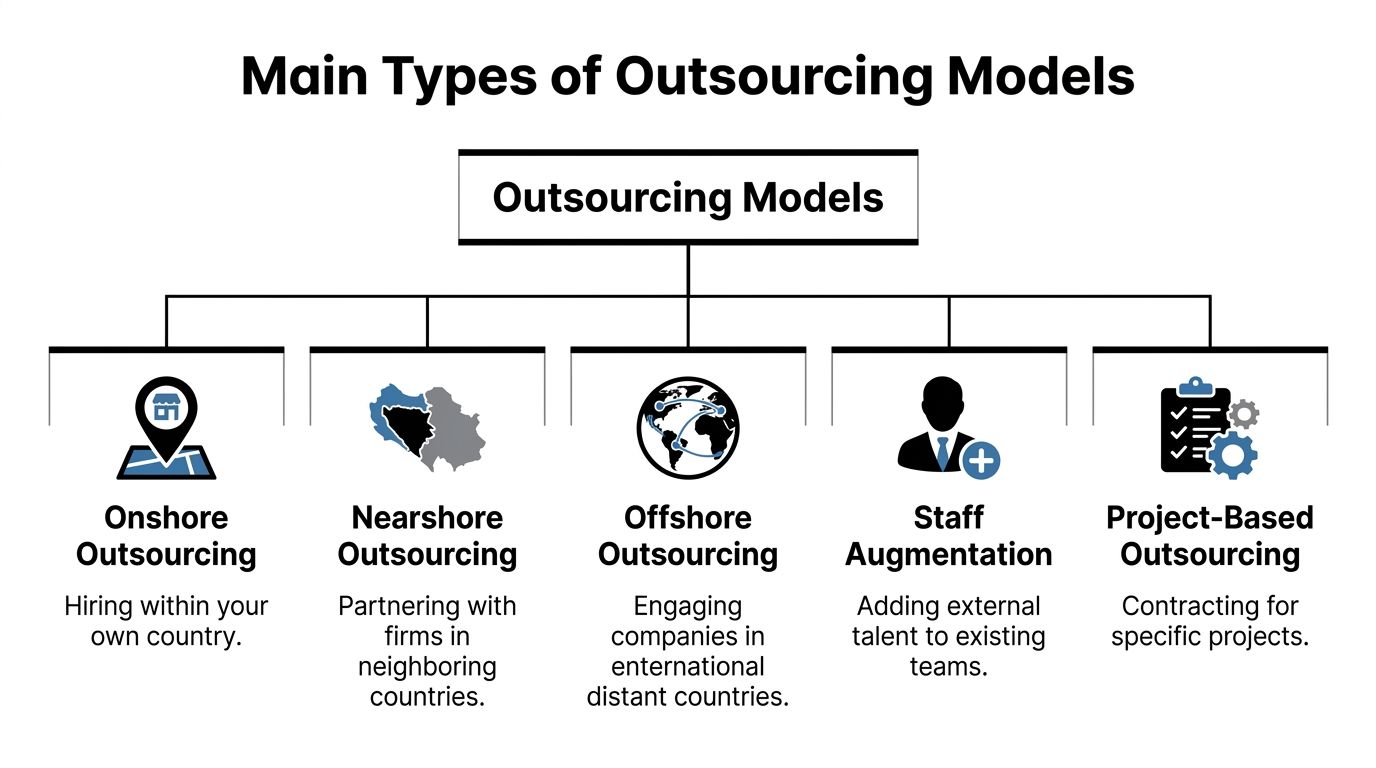
The Main Types of Outsourcing Models
People often use “outsourcing” as if it describes one single setup. It doesn’t. There are different models depending on what you outsource and where the provider is located.
Service-based models
Here are the main service categories entrepreneurs usually encounter.
BPO
Business Process Outsourcing (BPO) covers repeatable operational work. This is the model many people first think of.
Examples include:
- Customer support
- Data entry
- Payroll processing
- Appointment setting
- Claims handling
BPO is useful when the work follows a clear process and needs consistency.
KPO
Knowledge Process Outsourcing (KPO) involves more specialized, judgment-heavy work.
Examples:
- Market research
- Financial analysis
- Legal support services
- Business intelligence reporting
- Research assistance
KPO providers usually bring deeper subject expertise than a standard back-office team.
ITO
Information Technology Outsourcing (ITO) focuses on technical functions.
Examples:
- Help desk support
- Infrastructure management
- Software development
- Cybersecurity monitoring
- Cloud administration
This model is common when a business needs technical capability fast but doesn’t want to build a full internal IT department yet.
Engagement-based models
Some outsourcing is structured around how the work gets delivered.
- Staff augmentation adds outside professionals to support your existing team.
- Project-based outsourcing hands over a defined deliverable, such as a mobile app build or a data migration.
- Standardized service models are useful when you need repeatable output with clear service levels.
Location-based models
The other major way to classify outsourcing is geography.
| Factor | Onshore (Same Country) | Nearshore (Neighboring Country) | Offshore (Distant Country) |
|---|---|---|---|
| Cost | Usually highest | Moderate | Often lowest |
| Time zone alignment | Strong | Often manageable | Can vary widely |
| Cultural familiarity | Highest | Often close | Depends on provider |
| Talent access | Limited to local market | Broader regional access | Broad global access |
| Oversight style | Easier in-person coordination | Easier than distant teams | Requires stronger process discipline |
How to choose the model
Consider this approach:
- Choose BPO when the work is process-driven.
- Choose KPO when you need expert judgment.
- Choose ITO when you need technical depth.
- Choose onshore, nearshore, or offshore based on your comfort with cost, communication rhythm, and time zone overlap.
What matters most isn’t the label. It’s whether the model fits the task.
Common Business Services You Can Outsource
Many founders know outsourcing exists, but they underestimate how many business functions can be delegated safely and effectively.
The easiest way to spot opportunities is to look at your company by department.
Operations people often outsource first
Customer-facing and administrative functions are common starting points because they’re time-intensive and process-based.
- Customer service includes voice support, live chat, email handling, and ticket triage.
- Administrative support can include calendar management, order processing, and document handling.
- HR support often includes candidate screening, interview scheduling, and onboarding coordination.
- Finance support may cover bookkeeping, payroll support, accounts receivable follow-up, and reporting prep.
These are strong outsourcing candidates because they matter a lot, but they don’t always require founder-level attention.
Technical and specialist services
As companies mature, they often outsource work that needs tools or expertise they don’t want to build internally.
- IT services such as help desk support, user provisioning, network administration, and cybersecurity monitoring
- Marketing support including content production, paid ad operations, email execution, and design work
- Software and web work like QA testing, front-end development, maintenance, and integrations
A good practical reference for what can be bundled into a managed workspace setup is https://seatleasingbpo.com/inclusions/, which outlines the kinds of infrastructure and support services some providers handle alongside physical operations.
A closer look at data analytics outsourcing
Analytics is a good example of modern outsourcing because it goes far beyond basic admin support.
A provider with certified technical expertise can help teams analyze data faster, with project timelines reduced by up to 30%, and advanced providers offering predictive analytics can cut in-house analytics spend by 30% (Vidi Corp on outsourcing data analytics).
That matters when a business has data but not enough internal bandwidth to turn it into decisions.
For example, an online retailer might outsource:
- Dashboard creation in Power BI
- Sales trend analysis
- Inventory forecasting
- Fraud detection review
- Automated report generation
A good outsourcing partner shouldn’t just send reports. They should make the information easier to act on.
That’s the difference between outsourcing tasks and outsourcing capability.
Weighing the Benefits and Risks of Outsourcing
A founder usually feels the pressure first in time, not in budget.
One week you are reviewing sales, answering customer issues, chasing invoices, and trying to hire. The next week you realize the underlying problem is capacity. Outsourcing can relieve that pressure, but only if you treat it like a business design choice, not a quick handoff.

Where outsourcing creates the most value
The clearest benefit is focus. If routine work moves to a trusted partner, your internal team gets more time for the jobs only they can do, such as product direction, client relationships, pricing, and hiring.
That is the basic win.
The bigger win in 2026 is flexibility. A good outsourcing model lets a business add capability faster than it could by building every role, process, and facility on its own. For a growing company, that works like renting a fully equipped kitchen instead of building a restaurant before testing the menu. You start serving sooner, learn faster, and avoid locking yourself into fixed costs too early.
That is one reason flexible models such as Seat Leasing BPO are getting more attention. Instead of sourcing talent and then separately arranging workspace, internet, hardware, IT support, and facilities, a company can use one setup that is already operational. For businesses opening a new team or entering a new market, that shortens the gap between plan and execution. You can explore more operating models and examples through the Seat Leasing BPO blog on outsourced team setups and operations.
A few benefits tend to matter most in practice:
Access to ready-to-work talent
You are not always starting from zero. Many providers already have trained staff, team leads, and support systems in place.Faster deployment
You can launch a function in weeks instead of spending months on recruiting, procurement, and office preparation.Capacity you can adjust
If demand rises or falls, outsourcing often makes it easier to scale a team without reorganizing your whole company.Lower operational drag
In workspace-based models, the provider may handle facilities, connectivity, equipment, and day-to-day support, which reduces setup work for your internal team.Positive local impact
Outsourcing also affects the communities where work is delivered. A stable partnership can create jobs, build technical skills, and bring long-term business activity into partner regions. That social effect is often overlooked, but it matters if you want growth that is efficient and responsible.
If you want a broader overview of the business case, this guide to top outsourcing benefits is a helpful companion read.
The risks are real, but they are usually manageable
Outsourcing fails for predictable reasons. The work is poorly defined. The provider is measured on the wrong outcomes. Communication is irregular. Security rules are vague. None of those problems are mysterious.
They are management problems.
Loss of direct control
A founder can no longer walk across the room and check how work is being done. That feels uncomfortable at first, especially for owners who built the process themselves.
How to reduce the risk: set clear service levels, define who approves what, and document the handoff points between your team and the provider.
Communication gaps
Small misunderstandings grow into missed deadlines when instructions live in scattered chats or verbal updates.
How to reduce the risk: appoint one owner on each side, use written SOPs, and hold recurring reviews with a fixed agenda.
Data security concerns
The moment an outside team touches customer records, financial data, or internal systems, your standards need to be explicit.
How to reduce the risk: ask about role-based access, device controls, password rules, incident response, and compliance practices before signing the contract.
Hidden costs
A low monthly price can hide extra charges for onboarding, software, management oversight, after-hours support, or work outside scope.
How to reduce the risk: request a line-by-line breakdown of inclusions, exclusions, change-request fees, and any setup costs.
Decision test: Outsource work that is repeatable, measurable, and important to operations. Keep work in-house if it defines your brand voice, core intellectual property, or long-term strategic advantage.
Used well, outsourcing is not just a cost decision. It is a way to build a business that can test, launch, and expand with less friction and more room to adapt.
Modern Outsourcing in Action with Real Examples
A founder closes a strong sales month on Friday and realizes by Monday that the business is already behind. Customers need replies, reports are late, and a new market opportunity cannot wait three months for hiring and office setup. Modern outsourcing proves its value in such situations. It gives a company room to act now, not after a long internal build.
Three common scenarios
A software startup launches a product and quickly needs customer support beyond local business hours. Instead of building a full internal team from scratch, it hands frontline support to an outside provider and keeps technical escalations with the product team. The company gets broader coverage without slowing down development.
A growing e-commerce brand has sales data in one platform, ad spend in another, and inventory numbers somewhere else. Leadership does not need a full analytics department yet. It needs clear dashboards and regular reporting. Outsourcing that setup works like bringing in a specialist contractor to finish the wiring in a new building. The business gets the system it needs without hiring for a permanent role too early.
A professional services firm wants to start operations in a new region fast. Renting space, installing internet, buying equipment, securing devices, and setting up IT support can turn into a project of its own. An outsourced workspace model solves the operating setup and lets the firm focus on serving clients.
Where seat leasing fits
Seat Leasing BPO is one of the clearest examples of how outsourcing has changed. In a traditional model, you pay for work output. In seat leasing, the provider can also supply the workspace, internet, hardware support, utilities, security controls, and day-to-day operational setup. The arrangement works like opening a branch office without having to build the branch office yourself.
That added flexibility matters for companies that need speed. A startup can test support capacity in a new market. A remote-first company can create a local operating base. A larger firm can add temporary capacity for a campaign, seasonal spike, or pilot program without committing to a long property lease or a heavy internal rollout.
It also changes the conversation around outsourcing. Cost still matters, but speed, optionality, and execution matter too. Some businesses use seat leasing because they want to launch in weeks instead of quarters. Others use it because they want a controlled way to expand while keeping their core leadership team focused on sales, product, or client delivery.
There is also a community effect that owners often miss at first. When outsourcing partners build teams and facilities in developing business hubs, they create jobs, training, and local spending in those areas. That does not replace the business case. It strengthens it. Growth can be practical for the client and positive for the partner community at the same time.
For companies comparing flexible operating models, the Seat Leasing BPO blog on outsourcing and workspace operations gives useful examples of how these setups work in practice.
Some businesses do not need a larger office. They need a faster way to become operational.
That is why modern outsourcing shows up in so many different forms. A company may outsource labor, systems, infrastructure, or a mix of all three, depending on what needs to happen quickly and what should stay under direct internal control.
How to Choose the Right Outsourcing Partner
Choosing a provider is less about finding the lowest bid and more about reducing operational risk.

Start with scope, not vendors
Most outsourcing mistakes happen before the first meeting. The company hasn’t defined the work clearly enough.
Write down:
- What task or function you want handled
- What success looks like
- What must stay in-house
- Which tools, systems, or data the partner will access
If the job is not explained clearly, the provider can’t price or execute it well.
Vet the partner like an operator
Once your scope is clear, evaluate providers in a practical way.
Check relevant experience
Ask what kind of work they already handle that resembles yours.Review process discipline
Ask how they onboard, report progress, escalate problems, and manage quality.Test security maturity
Ask about data handling, user access, device controls, and compliance habits.Request a proposal with boundaries
You want to know what’s included, what isn’t, and how changes are managed.
A short video can also help frame what to look for before you sign anything.
Use a pilot before a long commitment
A pilot project is one of the safest ways to start. Give the provider a contained piece of work with clear expectations and review how they communicate, solve problems, and maintain consistency.
What you’re really testing is not just output. You’re testing whether they’re easy to work with when something goes wrong.
Answering Your Top Outsourcing Questions
A few questions usually come up after people understand the basics.
Is outsourcing only for large companies
No. Small businesses often benefit the most because they can’t afford to hire full-time specialists for every function. Outsourcing lets them buy capability without building every department internally.
Freelancers use it too. A solo consultant might outsource bookkeeping, design work, or admin support to stay focused on billable work.
Does outsourcing always mean sending work overseas
No. Outsourcing and offshoring are related, but they’re not the same thing. You can outsource to a provider in your own city, your country, a neighboring region, or overseas. The key idea is that the work is handled by an outside specialist.
Is outsourcing bad for jobs
It can be disruptive in some contexts, and business owners shouldn’t pretend that concern is trivial. But that isn’t the whole picture.
Outsourcing also creates employment where traditional entry paths are limited. In the BPO sector, providers often hire for roles that don’t require elite credentials, which opens real access to income and training.
Can outsourcing have a positive social impact
Yes, especially when providers operate in communities where stable jobs are scarce.
Data cited in global reporting shows that the BPO industry has created over 1.5 million jobs in the Philippines alone by 2025, and models like seat leasing can expand that effect by making it easier to scale operations in high-unemployment regions (Oworkers on BPO benefits).
That social angle gets missed in many business discussions. People focus on the client’s savings, but the provider side matters too. When outsourcing firms invest in facilities, IT, training environments, and support infrastructure, they can create durable work opportunities in places where opportunity is uneven.
Outsourcing isn’t only a way to move work. In the right model, it can also move opportunity.
That’s one reason modern outsourcing deserves a broader definition. It’s not just about trimming cost. It’s about building flexibility, accessing expertise, launching faster, and in some cases supporting employment in communities that benefit from new operational hubs.
If you’re exploring a practical outsourcing model that includes workspace, operational setup, and infrastructure support, Seat Leasing BPO is one option to review. It’s designed for businesses that want to get teams operational without taking on the full burden of office buildout, IT setup, and long lease commitments.