Your sales team is still booking calls. Your product still solves a real problem. But growth has slowed because marketing has become too complex for one overstretched generalist and too important to keep improvising.
That is where many companies land before they make their first serious move into digital marketing outsourced. The founder is approving ad copy at night. The operations lead is posting on LinkedIn between meetings. Someone installed GA4, but nobody trusts the reports. SEO work happens in bursts, paid campaigns drift, and content gets published without a distribution plan.
This is not a failure of effort. It is usually a failure of structure.
Modern marketing is no longer one job. It is a system of specialist roles, technical tools, workflows, reporting layers, creative production, and channel management. If you try to run that system with a tiny internal team, you get predictable results. Slow execution. Blurry accountability. Expensive mistakes that hide behind busywork.
The Crossroads of Growth and Expertise
A familiar pattern shows up when a business moves past early traction.
At first, marketing feels manageable. One person writes emails, updates the website, posts on social, and launches the occasional ad campaign. That works while the company is still proving demand. It stops working when growth depends on disciplined execution across multiple channels.
The pressure usually hits all at once. Rankings slip after search changes. Paid media costs rise because campaigns are not being tightened weekly. The website converts poorly because nobody owns landing page testing. Reporting becomes a monthly argument instead of a decision tool.
When internal effort stops being enough
I see this most often in firms that have reached product-market fit but have not yet built a real marketing function.
The team is smart. They know the customer. They care about the brand. But they do not have enough depth in SEO, paid media, creative, analytics, automation, and conversion strategy to compete consistently.
That gap is exactly why outsourcing has become mainstream. The global digital marketing outsourcing market is projected to grow from USD 25.4 billion in 2024 to approximately USD 74.76 billion by 2034, at a CAGR of 11.4%, with North America holding 38.6% of the market in 2024 according to Market.us research on digital marketing outsourcing.
Businesses are not outsourcing because it sounds trendy. They are doing it because building a capable in-house team is slower, harder, and more expensive than most leaders expect.
The Decision
This is not mainly a cost-cutting move. It is a capability move.
You are deciding whether to keep stretching a limited team across work they cannot reasonably cover, or bring in specialist capacity that already knows how to execute. That includes people who live inside Google Ads, Meta campaigns, technical SEO audits, content operations, HubSpot workflows, and analytics dashboards every day.
Practical takeaway: If your team cannot explain which channel is producing qualified pipeline, where conversion leakage is happening, and what gets fixed next, you do not have a marketing capacity issue alone. You have an operating model issue.
A strong outsourced setup gives you speed without a long hiring cycle. It gives you access to tools and expertise without forcing a full internal rebuild. This allows leadership to focus on strategic direction while specialists handle execution.
Defining Outsourced Digital Marketing
Think of marketing like building a house.
You can hire one person who claims to handle design, wiring, plumbing, foundation work, and finishing. That usually ends badly. Serious businesses hire specialists because each discipline has its own standards, tools, and failure points.
Digital marketing outsourced works the same way. You are not just handing work to “an agency.” You are assigning specialized functions to people who do that work full time.
The specialist roles you are buying
Here is what usually sits under the outsourcing umbrella:
- SEO and technical search work: This includes site audits, keyword strategy, content mapping, internal linking, metadata, schema, page speed coordination, and fixing crawl or indexing issues.
- Paid media management: Google Ads, Meta, LinkedIn, YouTube, retargeting, audience setup, bidding strategy, creative testing, and budget allocation.
- Content production: Blog posts, landing pages, email sequences, video scripts, ad copy, lead magnets, and editorial planning.
- Social media operations: Content calendars, creative adaptation, posting cadence, community handling, and campaign support.
- Analytics and reporting: GA4, dashboard setup, attribution logic, CRM integration, funnel reporting, and performance reviews tied to revenue outcomes.
- Conversion work: Landing page optimization, form analysis, message testing, call-to-action refinement, and user journey improvements.
One vendor may offer all of that. Another may handle only one layer well. That is why companies need to understand the model before signing a contract.
Why generalists break at scale
A capable in-house marketer can absolutely lead strategy. What one person usually cannot do is execute every specialist function to a high standard at the same time.
That is where consulting and outsourcing overlap. If you need a clean explanation of the strategic role versus the execution role, this breakdown of What Is Digital Marketing Consulting? is useful because it clarifies where advisory support ends and delivery work begins.
The distinction matters. A consultant may tell you what to do. An outsourced team should get it done.
What good outsourcing looks like in practice
A healthy outsourced setup should give you three things:
- Clear ownership over channels and outputs.
- Operational consistency so campaigns do not stall when internal priorities shift.
- Decision-ready reporting so leadership can act on the data.
If a provider cannot explain who handles SEO changes, who owns creative revisions, who checks analytics accuracy, and how campaign decisions get made, you are not buying expertise. You are buying confusion with a nice pitch deck.
Why Businesses Outsource Digital Marketing
Most owners start with the wrong question.
They ask, “Is outsourcing cheaper than hiring?” That is too narrow. The key question is whether outsourcing gives you stronger marketing capability, faster execution, and cleaner economics than trying to build everything yourself.
For many businesses, the answer is yes.
The financial case is bigger than payroll
An in-house team costs more than salaries. You also pay for recruitment, onboarding time, management overhead, software subscriptions, devices, process documentation, training, and the productivity loss that comes from role gaps.
A company trying to hire for SEO, paid ads, design, copy, analytics, and lifecycle marketing quickly discovers that “one marketer” is not a department. It is a bottleneck.
That is one reason outsourcing is now standard behavior among smaller firms. Digital marketing is the third most commonly outsourced service for small businesses at 34%, behind accounting and IT at 37% each, according to Exploding Topics outsourcing statistics.
That stat matters because it signals something practical. Small businesses already understand that some functions are too specialized and too operationally demanding to keep fully in-house.
Expertise arrives faster than hiring
A solid outsourced partner brings a bench of specialists. That changes the game immediately.
Instead of waiting months to recruit the perfect paid media manager, technical SEO lead, content strategist, and marketing analyst, you gain access to those capabilities through one operating arrangement. This is often the first time leadership sees what disciplined campaign management looks like.
A strong provider should know how to work inside tools like GA4, Search Console, Google Ads, Meta Ads Manager, HubSpot, Looker Studio, Ahrefs, Semrush, and your CRM. They also need to know how to connect those tools into a workflow that supports decisions.
Agility beats headcount
Outsourcing gives you room to adjust.
You can scale up when launching a product, entering a new market, rebuilding a website, or fixing a pipeline problem. You can narrow the scope when priorities change. Internal teams do not give you that flexibility without hiring, restructuring, or carrying idle capacity.
That flexibility becomes even more valuable when leadership wants marketing to move faster than HR can.
The operating reality most founders miss
The best outsourcing decisions are not made in the marketing meeting. They are made in the operating meeting.
Leadership needs to ask:
- Where is execution breaking down: Strategy, creative, analytics, or channel management?
- What is the cost of delay: Lost leads, slow launches, weak reporting, or poor conversion?
- Which functions need specialists now: Not in six months.
If you are evaluating models, the thinking on the Seat Leasing BPO blog is useful because it pushes the conversation beyond marketing theory and into operational setup, which is where outsourcing either works or fails.
Advisor’s view: Do not outsource because your team is tired. Outsource because the business needs specialist capacity and a repeatable system.
The companies that get value from outsourcing are not looking for cheaper labor alone. They are buying execution discipline, wider expertise, and the ability to scale without rebuilding the organization every quarter.
Comparing Digital Marketing Outsourcing Models
Most companies oversimplify this choice. They compare a freelancer to an agency and stop there.
That misses the core issue. You are not only choosing who does the work. You are choosing how the work will be staffed, managed, reported, and scaled.
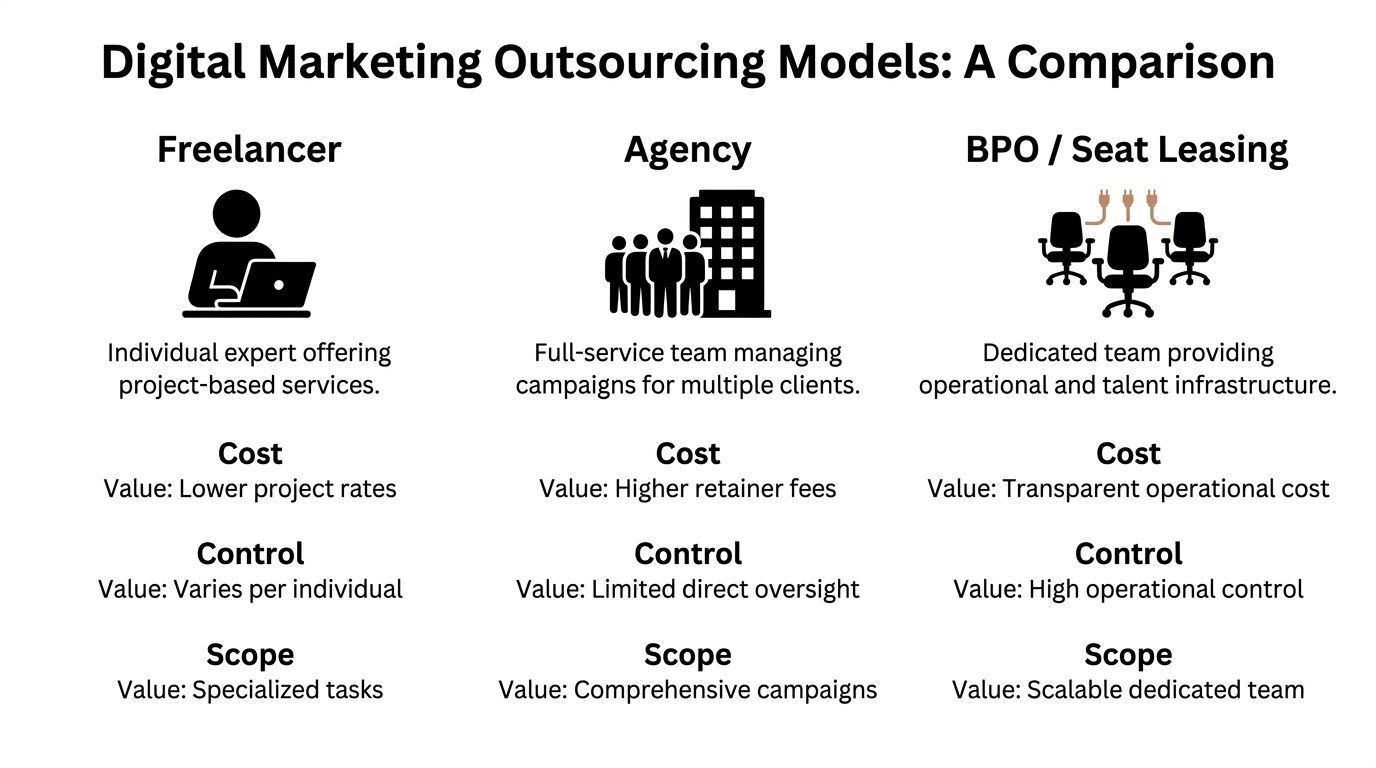
The market is moving toward more specialized support. The marketing technology outsourcing market was valued at USD 44.09 billion in 2023 and is growing at a 10.2% CAGR to 2030, driven by demand for expertise in complex tools and platforms, according to A2Z Resource Group’s review of outsourced digital marketing services.
That trend matters because your outsourcing model determines how much of that expertise you can access and control.
The three models that matter
Most businesses should assess these three options:
- Full-service agency
- Dedicated team
- BPO seat leasing
Each solves a different problem.
Outsourcing Model Comparison
| Attribute | Digital Marketing Agency | Dedicated Team | BPO Seat Leasing |
|---|---|---|---|
| Structure | External firm with shared internal specialists across clients | Assigned marketers working primarily on your account | Dedicated staff supported by managed workspace and operating infrastructure |
| Best fit | Companies that want strategy and execution with limited internal management | Firms that need deeper brand immersion and steady output | Businesses that want control, scalability, and operational cost efficiency |
| Control level | Moderate | High | High |
| Speed to launch | Usually fast | Moderate, depends on team assembly | Fast once staffing and workspace model are aligned |
| Cost shape | Retainer-based, often bundled | Payroll-like recurring team cost | Transparent operational model tied to people and infrastructure |
| Scalability | Strong for campaigns and channel expansion | Strong for stable, ongoing workloads | Strong for sustained execution and growth without heavy setup burden |
| Brand immersion | Varies by agency | Usually deep | Deep if managed well |
| Operational burden on client | Low to moderate | Moderate | Moderate, but backend support is built in |
Agency model
An agency is often the right call when leadership wants a team that can step in quickly and take ownership of strategy, creative coordination, media buying, reporting, and campaign delivery.
This works best when:
- Your team is small: You need outside leadership and execution.
- Your scope is broad: SEO, ads, content, and reporting all need attention.
- You prefer one accountable partner: Fewer moving parts, simpler management.
The downside is reduced day-to-day control. Your account is one of several. The agency may be excellent, but it still runs on shared capacity and internal prioritization.
Dedicated team model
A dedicated team sits closer to an extension of your business.
This model suits companies with ongoing production needs, deeper channel complexity, or heavier brand requirements. It is useful when marketing supports sales enablement, product launches, account-based campaigns, or a constant content engine.
The upside is immersion. The downside is management discipline. If your side lacks a capable owner, even a dedicated team can drift.
BPO seat leasing model
This is the model many businesses overlook.
Instead of buying only marketing labor, you combine dedicated talent with managed operational infrastructure. That changes the economics and the execution environment. The team works within a setup that already includes workspace, connectivity, IT support, and security oversight.
For companies that need reliable throughput, this is often the most practical middle ground between a classic agency and building a full internal department.
How to choose without overthinking it
A useful comparison outside this category is Cloud Present’s take on in-house vs. agency vs. hybrid models. It is about webinar production, but the logic applies directly here. The right model depends on workload consistency, internal leadership strength, and how much direct control you need.
Simple rule: If you want mostly hands-off execution, choose an agency. If you want embedded production capacity, choose a dedicated team. If you want embedded capacity with stronger operational efficiency, evaluate BPO seat leasing seriously.
The wrong decision is choosing based only on a monthly fee. The right decision comes from matching the model to your management style, delivery needs, and growth stage.
How Seat Leasing Supercharges Outsourced Teams
A lot of outsourced marketing arrangements underperform for a simple reason. The provider can do the work, but the operating environment is weak.
People lose time to connectivity issues, tool access problems, poor coordination, inconsistent security practices, and the usual friction that shows up when a team is assembled without proper infrastructure. That friction rarely appears in the proposal, but it hits execution fast.
Why operations matter to marketing output
Marketing output depends on routine. Campaigns need assets approved on time. Reporting needs reliable system access. Designers, buyers, writers, analysts, and coordinators need stable tools and fast communication.
Seat leasing solves a layer that many companies ignore. It gives outsourced teams a managed environment built for ongoing work, not improvised work.
The underserved angle here is important. Seat leasing BPO can deliver up to 80% cost savings on office setups for outsourced marketing teams while providing managed IT and infrastructure, allowing startups to scale without capital expenditures, as discussed in Marketing Angels’ analysis of future outsourced marketing trends.
That is more than an office story. It is an execution story.
What this changes in practice
Instead of asking your outsourced team to figure out every operational detail themselves, the seat leasing setup handles the backend.
That usually includes:
- Managed connectivity: Teams stay online and productive.
- IT support: Device, access, and system issues get handled quickly.
- Cybersecurity controls: Better protection for accounts, data, and credentials.
- Physical workspace readiness: No delay from setting up an office from scratch.
This short explainer adds context on how the model works in real business settings:
Where the model makes the most sense
Seat leasing is especially effective when a business wants a dedicated outsourced team but does not want the cost or delay of building a new office footprint. It also works well when leadership wants cleaner control over staffing and workflow than a traditional agency setup usually allows.
The value is operational clarity. Your marketers can spend their time on campaign planning, account management, creative delivery, reporting, and optimization instead of wrestling with setup problems.
For businesses exploring infrastructure-backed outsourcing models, Seat Leasing BPO provides a useful reference point for what a managed workspace environment typically includes.
Key point: Strategy alone does not produce results. A stable operating environment does a lot of the heavy lifting.
If you want outsourced marketing to perform like a real team, not a loose collection of contractors, the infrastructure model matters more than most buyers realize.
Selecting and Integrating Your Marketing Partner
Most outsourcing failures are selection failures.
The business buys the pitch, not the operating reality. Then three months later, nobody knows who owns what, reports are vague, and the relationship turns into a weekly status meeting with little movement.
A better process is boring, disciplined, and specific.
How to vet a serious partner
Start with evidence of competence, not polish.
Ask for these items:
- Relevant portfolio work: Not random creative samples. You want work tied to your channel mix, business model, and sales cycle.
- Clear service ownership: Who handles paid media? Who writes? Who reviews analytics? Who approves changes before they go live?
- Reporting examples: Ask for a sample dashboard. If they cannot show how they report, expect confusion later.
- Communication rhythm: Weekly call, monthly review, escalation path, and expected response times.
- Tool familiarity: GA4, Google Ads, Search Console, Meta, CRM systems, project management tools, and dashboard software should already be part of their workflow.
- Access and security process: How credentials, permissions, and approvals are handled.
Then ask a harder question: what happens when performance stalls? Weak partners answer with platitudes. Strong partners answer with a diagnosis process.
What to lock down before kickoff
The contract should make the relationship easier to manage, not harder.
Confirm:
- Scope boundaries so extra work does not become standard practice unnoticed.
- Approval rules for ads, copy, design, and site edits.
- Data ownership for accounts, dashboards, creative files, and campaign history.
- Exit procedures so transition risk stays controlled.
- Primary contacts on both sides.
If you are comparing providers that include operational support, the service details on Seat Leasing BPO inclusions are the kind of specifics you should look for in any infrastructure-backed arrangement.
A practical first 30 days
Do not leave onboarding to chance. Use the first month to force alignment.
Week one: Run a goals workshop. Define business priorities, target customer segments, core offers, and immediate problem areas.
Week two: Complete brand immersion. Share voice guidelines, past campaign results, product details, objections from sales calls, and competitor context.
Week three: Set reporting and workflows. Finalize dashboards, communication cadence, project boards, approval steps, and file access.
Week four: Launch a focused operating sprint. Pick a few priorities that can be executed cleanly, such as fixing campaign tracking, tightening paid account structure, or improving a high-value landing page.
The goal is not a dramatic early win. The goal is to create a working system.
Managing Performance and Mitigating Common Risks
Most companies manage outsourced marketing badly because they measure the wrong things.
They ask about impressions, likes, traffic spikes, and content volume. Those numbers can be useful diagnostics, but they are not business outcomes. If your partner reports activity without proving commercial impact, you are funding motion, not progress.
Track business outcomes, not vanity metrics
A sound outsourced setup should report against the metrics leadership already uses to judge the business.
That means looking at measures such as:
- Customer acquisition cost
- Lead quality
- Sales-qualified pipeline contribution
- Channel-specific return
- Conversion rates on high-intent pages
- Retention-supporting signals from lifecycle campaigns
The exact dashboard varies by business model, but the principle stays the same. Reporting must answer what is working, what is underperforming, and what changes next.
Build a management rhythm
You do not need constant meetings. You need useful meetings.
A practical rhythm usually includes:
- Weekly tactical review: What changed, what was launched, what is blocked.
- Monthly business review: Performance by channel, budget use, pipeline impact, and next priorities.
- Quarterly strategy reset: Offer changes, market shifts, seasonal adjustments, and channel bets.
If a partner cannot discuss performance in commercial terms, they should not be managing your growth channels.
Management tip: Ask one question every month. “If we had to cut one tactic and double down on one tactic, what would you choose and why?” Good partners answer clearly.
The biggest outsourcing risks are manageable
Leaders usually worry about three things. Loss of control. Communication breakdowns. Dependency on an external team.
Those concerns are valid. They are also solvable if you design the relationship properly.
Loss of brand control
This happens when the provider creates content and campaigns without enough guidance.
Fix it with a real operating kit:
- Brand voice guide
- Messaging hierarchy
- Offer positioning
- Visual rules
- Approval process for public-facing assets
Do not assume “they’ll learn the brand.” Make the brand transferable.
Communication breakdowns
This is usually a process issue, not a personality issue.
Use one project system. Keep one primary decision-maker on your side. Define response expectations. Separate tactical updates from strategic decisions. If everything happens in scattered emails and chat threads, confusion is guaranteed.
Over-dependency
This is the risk too many companies ignore until a transition becomes painful.
Protect yourself by ensuring account ownership stays with the business. Keep passwords, ad accounts, analytics properties, CRM admin rights, and creative files under company control. Require documentation for recurring workflows and campaign structures.
There is also a model-level mitigation strategy worth noting. BPO-integrated outsourcing models can reduce dependency and control risks by 30% to 50% through scalable budgeting and access to broader talent pools that stay current on trends, according to Girl Power Talk’s review of outsourcing benefits and risks.
That matters because risk is not only about trust. It is about whether your outsourcing structure gives you flexibility when conditions change.
What strong oversight looks like
You do not need to micromanage. You do need to govern.
That means:
- setting commercial KPIs,
- reviewing decisions rather than just deliverables,
- maintaining asset ownership,
- documenting workflows,
- and refusing to confuse busyness with performance.
If you treat outsourced marketing like a black box, it will eventually behave like one. If you manage it like an extension of the business, it can become a serious growth asset.
If you want an outsourced marketing setup that is easier to scale and less expensive to operate, Seat Leasing BPO is worth a close look. Their model helps businesses build dedicated teams with managed workspace, IT, cybersecurity, connectivity, and flexible infrastructure already in place, which removes a major chunk of the operational burden from growth-stage companies.